As more finance teams bring AI into their financial operations, an important question comes up. There’s a lot of promise that AI brings. But can finance teams actually trust it?
In finance, trust means something very specific. It is not enough for an AI system to produce the right answer most of the time. Finance teams need to understand how results were produced, verify the underlying data, review critical decisions, and maintain evidence that can withstand internal and external scrutiny.
The challenge is that many AI systems were not originally designed for highly controlled accounting environments. They were built to generate useful outputs, not necessarily to provide the transparency, oversight, and documentation that finance teams require.
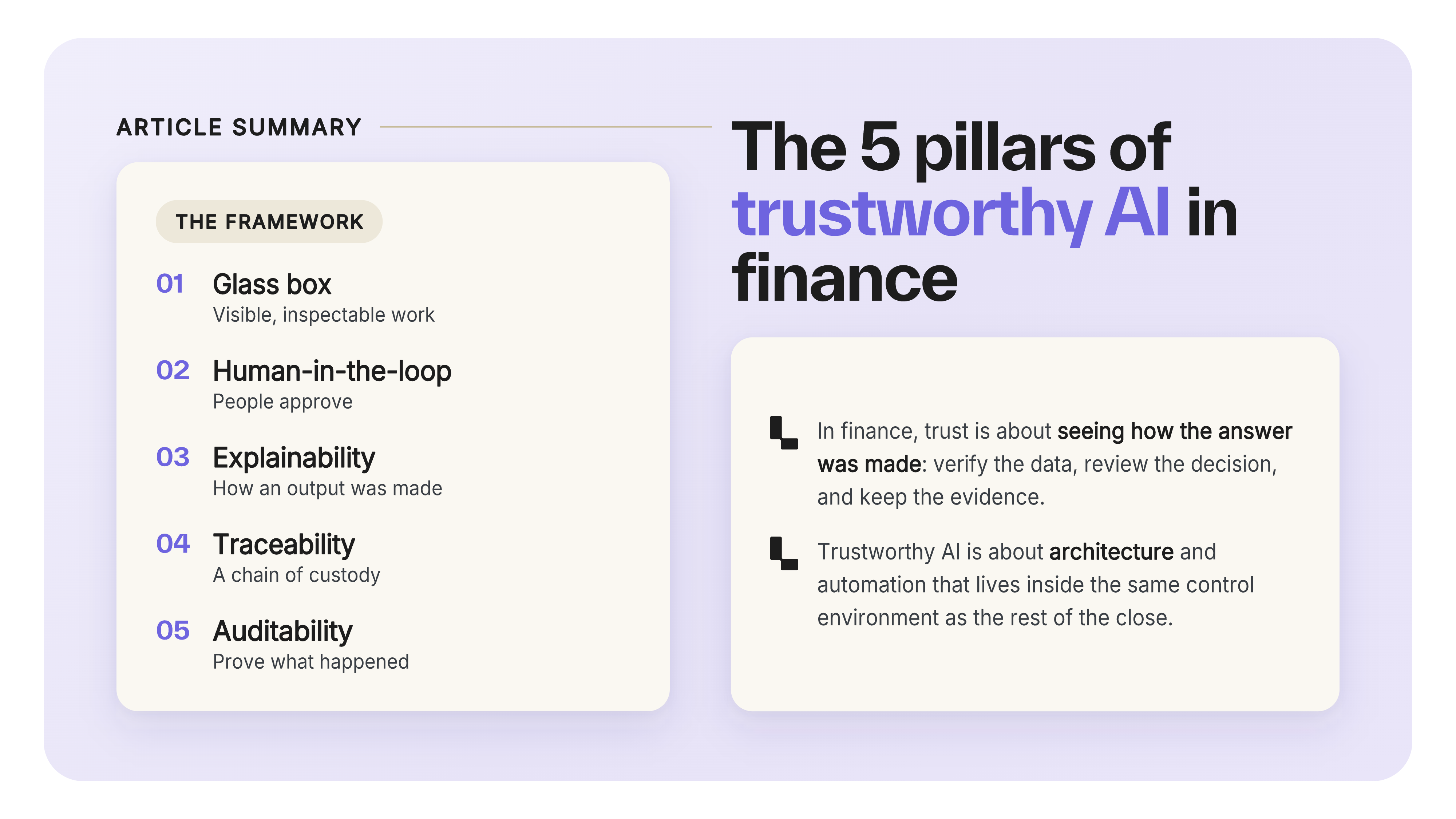
As a result, evaluating AI in finance requires looking beyond accuracy alone. Trustworthy AI must operate within the same control environment as the rest of the month-end close process. The following five pillars provide a framework for understanding what that looks like in practice.
5 pillars of trustworthy AI in finance
As finance teams adopt AI in their workflows, a few foundational concepts help clarify what high-integrity automation actually looks like in practice.
Glass box vs. black box AI
Glass box AI means the agent’s work is visible, inspectable, and auditable.
Nothing is hidden, abstracted, or approximated behind non-transparent models. Accountants can review AI outputs with the same rigor they apply to their own work—tracing inputs, logic, and results step by step.
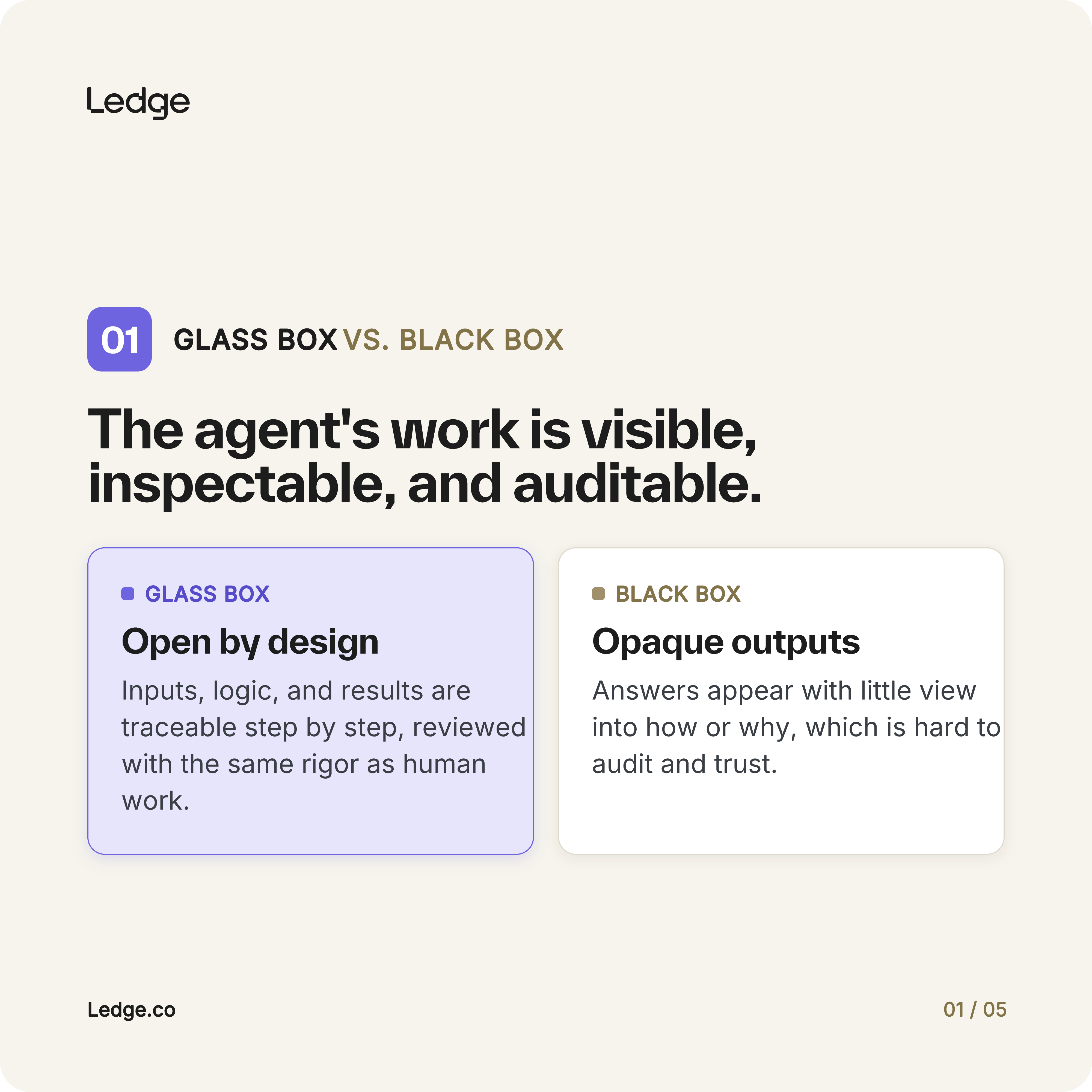
This stands in contrast to black box AI, where decisions emerge from models that offer little visibility into how or why an outcome was produced. Black box systems may feel powerful, but they make auditability, compliance, and trust difficult, especially in regulated finance environments.
Human-in-the-loop oversight
Human-in-the-loop (HITL) AI in finance combines automation with human oversight to ensure accuracy, auditability, and trust.
In this model, AI handles repetitive tasks like reconciliations, working papers, journal entry drafting, and flux analysis, while people review, approve, and investigate the AI outputs at specific decision points.
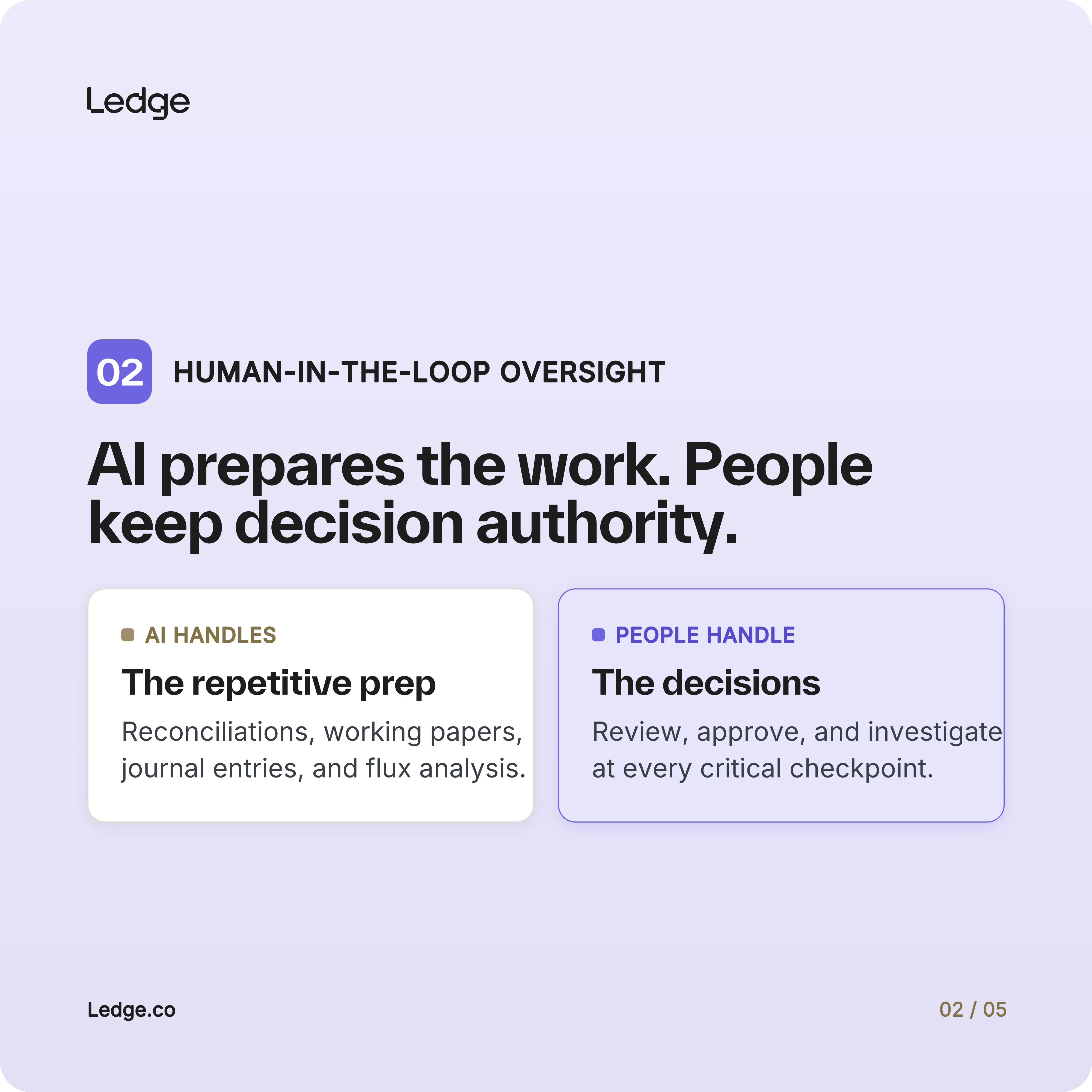
This hybrid approach keeps humans in control of key decisions, creating transparent, explainable systems that strengthen compliance and confidence in AI-driven finance operations.
A well-architected HITL process ensures AI never operates as a “black box.” Every action has a human checkpoint and an audit trail.
Explainability
Explainability means you can clearly understand and communicate how an AI output was produced.
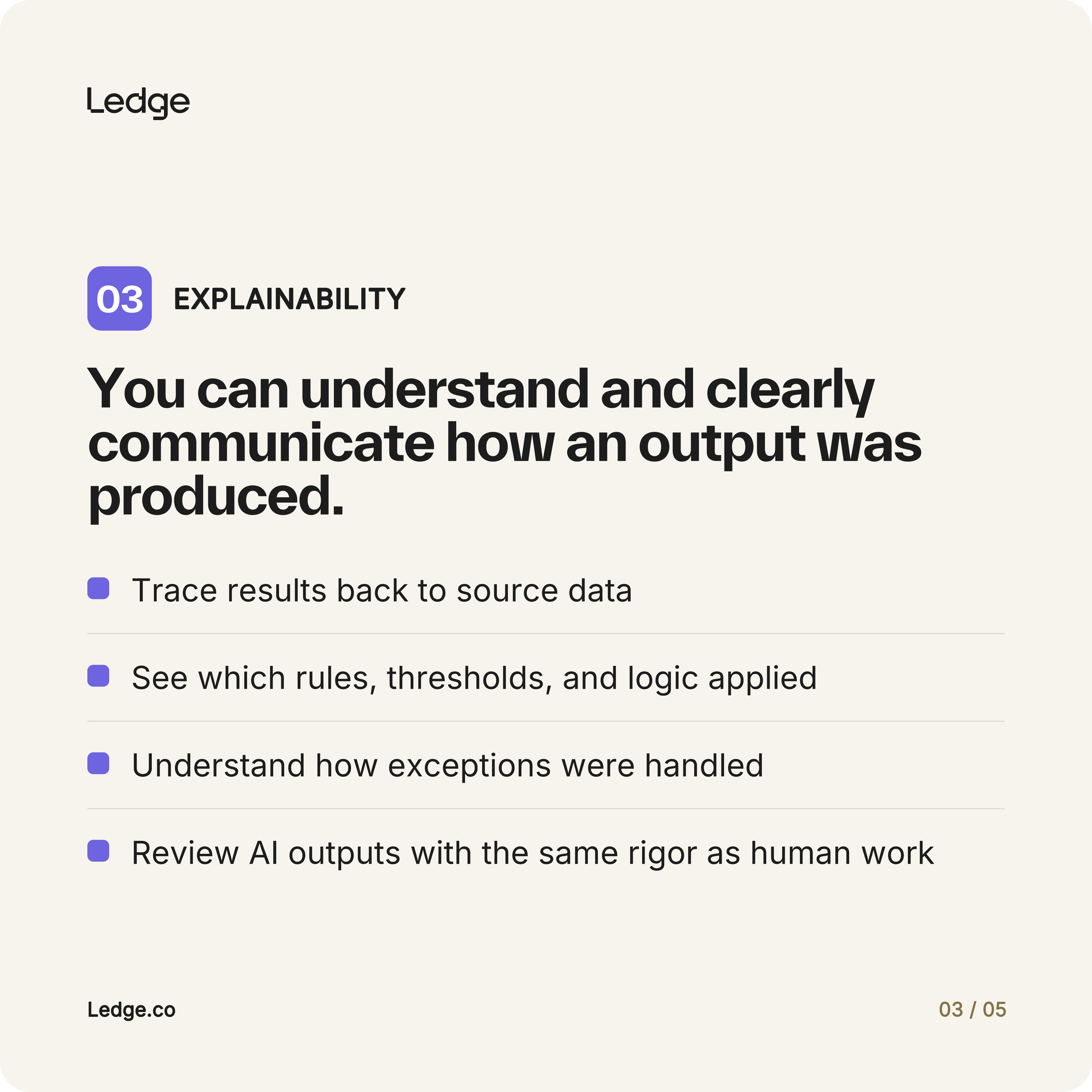
Explainable systems allow teams to:
- Trace results back to source data
- See which rules, thresholds, and logic were applied
- Understand how exceptions were handled
- Review agentic AI outputs with the same rigor as human work
When AI is explainable, it becomes part of your accounting process—not a separate, opaque layer. Teams can validate results, spot issues early, and confidently stand behind automated outputs in front of leadership, auditors, and regulators.
Traceability
Traceability means you can follow every output back through the workflow that produced it.
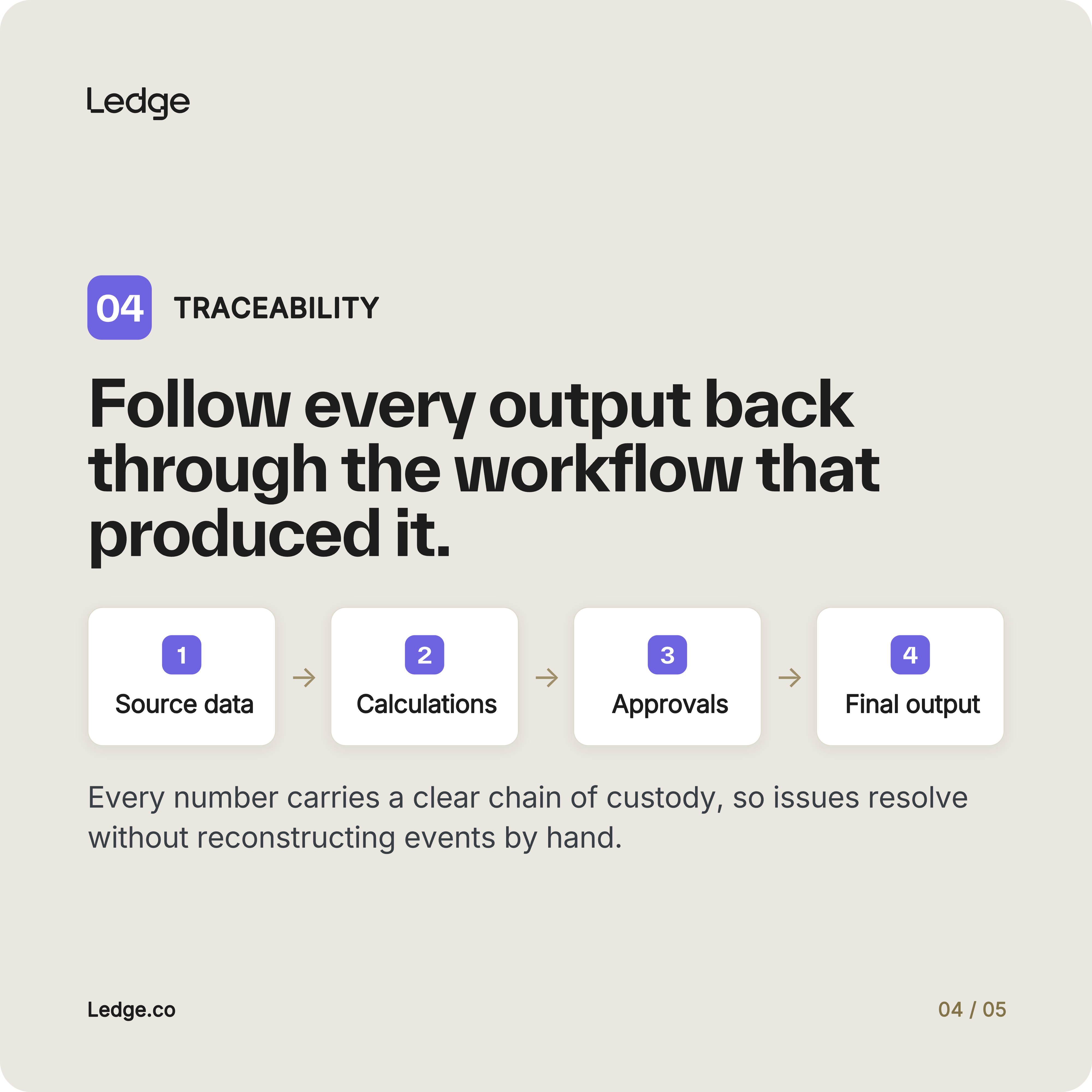
A traceable AI system maintains a clear chain of custody for financial work, connecting source data, calculations, approvals, and final outputs into a single record. Teams can:
- Trace outputs back to source transactions and supporting documentation
- See which systems, datasets, and prior-period references were used
- Follow the sequence of actions performed by AI agents and human reviewers
- Understand when, where, and why changes were made
- Maintain continuity across accounting periods
Traceability creates confidence that financial results are grounded in real business activity rather than disconnected automation.
When issues arise, teams can quickly identify the source, understand the workflow path, and resolve discrepancies without manually reconstructing events. In finance, traceability turns AI-generated work into work that can be verified, reviewed, and trusted.
Auditability
Auditability means you can prove what happened.
Every action. Every change. Every result.
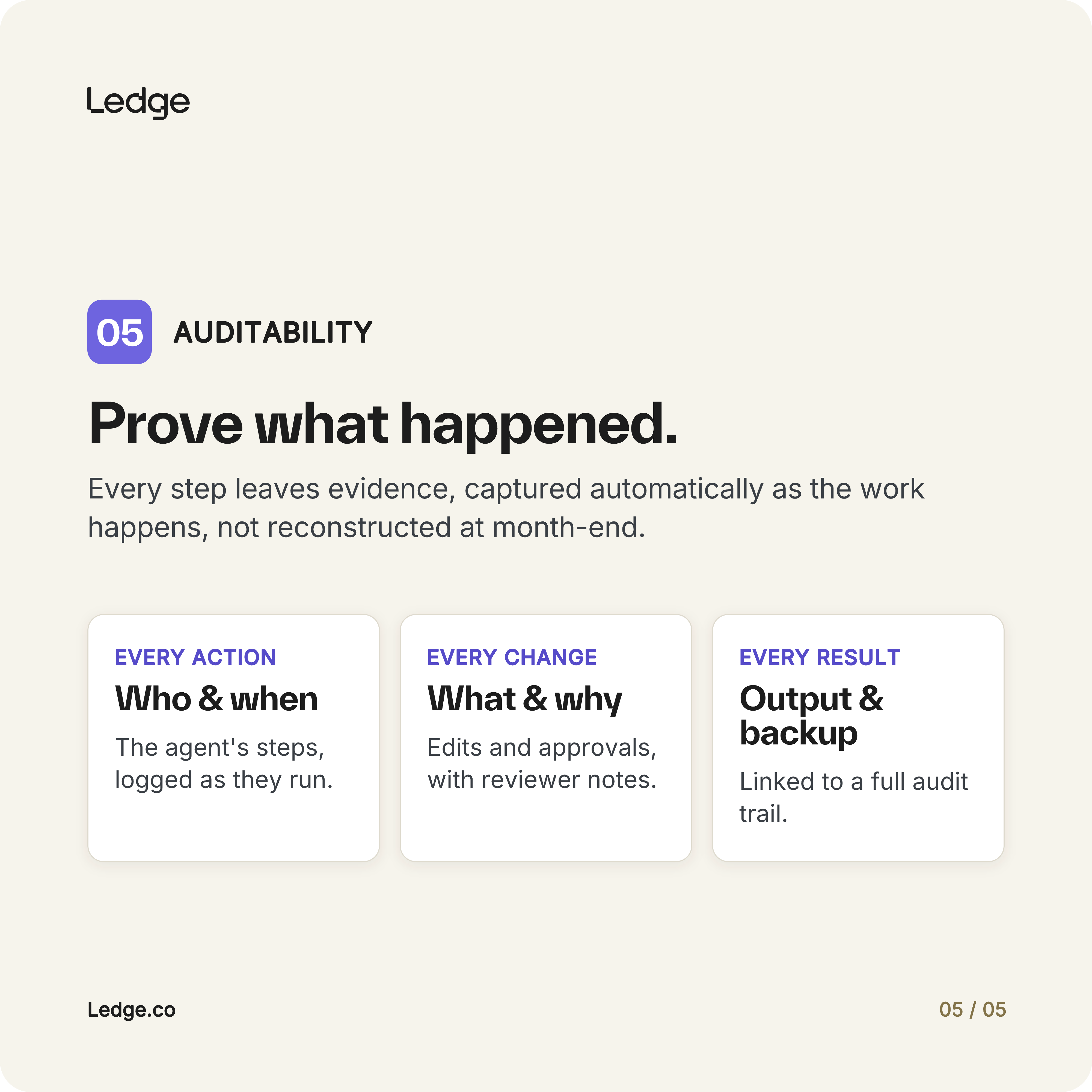
In well-governed finance systems, automation must produce the same evidence trail expected of human work. That includes:
- Clear records of inputs and outputs
- Documentation of approvals and reviews
- Traceable workflows across periods
- Reproducible results
- Built-in support for internal controls and external audits
Auditability ensures AI operates with discipline.
A properly architected system creates an automatic audit trail for every workflow, so finance teams don’t have to reconstruct history at month-end or during an audit. Accountability is built in, not bolted on.
Together, explainability, traceability, and auditability make AI operationally safe for finance, transforming automation from a potential risk into trusted infrastructure.
What trustworthy AI looks like in practice
An example in Ledge
In Ledge finance teams build their own task-specific AI agents—without code, using plain language—instead of using the software’s predefined workflows.
With this level of control and oversight, AI agents don’t “decide” what to do in open space.
Agents operate inside explicit, predefined accounting workflows. Accounting teams define the logic, thresholds, and controls. AI executes within guardrails.
The result is predictable, repeatable, and auditable outputs tailored to the specific needs of the finance team.
From automation to accountability
Trustworthy AI in finance is not about giving AI systems the autonomy to make their own decisions. It’s about architecture.
These AI systems must be transparent rather than opaque. That means humans must retain clear decision authority with explainable outputs and auditable workflows.
When these foundations are in place, automation strengthens internal controls instead of weakening them.
The future of AI in finance is about embedding automation into well-defined accounting processes where every action is visible, reviewable, and accountable.
When AI is designed this way, it becomes part of the financial control environment itself, supporting a month-end close that is faster, more scalable, and built on integrity rather than risk.