If you’re looking for a concrete place to start realizing real gains from AI, the month-end close is one of the most effective entry points.
The close is where spreadsheets multiply, and operational strain concentrates.
Even for teams using ERPs or legacy platforms to organize the close, execution remains manual and fragmented. Information lives across systems. Workflows break apart. Context gets lost. As a result, the same labor-intensive tasks must be rebuilt every period.

That repetitive execution becomes the bottleneck.
It's precisely what makes the close ideal for AI.
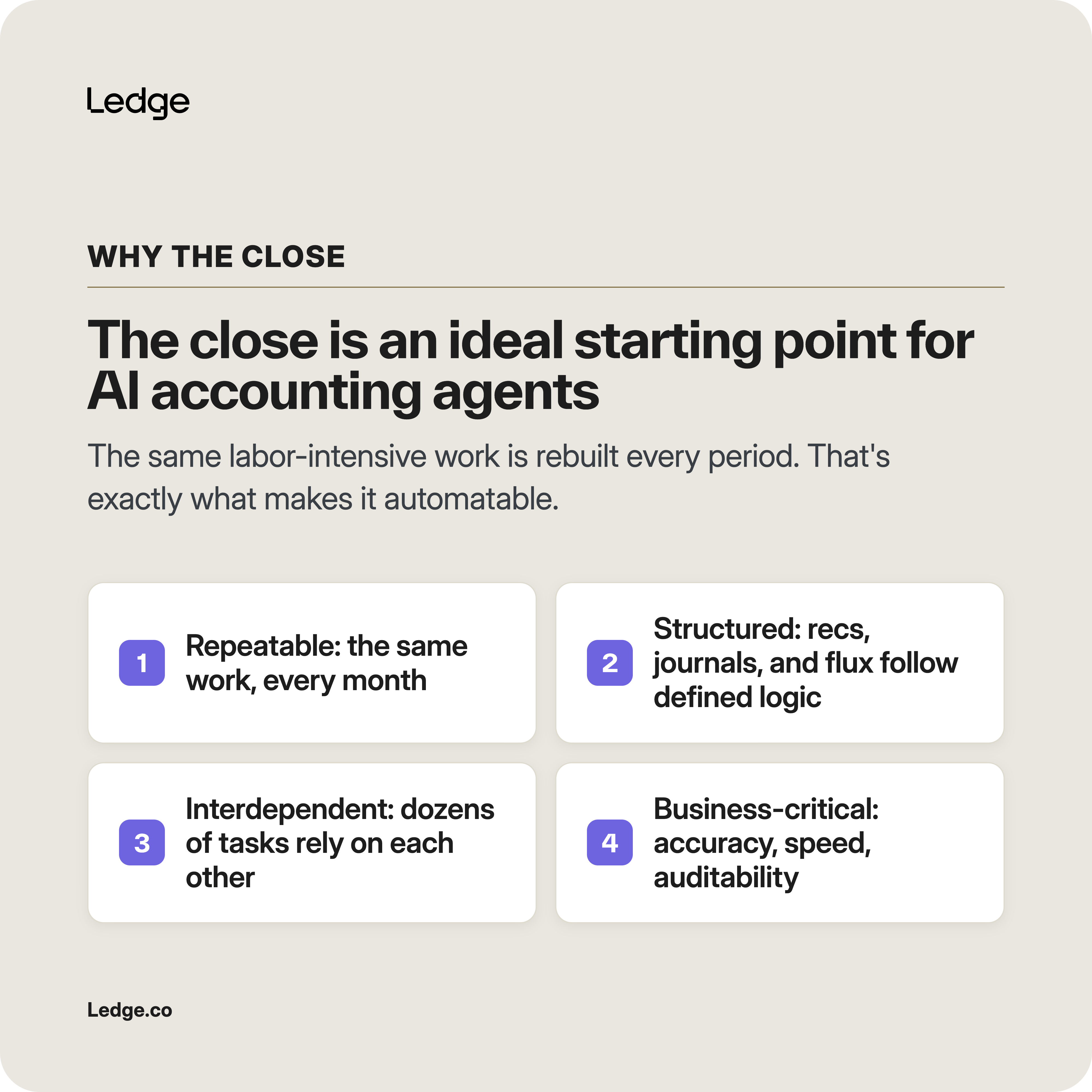
The close is:
- Repeatable: The same work happens every month.
- Structured: Reconciliations, journals, workpapers, and flux follow defined logic.
- Interdependent: Dozens of tasks rely on each other.
- Business-critical: Accuracy, speed, and auditability matter.
This combination makes close workflows uniquely automatable.
What an AI accounting agent is not
One common misconception is that AI operates autonomously, that it makes independent decisions without oversight.
That’s not how high-quality AI accounting agents should work.
What an AI accounting agent actually does in the close
Your month-end close agents execute defined work, as established by your finance team.
In Ledge, AI operates inside your existing logic, formats, and controls. Account reconciliations follow your rules. Journal entries reflect your accounting policies. Outputs match your standards.

What differentiates Ledge from other close platforms is control.
Instead of forcing teams into preconfigured workflows, Ledge lets finance teams describe your exact processes—how reconciliations run, how journal entries are drafted, how spreadsheets and workpapers are built, so AI executes your close the way your company needs to do it.
The software adapts to your exact close workflows.
How AI accounting agents advance the month-end close
When we talk about AI agents at Ledge, we don’t mean a single general-purpose AI trying to manage your entire close.
We mean purpose-built, task-specific agents, each of which is designed to execute a specific part of the workflow.
Think of these AI agents as digital staff accountants, meant to handle the administrative work of preparing data, building your spreadsheets, and using your formulas. These agentic digital accountants are simply software, following rigorous standards for governance and compliance.
Each AI agent is assigned a defined responsibility, such as:
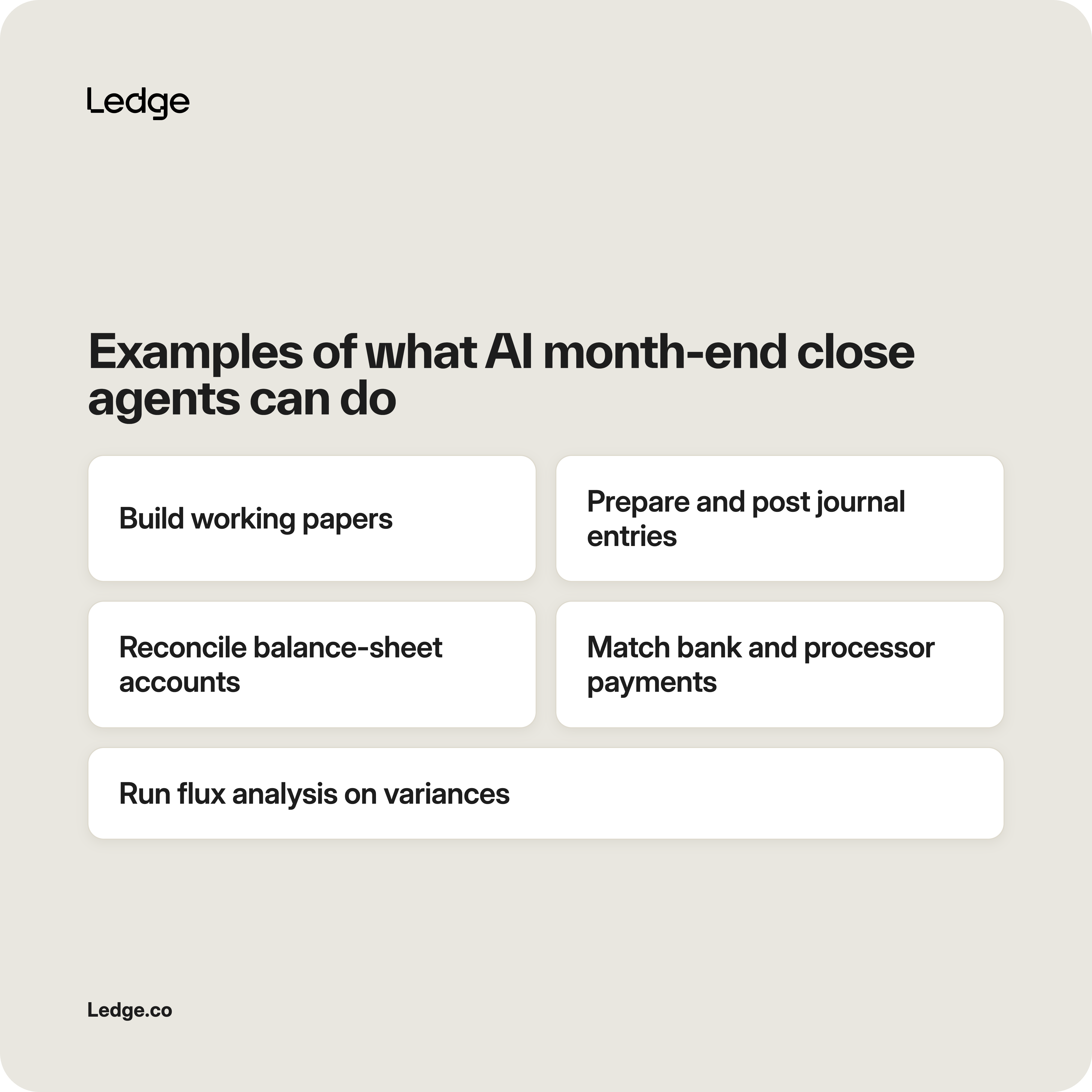
- Auto-generating working papers by pulling data from your ERP and other systems to build complete, multi-tab spreadsheets with live formulas and full traceability
- Preparing the spreadsheet backup, generating the journal entry, routing it for review, and posting to ERP with evidence and audit context attached by default
- Preparing every balance sheet reconciliation—bank, subledger, intercompany accruals, and deferred revenue as part of the close, inside an agentic close checklist
- Matching payments from banks, payment processors, and remittance files to your ERP, so you can stop chasing attachments, formatting files, and cleaning up clearing accounts
- Connecting your ERP, banks, Payment Processors, and internal systems to reconcile payments in real-time, automatically matching transactions, flagging mismatches, and resolving exceptions with AI and built-in workflows
Finance still runs the close, AI agents are task-focused software
Every AI agent operates inside your rules, formats, and controls. They follow your reconciliation logic. They apply your accounting policies. They produce outputs that match your standards.
Most importantly, agents don’t work in isolation.
The month-end close is a connected system.
AI agents help your finance team get the work done faster, all while establishing an additional safeguard to manage risks from human error.
Example of AI agents helping with the close
Here’s an example of what that means, in practice, for the process that an AI accounting agent takes to build a working paper:
Setting up the accounting agent
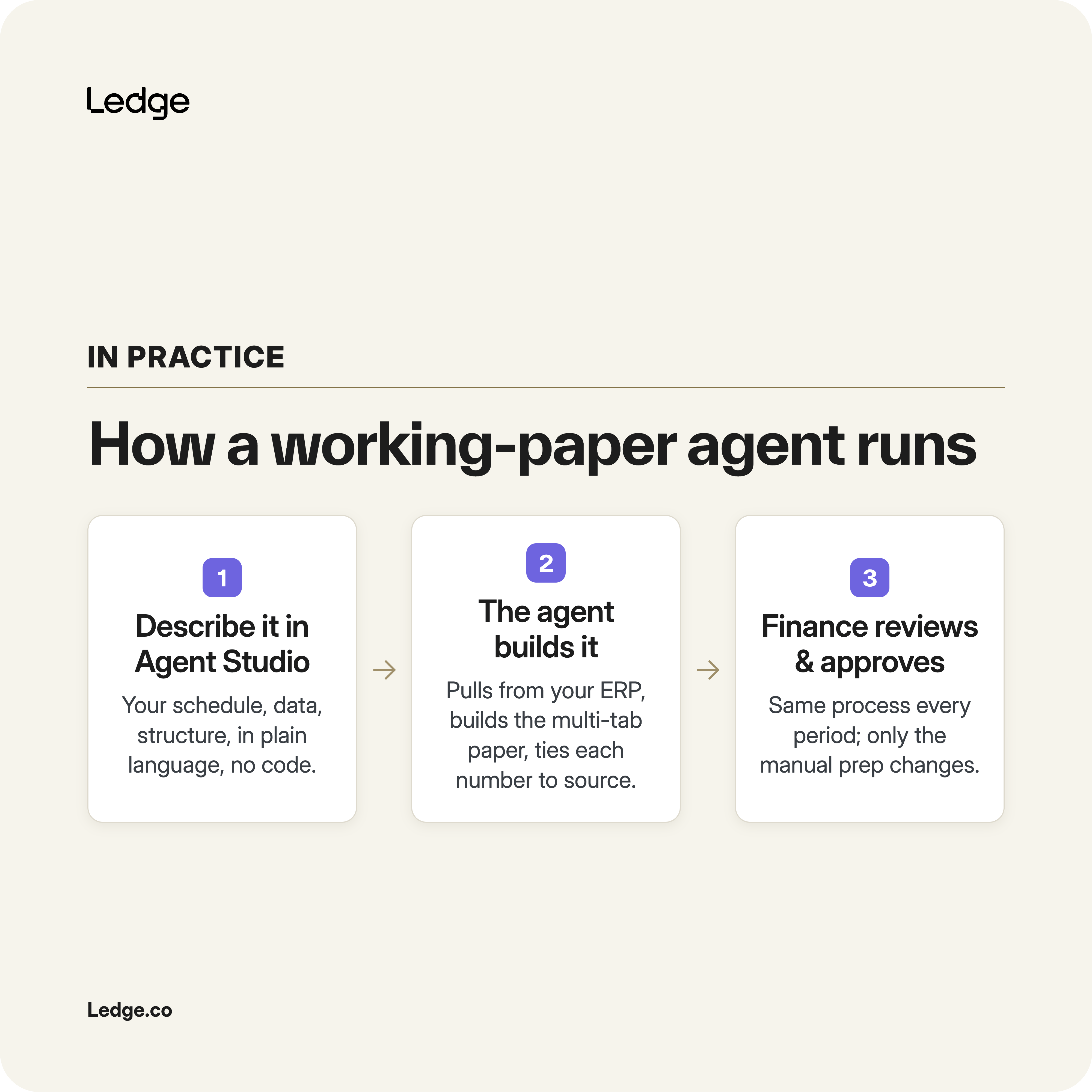
Finance starts by using Ledge Agent Studio to build your task-specific agent.
That means describing how your schedule works, the data it uses, the structure you expect, and the way you tie things out. You can also specify whether your process uses POs, bills, payroll data, allocations, entity rules, or something unique to your business.
You do not need code, and you can build your agent using natural, conversational language.
You can have Ledge generate a multi-tab spreadsheet with live formulas that mirror how your preparers structure them.
The agent follows your exact approach for each working-paper task.
Running the working paper
Once configured:
- The agent pulls the required data from your ERP and other systems.
- It builds the working paper using your structure and formulas.
- It generates a complete, multi-tab spreadsheet with full traceability.
- Each number ties back to its source data.
If something is unclear, the agent asks for input. Finance reviews the output and makes any needed adjustments.
The same process runs every period. Your workflow stays the same. Your spreadsheets stay the same. Your standards stay the same.
Only the manual preparation changes.
The agent prepares the working paper.
Finance reviews and approves.
That’s how AI agents support the close—by executing defined tasks, inside your rules, with finance in control.
Tips to set up an AI-powered close you can trust
- Start with one clear outcome. Define a single KPI, such as reducing manual close hours or shortening review cycles, before introducing AI. This creates alignment, establishes a baseline, and makes progress measurable.
- Document how the close actually works. Map every task, system, dependency, and owner. Identify where data is exported, manually manipulated, or re-entered. Classify work as rule-based, judgment-based, or hybrid to surface the best automation candidates.
- Turn your close into a structured checklist. Translate documentation into specific, outcome-driven tasks with clear ownership, dependencies, and review points. This checklist becomes the control layer that AI operates within.
- Roll out AI in phases. Start with observation and validation. Move to AI-assisted preparation. Then introduce trusted automation for low-risk workflows. Over time, evolve toward a continuous close. Progress based on performance—not timelines.
- Build explainability and auditability into every workflow. Require source-linked evidence, clear reasoning for outputs, and side-by-side review of inputs and results. Treat explainability as a control, not a feature.

Throughout the steps above, it’s critical to keep your finance team firmly in the loop.
Define approval thresholds, maintain a tight scope with respect to what AI agents can and cannot do, and ensure reviewers can override AI decisions. Let automation handle preparation while finance retains judgment, accountability, and final approval.
Teams that formalize their processes and scale automation methodically are the ones that see durable gains—faster cycles, fewer errors, and more time spent on higher-value work. The payoff is a close that operates like a system rather than a series of disconnected tasks.