Finance leaders are right to approach AI with caution.
Accounting teams work with sensitive financial data, complex controls, and processes that must stand up to internal review and external audit. Introducing an AI system can create legitimate concerns about accuracy, security, explainability, and oversight.
But risk assessments often examine only one side of the decision to implement AI.
They ask what could go wrong if the accounting organization adopts AI without also considering what could go wrong if it continues relying on manual processes, disconnected spreadsheets, overextended employees, and systems that were not designed for today’s transaction volumes.
In some accounting workflows, not using AI may now introduce more risk than adopting it responsibly.
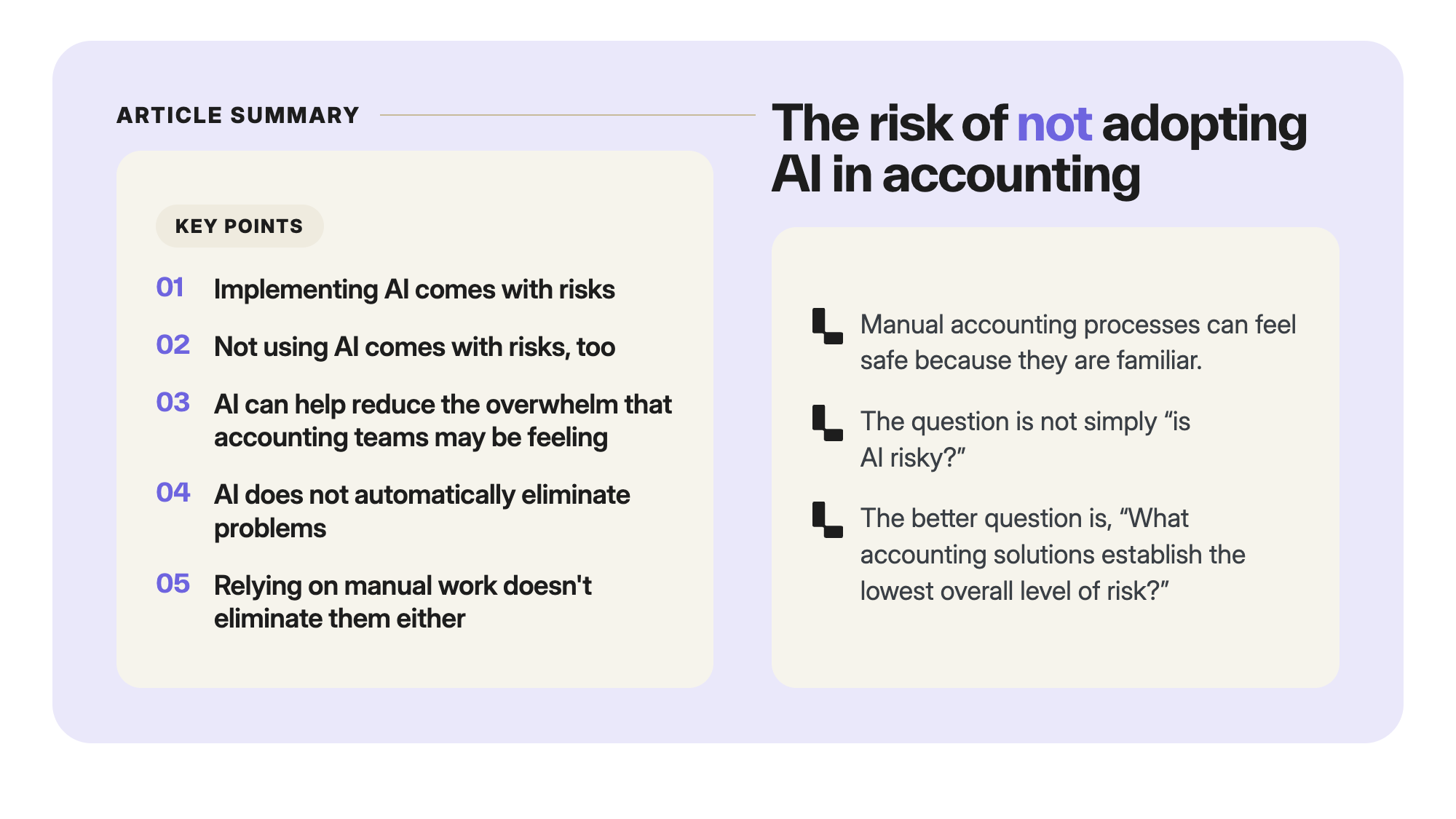
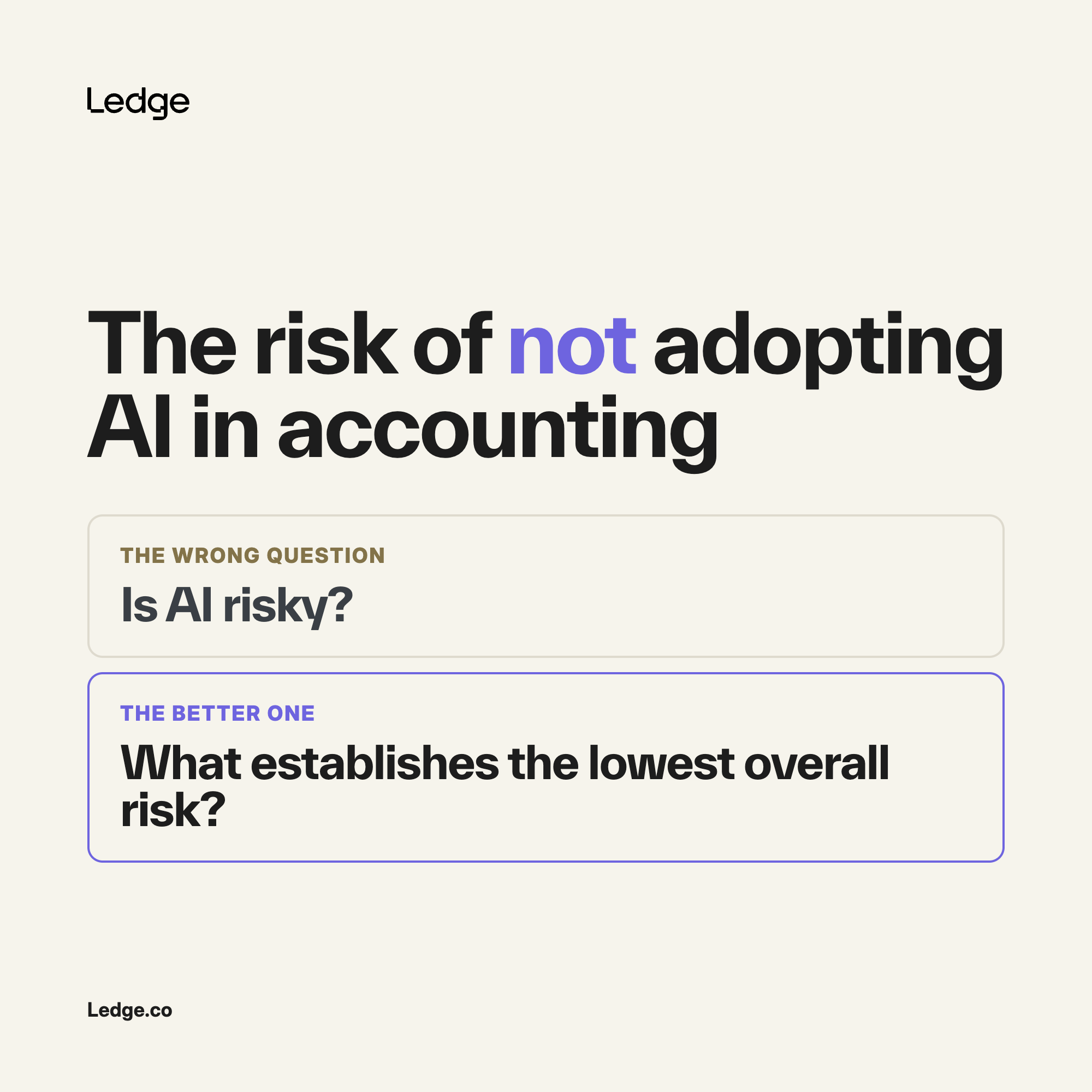
The question is no longer simply, “Is AI risky?”
The better question is, “What accounting solutions establish the lowest overall level of risk?”
The status quo is not risk-free
Manual accounting processes can feel safer because they are familiar. The team understands how the work gets done, who owns each step, and where approvals occur.
But familiar does not necessarily mean controlled.
A month-end close process may still depend on employees downloading reports, copying information between systems, maintaining spreadsheet formulas, following up through Slack, and remembering exceptions from previous periods.
Each individual task may appear manageable. Collectively, however, they create a process with many opportunities for delay and error.
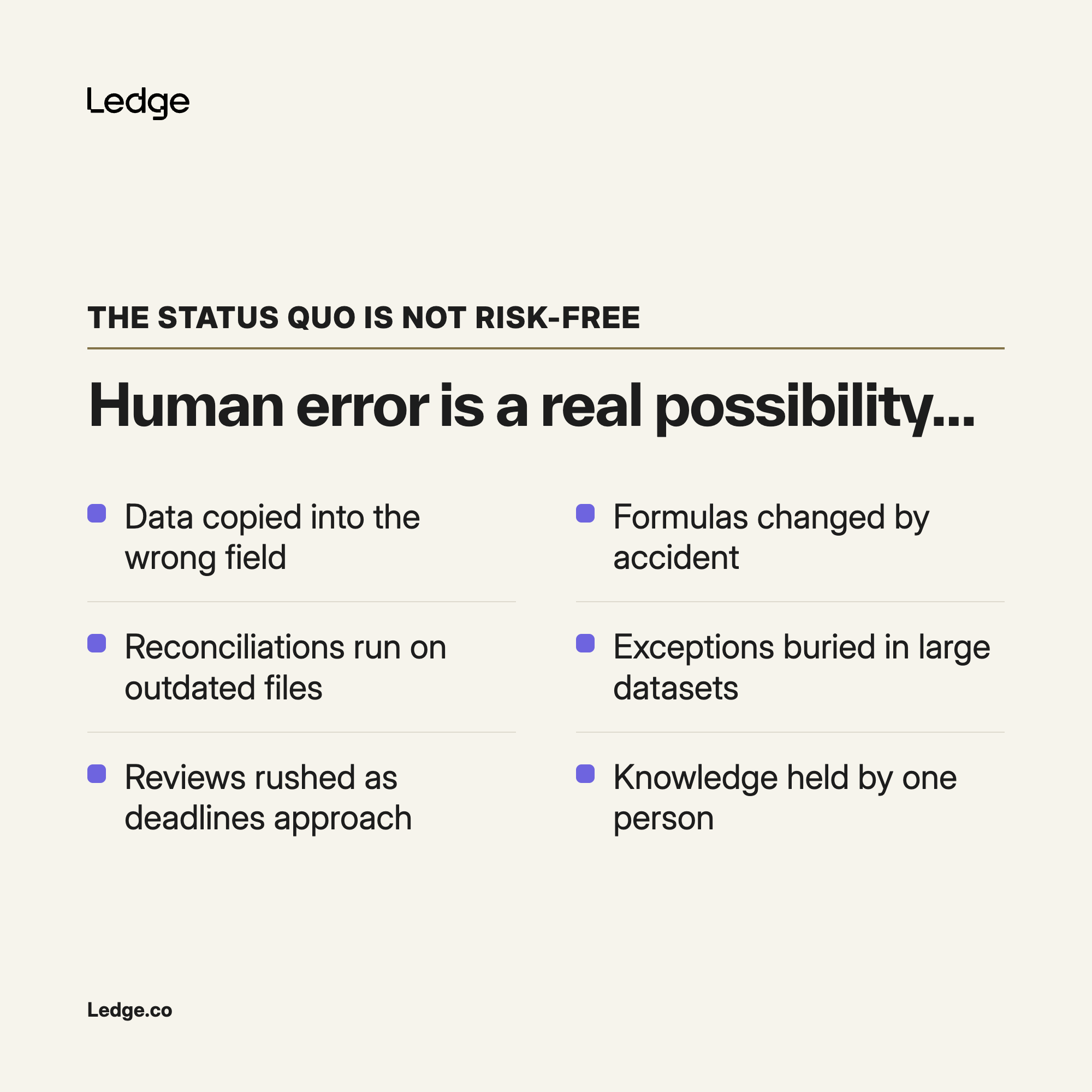
Common risks include:
- Data being copied into the wrong field or spreadsheet
- Formulas being accidentally changed
- Reconciliations being completed using outdated files
- Exceptions being missed because they are buried in large datasets
- Reviews being rushed as deadlines approach
- Institutional knowledge being concentrated in one employee
- Supporting documentation being stored across multiple systems
- Important follow-ups depending on memory and manual reminders
AI does not automatically eliminate these problems. But continuing to rely exclusively on manual work does not eliminate them either.
A responsible evaluation should compare the risks of the proposed AI system with the actual risks of the existing process, rather than an idealized version of how the process is supposed to work.
Comparing the risks of AI adoption and inaction
The purpose of this comparison is not to suggest that AI is automatically safer. It is to make the risks on both sides of the decision visible.
When transaction volume exceeds human review capacity
One of the clearest cases for AI emerges when the amount of financial data becomes too large for a person to review meaningfully.
An accounting team may technically review a reconciliation every month. But if that review involves scanning thousands of transactions under significant time pressure, the level of scrutiny may be limited.
The process contains a human reviewer, but that does not necessarily mean every relevant anomaly is receiving human attention.
AI accounting agents can help by examining a much larger population of transactions and identifying the items that warrant investigation. The accountant can then spend more time evaluating exceptions, applying judgment, and determining the correct treatment.
This does not remove the human from the process. It makes human review more targeted.
Without this type of support, growing transaction volumes may result in one of two outcomes: the close takes progressively longer, or the team conducts a shallower review to meet the deadline.
Both create risk.
How AI can change the role of the reviewer
The accountant remains responsible for evaluating the results. AI changes where human attention is applied rather than eliminating the need for human review.
When repetitive work increases the likelihood of human error
Accounting teams often perform the same steps every month: gathering files, formatting data, matching records, checking thresholds, documenting variances, and preparing information for review.
People are capable of performing these tasks accurately. But repetition, fatigue, interruptions, and time pressure can make consistency difficult.
AI accounting agents can execute defined workflows repeatedly, apply the same instructions to each dataset, and flag situations that fall outside established rules.
That consistency can be especially valuable in high-volume processes such as:
- Transaction matching
- Payment reconciliation
- Balance sheet reconciliation
- Variance analysis
- Accrual preparation
- Supporting-document collection
- Close checklist monitoring
There should still be clear controls around the agent’s work, particularly when a task involves judgment or financial posting. But for repetitive processes, using a properly designed system may introduce less risk than asking employees to reproduce hundreds of detailed steps manually each period.
When key-person dependency threatens business continuity
Many accounting organizations depend on a small number of people who understand how critical processes actually work.
The formal checklist may describe the main steps, but the employee performing the reconciliation often knows the unwritten details:
- Which reports must be adjusted before use
- Which exceptions are normal
- Which stakeholders need to be contacted
- Which spreadsheet tabs contain the latest logic
- Which issues recur at the end of every quarter
- Which transactions require additional documentation
When that person is unavailable or leaves the organization, the team may struggle to reconstruct the process.
An AI agent cannot replace institutional expertise on its own. However, building an AI accounting agent requires teams to document instructions, decision rules, source systems, exception paths, and review requirements more explicitly.
The resulting system can make the process less dependent on one person’s memory.
In this situation, delaying AI adoption may preserve a fragile operating model in which essential financial processes cannot be executed reliably without specific employees.
When the month-end close is already creating operational risk
A slow or unpredictable close is not merely an inconvenience for the accounting department.
It can affect the quality and timing of decisions across the business.
When financial information is delayed, leaders may be making decisions using incomplete or outdated data. Finance teams may have less time to analyze results, investigate unusual activity, prepare forecasts, or advise the organization.
A prolonged close can also compress the review period. The team may spend most of the available time collecting and reconciling data, leaving senior accountants and controllers with only a narrow window to examine the results.
AI can help shift effort away from data preparation and toward analysis and review.
The risk of not adopting AI, in this case, is not simply that the organization closes more slowly. It is that finance continues to provide insight after important decisions have already been made.
When manual controls create less visibility than automated ones
Some organizations assume that a manual process is inherently more transparent than an AI-assisted process.
That depends on how each process is designed.
A spreadsheet-based workflow may provide limited visibility into:
- Who changed a formula
- Which source file was used
- Why an exception was accepted
- Whether every required step was completed
- Which version of a working paper was approved
- When a reviewer examined the final output
By contrast, a well-designed AI accounting system can maintain logs of the actions it performs, the files it accesses, the exceptions it identifies, and the approvals it receives.
AI systems should not be treated as opaque black boxes. Teams need the ability to understand what an agent did, inspect its work, and retain supporting evidence.
But when those capabilities are built into the workflow, an AI-assisted process may provide stronger documentation than a manual process conducted across spreadsheets, email, and messaging platforms.
When employees spend too much time preparing work instead of reviewing it
Accounting expertise is most valuable when professionals are investigating discrepancies, interpreting financial activity, evaluating risk, and exercising judgment.
Yet many teams spend a significant portion of the close gathering information and preparing it for review.
This creates a mismatch between the team’s skills and how its time is used.
It can also create a control problem. When experienced accountants are consumed by data preparation, they have less time to perform the higher-level review that protects the organization.
AI can take on portions of the preparation process while routing uncertain or material items to the appropriate reviewer.
The objective is not to automate judgment. It is to preserve human capacity for the situations in which judgment is most important.
Where finance teams should focus human capacity
The goal is to use technology for the work that consumes human capacity without benefiting substantially from human judgment. Accountants can then devote more attention to interpreting results, resolving complex exceptions, strengthening controls, and advising the business.
When competitors are developing faster finance functions
The risks of not adopting AI in the month-end close are not limited to accounting accuracy and internal operations.
There is also a strategic risk.
Organizations that modernize their finance functions may be able to:
- Close their books faster
- Detect issues earlier
- Operate with greater transaction volume
- Integrate acquisitions more efficiently
- Produce more timely reporting
- Give finance teams more time for planning and analysis
- Scale without increasing headcount at the same rate as transaction complexity
Companies that delay adoption may continue adding manual processes and employees to compensate for growing operational complexity.
Over time, the difference becomes structural. One finance organization is designed to learn, scale, and respond quickly. The other remains constrained by the number of tasks its employees can complete manually.
A robust AI strategy does not mean automating everything
Recognizing the risks of not using AI does not mean organizations should deploy it indiscriminately.
Some tasks are more appropriate for automation than others. High-impact decisions, unusual transactions, accounting estimates, and areas requiring significant professional judgment may need substantial human involvement.
A responsible implementation typically includes:
- Clearly defined tasks and boundaries
- Controlled access to financial systems and data
- Documented instructions and accounting policies
- Rules for escalating exceptions
- Human approval for material actions
- Testing against historical scenarios
- Ongoing performance monitoring
- Complete logs and supporting documentation
- A process for updating the agent when workflows change
The goal is not maximum automation. It is a thoughtfully designed division of labor between software and accounting professionals.
Deterministic systems can be used for actions that must always follow fixed rules. AI can assist with tasks involving variable files, unstructured information, pattern recognition, and changing exceptions. Humans can retain authority over approvals, judgment, and material financial decisions.
This combination is often safer than expecting either people or AI to manage the entire process alone.
How to determine whether not using AI has become the greater risk
No single signal proves that an organization should automate a process. However, several appearing together may indicate that maintaining the existing workflow has become the riskier option.
Signs that manual accounting processes are creating too much risk
Finance leaders can begin by asking a few practical questions about the current workflow:
- Is transaction volume growing faster than the team’s ability to review it?
- Are accountants spending substantial time copying, formatting, or gathering data?
- Does the close depend heavily on spreadsheets or individual employees?
- Are reviews regularly compressed because preparation takes too long?
- Do recurring errors or exceptions appear each month?
- Is it difficult to trace how a reconciliation was completed?
- Are business leaders waiting too long for reliable financial information?
- Would the process become unstable if a key employee were unavailable?
- Is the team adding headcount primarily to manage repetitive work?
- Could an automated system surface issues that employees do not have time to investigate today?
The more often the answer is yes, the more important it becomes to evaluate the risks of maintaining the current process.
The safest decision may be to move forward carefully
AI adoption should be governed, tested, and monitored. Finance leaders should demand clear controls, reliable documentation, appropriate human review, and systems designed specifically for accounting workflows.
But caution should not be confused with inaction.
Manual processes carry risks. Spreadsheets carry risks. Delayed reporting carries risks. Employee burnout, fragmented documentation, key-person dependencies, and limited transaction review all carry risks.
The right comparison is not between a risky AI system and a perfectly safe manual process.
It is between two real operating models, each with its own limitations.
As accounting complexity grows, there will be more situations in which a carefully controlled AI agent is not the riskier choice. It is the mechanism that allows the finance team to reduce the risks already embedded in the way work gets done.