Unlike a human accountant, an AI accounting agent cannot fill in missing details, rely on institutional knowledge, or infer your intent. It executes exactly what is documented. If instructions are incomplete, ambiguous, or dependent on unwritten knowledge, the agent may not be able to complete the task correctly.
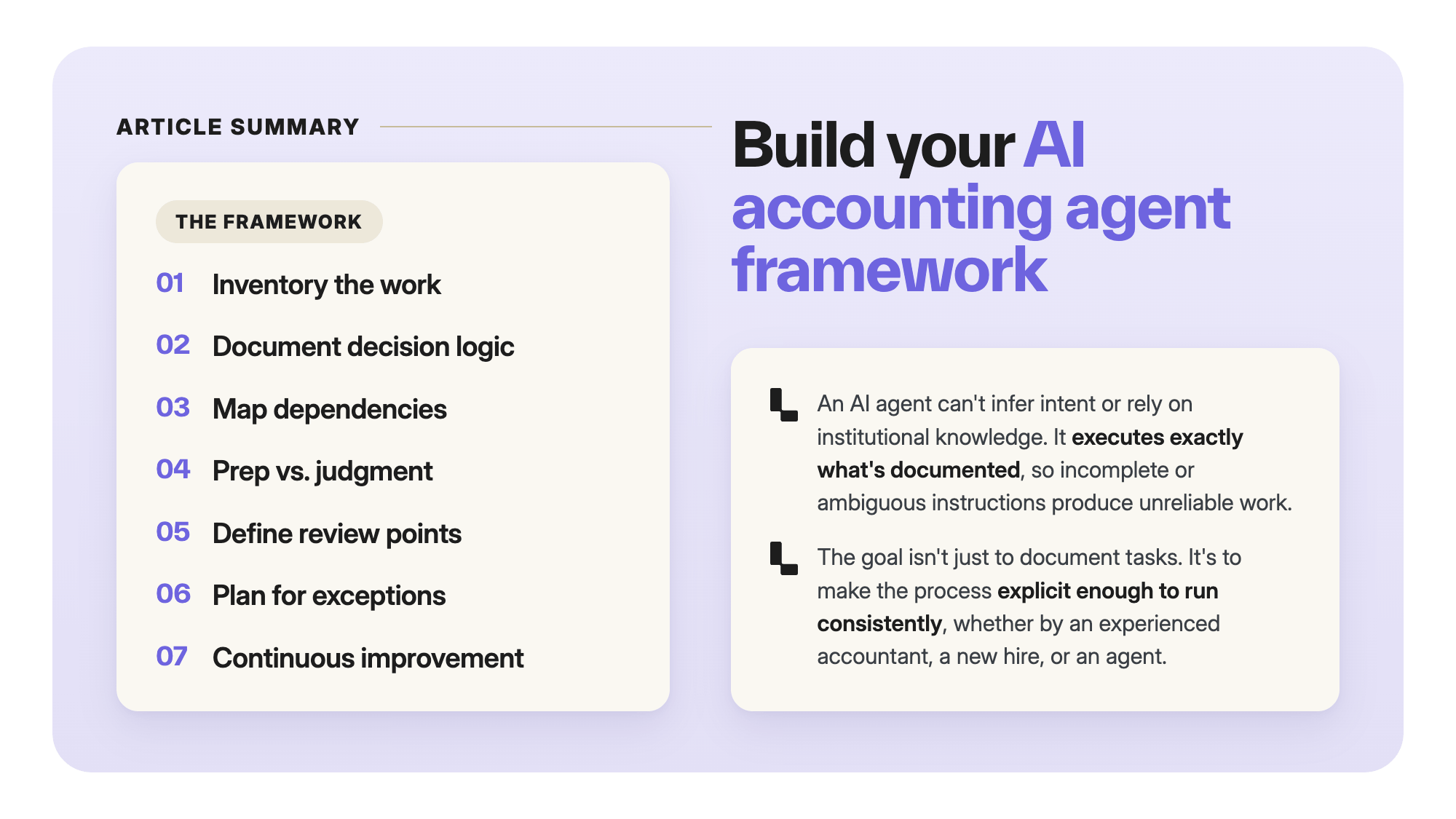
That's why, when building your AI agents, the goal is not simply to document tasks. It is to make the underlying process explicit enough that work can be performed consistently, whether by an experienced accountant, a new team member, or an AI agent.
You can expect a three-part process, overall:
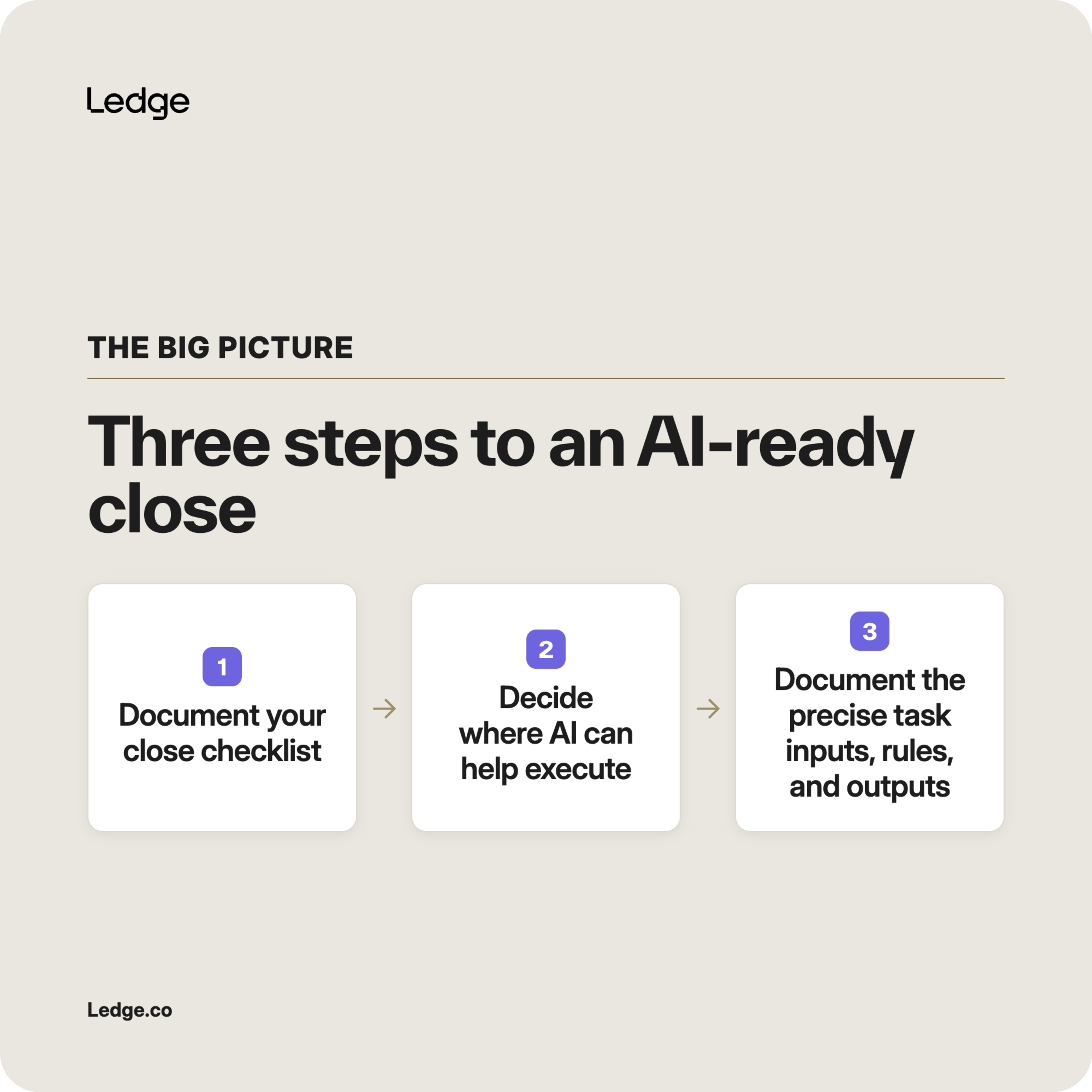
- Build a month-end close checklist that details the human tasks going into the process, already
- Identify which of the tasks will be completed by humans vs. AI
- Document the precise steps for the AI agent to take
The following toolkit—consisting of best practices, templates, and AI-readiness worksheets—can help you work through the steps of making your month-end close checklist AI-ready.
Best practices to set up your AI accounting agents for the month-end close
Most finance teams do not need to redesign their month-end close from scratch to begin using AI agents. In many cases, the required processes, controls, and workflows already exist. The challenge is making them clear enough that work can be executed consistently and reviewed appropriately.
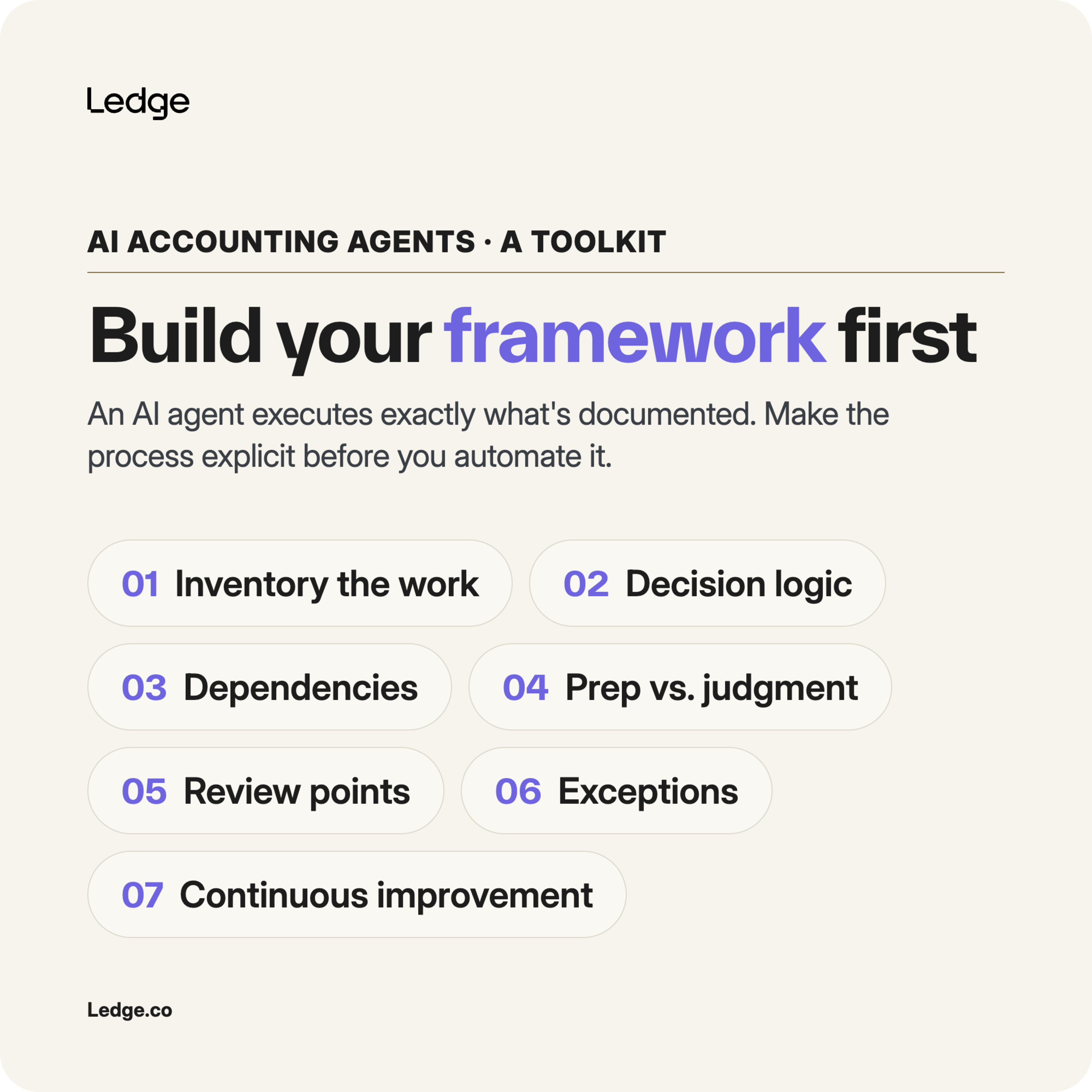
The discussion below outlines the key areas to review as you prepare your month-end close process for AI-assisted execution.
1. Start with a complete inventory of month-end close activities
AI agents work best when they operate within a clearly defined process.

Before implementing agents, it's worth reviewing your month-end checklist to ensure all recurring close activities are captured. This includes both major accounting workflows and the smaller recurring tasks that often live in spreadsheets, emails, or institutional knowledge.
2. Document the decision logic behind the work
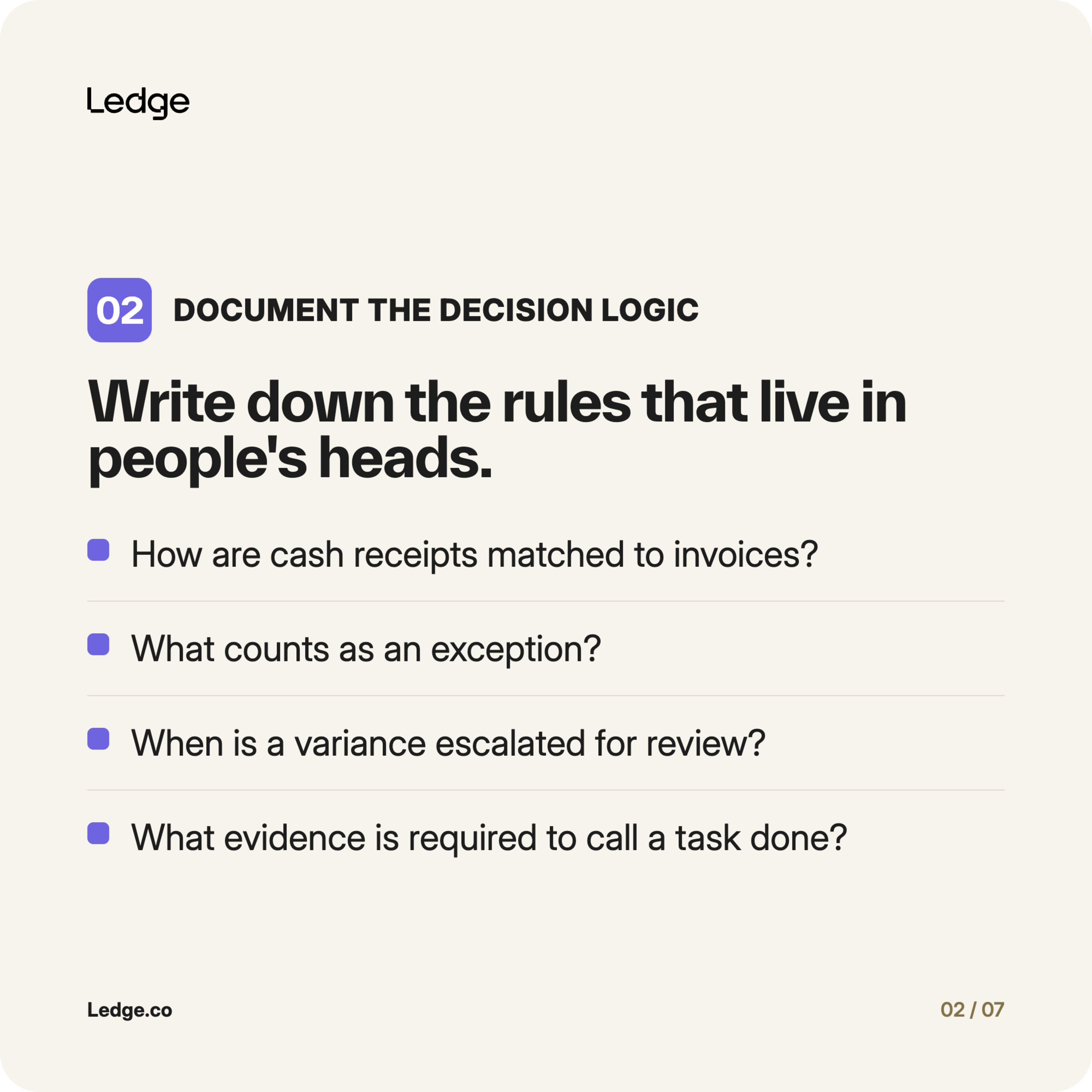
Many accounting processes rely on established patterns that experienced team members follow instinctively. The challenge is that these rules often live in people's heads rather than in formal documentation.
A senior accountant may know exactly how to handle a partial payment, investigate a variance, or determine whether an account reconciliation difference warrants escalation. Over time, these decisions become second nature. But if the logic has never been documented, it's difficult for anyone else—whether a new hire or an AI agent—to follow the same process consistently.
As part of the AI adoption process, it's important to make these rules more explicit.
For example:
- How should cash receipts be matched to invoices?
- What constitutes an exception?
- When should a variance be escalated for review?
- What supporting documentation is required before a task can be considered complete?
Many organizations already have answers to these questions. The implementation process simply creates an opportunity to capture and standardize the knowledge that already exists across the team.
The clearer the underlying logic, the more effectively AI agents can support the process.
3. Identify dependencies between tasks
Month-end close activities rarely happen in isolation.
Many tasks depend on information produced by other workflows. Accounts payable may need to be finalized before accrued expenses can be reviewed. Revenue data may need to be complete before revenue recognition activities can begin. Cash application can affect accounts receivable balances and subsequent reconciliations.
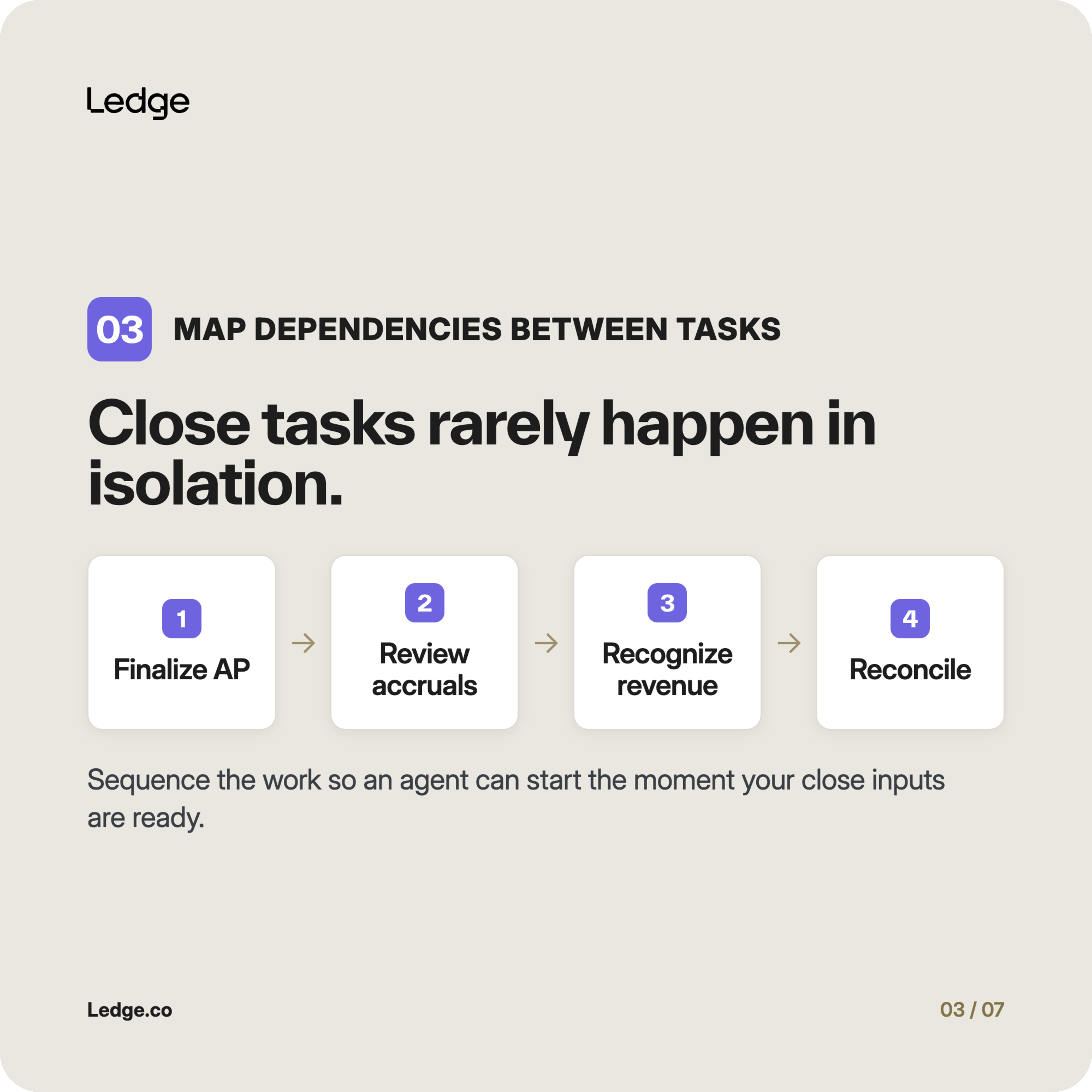
Taking time to identify these dependencies helps ensure that close activities occur in the right sequence.
It also creates opportunities for AI agents to begin work automatically as soon as the required information becomes available.
For many teams, this exercise provides valuable visibility into how work moves through the close process and where bottlenecks tend to emerge.
4. Distinguish between preparation and judgment
One of the most common misconceptions about AI in accounting is that every activity should be fully automated.
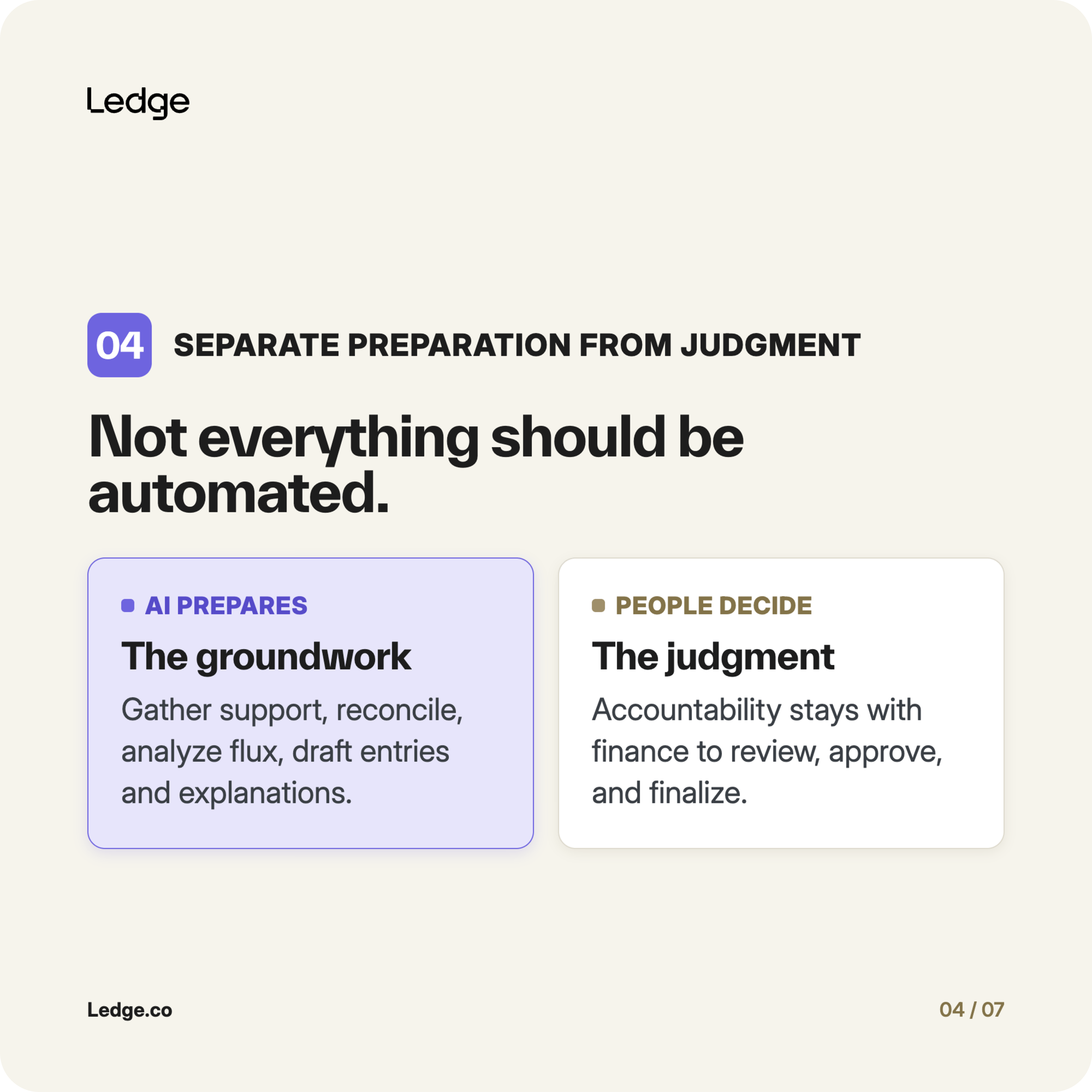
In reality, finance teams often achieve the best results when AI agents handle preparation work while accountants remain responsible for oversight and decision-making.
For example, an AI agent might:
- Gather supporting documentation
- Reconcile transactions
- Analyze month-over-month flux variances
- Prepare journal entry recommendations
- Draft explanations for unusual activity
Finance professionals can then review, approve, and finalize the work.
Thinking through these boundaries early helps clarify where AI can provide the greatest value while ensuring that critical accounting judgments remain under finance supervision.
5. Define review and approval points
As part of preparing for AI agents, finance teams should identify exactly where human review, approval, or signoff is required.

For example:
- Which journal entries require approval before posting?
- Which reconciliations can be completed automatically versus reviewed by an accountant?
- What materiality thresholds require escalation?
- Who is responsible for final approval of close activities?
Defining these checkpoints helps establish clear boundaries between AI execution and human accountability. It also helps ensure that internal controls remain intact as more work becomes automated.
6. Determine how you’ll handle exceptions
Accounting processes are designed to handle exceptions just as much as they are designed to process routine transactions.
Unmatched payments, unexpected variances, incomplete documentation, and timing differences are all a normal part of the close process.
As you prepare for AI agents, it's worth considering how these situations should be handled.
Questions to think about include:
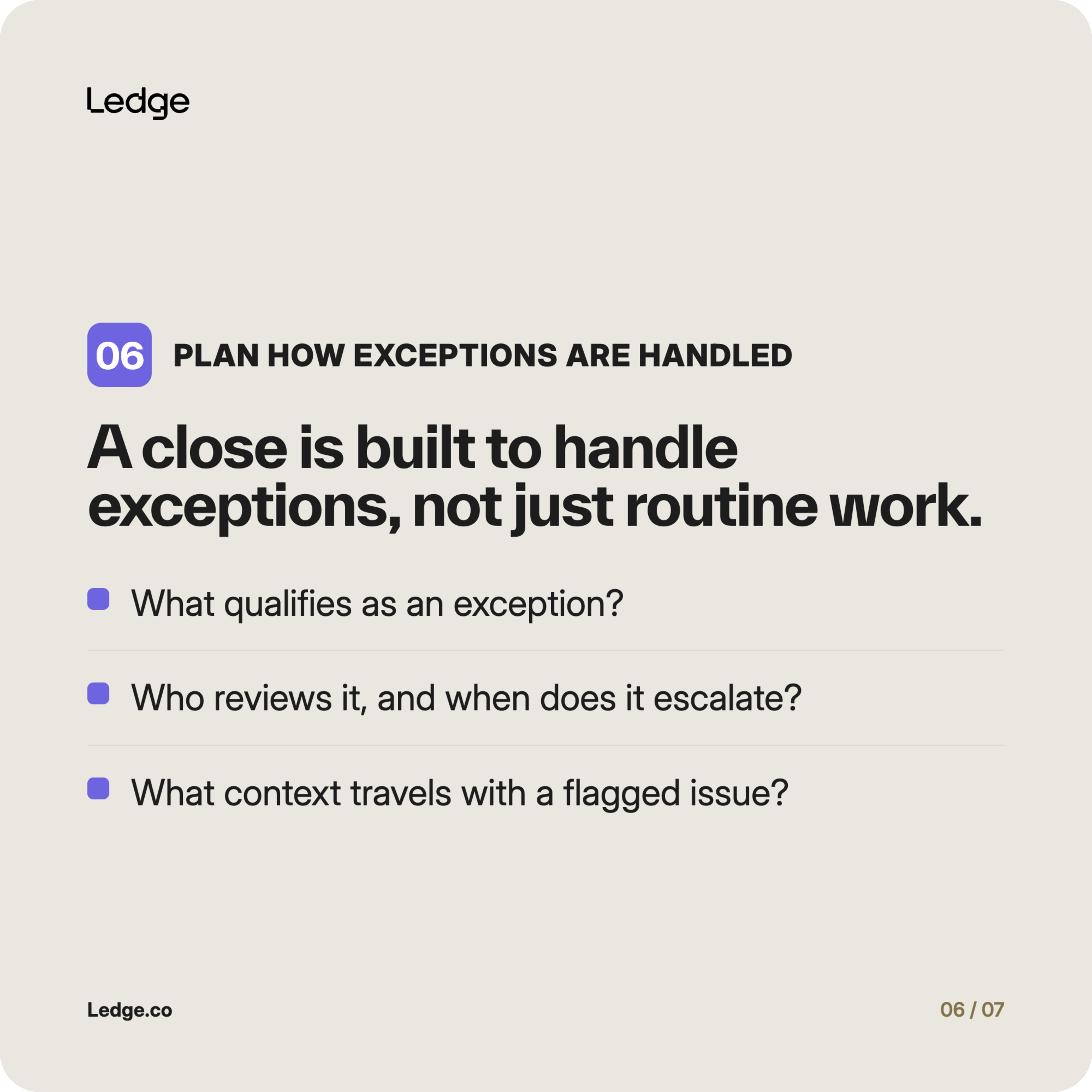
- What qualifies as an exception?
- Who should review exceptions?
- When should a workflow be escalated?
- What information should be included when an issue is flagged?
Clearly defined exception paths help ensure that unusual situations receive the appropriate level of review while allowing routine activities to continue moving forward efficiently.
7. View AI readiness as a continuous improvement opportunity
Preparing for AI agents isn't a one-time project.
Many finance teams find that the implementation process itself creates opportunities to improve how work gets done.

As workflows become more visible, teams often identify opportunities to:
- Clarify ownership
- Improve documentation
- Reduce redundant activities
- Strengthen controls
- Streamline handoffs between stakeholders
These improvements benefit both the finance team and the AI agents supporting the process.
Over time, close processes become more consistent, more scalable, and easier to manage.
Month-end close checklist templates and AI readiness worksheets
Practical templates and worksheets to help document your close process, identify automation opportunities, and prepare tasks for AI agents
The best practices above provides a high-level approach for preparing your month-end close process for AI agents. The templates and worksheets below are designed to help you put those concepts into practice.
Start by documenting the activities that make up your month-end close. Then, identify which tasks may be suitable for AI assistance and capture the decision logic, exception criteria, and approval requirements needed to execute those activities consistently.
1. Month-end close checklist for human task documentation
Outline the tasks required for your month-end close
If you don’t have a month-end close template available, start with this Google sheet.
It provides a foundation for documenting the recurring activities, owners, deadlines, and review points required to complete your month-end close.
While the template is not specifically designed for AI agents, it can help finance teams establish the process documentation needed before introducing AI into the close. As you work through the framework in this article, consider where additional decision logic, dependencies, exception criteria, and approval requirements may need to be documented.
2. AI-Ready Close Checklist
Expand each task with the information needed for AI-assisted execution
Traditional month-end close checklists typically focus on ownership, timing, and task completion. As finance teams prepare for AI agents, they often expand those checklists to include decision logic, exception criteria, approval requirements, and potential automation opportunities.
The worksheet and example below illustrate how a traditional close checklist can evolve into an AI-ready close checklist.
3. Task-specific AI-readiness template
Once your close activities are documented, the next step is defining how each task on your checklist should be executed. Where traditional close checklists typically focus on task ownership and timing. AI-ready processes also document the rules, inputs, exceptions, and review requirements needed to execute the work consistently.
For each task on your month-end close checklist, document the following:
Final thoughts
Preparing your month-end close checklist for AI agents is ultimately an exercise in making your close process more explicit, repeatable, and scalable. It requires documenting the workflows, decision logic, dependencies, review points, and exception paths that already exist within your organization so they can be executed consistently.
For many finance teams, the implementation process itself creates value. As workflows become more visible, teams often identify opportunities to strengthen controls, improve documentation, reduce bottlenecks, and clarify ownership across the close.
AI agents can then operate within that framework, helping automate routine work, surface issues earlier, and accelerate execution while keeping finance professionals in control of critical decisions.
The end goal is not to replace accounting judgment. It is to give finance teams more time to focus on analysis, decision-making, and the strategic work that drives business outcomes.