If you’re exploring how to build an AI accounting agent for the month-end close, it may be tempting to open ChatGPT or Claude and start experimenting. You might upload a spreadsheet, describe an accounting task, and test different prompts.
This can be a useful way to learn how LLMs might help you complete accounting work faster. But building an AI accounting agent that can operate reliably within the close requires several important steps before you begin prompting.
Without that preparation, you are likely to create an agent that works once in a controlled test but breaks when you try to use it repeatedly.
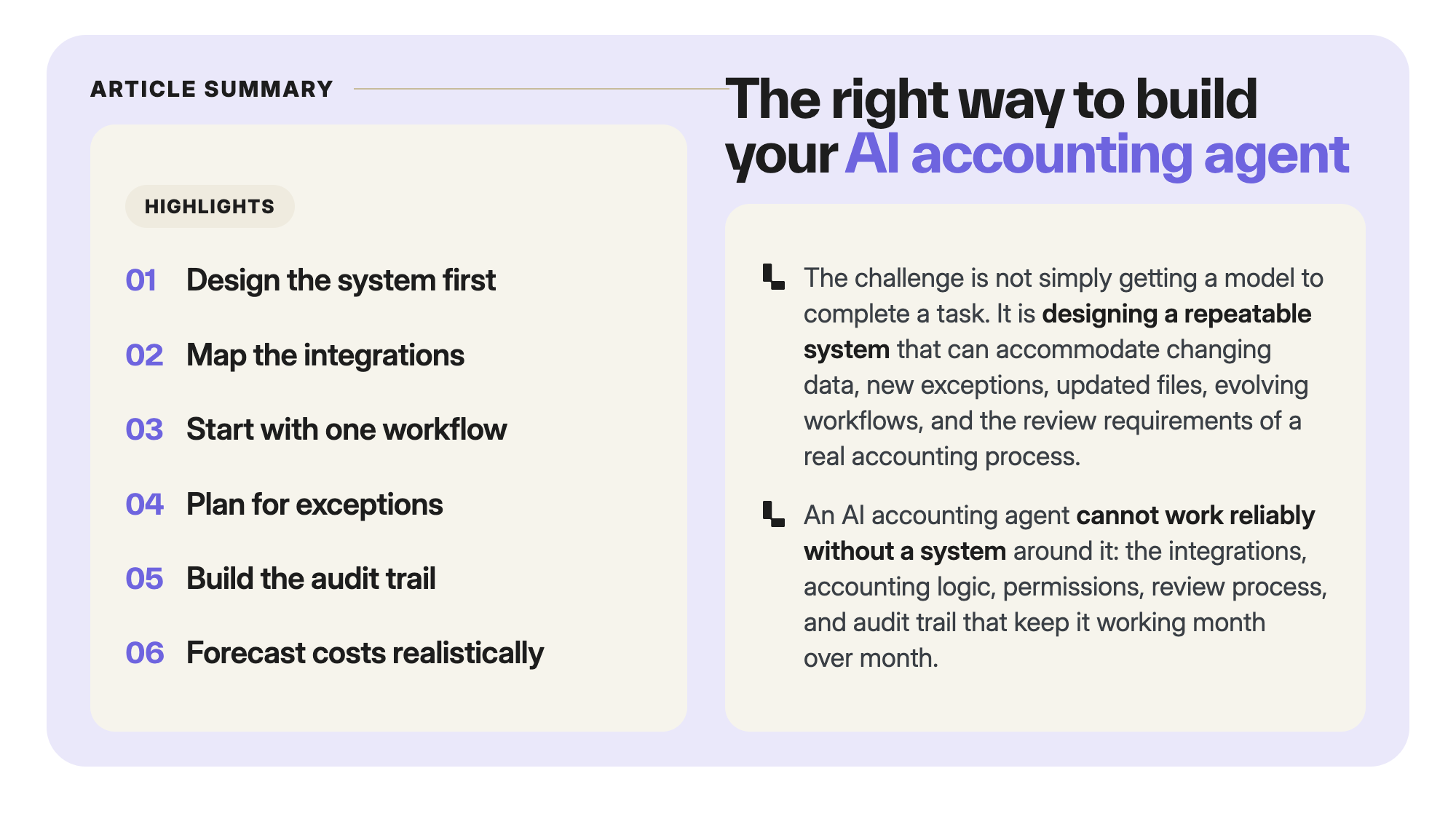
The challenge is not simply getting a model to complete a task. It is designing a repeatable system that can accommodate changing data, new exceptions, updated files, evolving workflows, and the review requirements of a real accounting process.
In other words, you are not just building an agent. You are building a system that allows the AI accounting agent to work reliably month after month.
Here’s what that looks like in practice.
What AI accounting agents need to work reliably
To complete a recurring accounting task, an AI agent needs access to the right data, clear instructions, defined permissions, accounting rules, exception-handling procedures, and a review process. It also needs to create a reliable audit trail showing which data it used, which actions it took, how it reached its output, and who reviewed and approved the work.
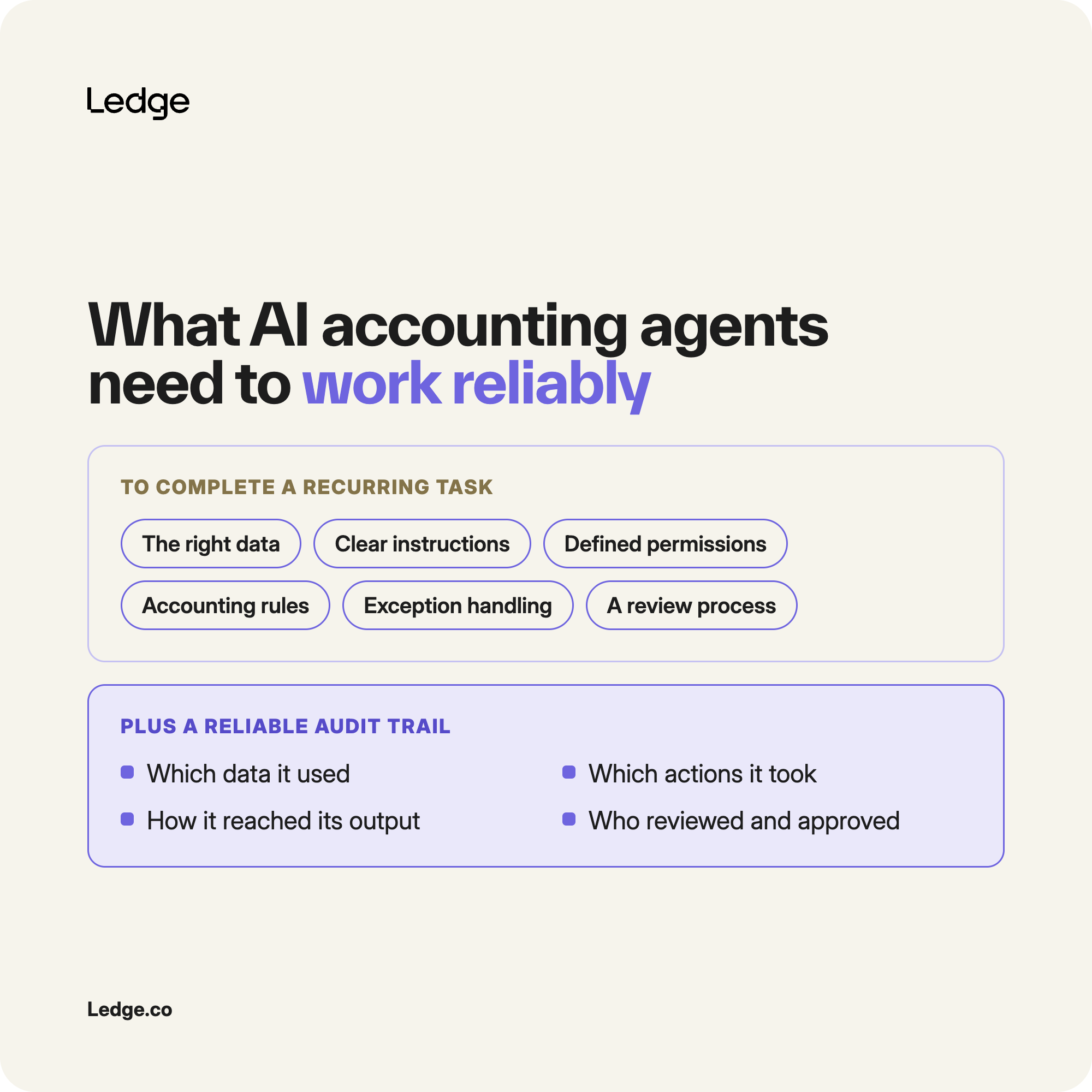
That surrounding system is what turns a successful prompt into a repeatable accounting workflow.
When you build and test your own AI accounting agent in a controlled environment, some of these requirements may still be handled manually. That means you’re still choosing the right spreadsheet, providing the necessary context, correcting formatting issues, and reviewing the output as it's generated.
The AI agent may appear to complete the task independently, but the person running the test is often supplying much of the structure behind the scenes.
That approach becomes difficult to sustain month over month.
The next reporting period may include a different transaction volume, a changed file format, a new entity, missing documentation, or an exception that was not present in the original dataset. Without a system for recognizing and managing those changes, the agent may stop working—or continue producing an output that is no longer reliable.
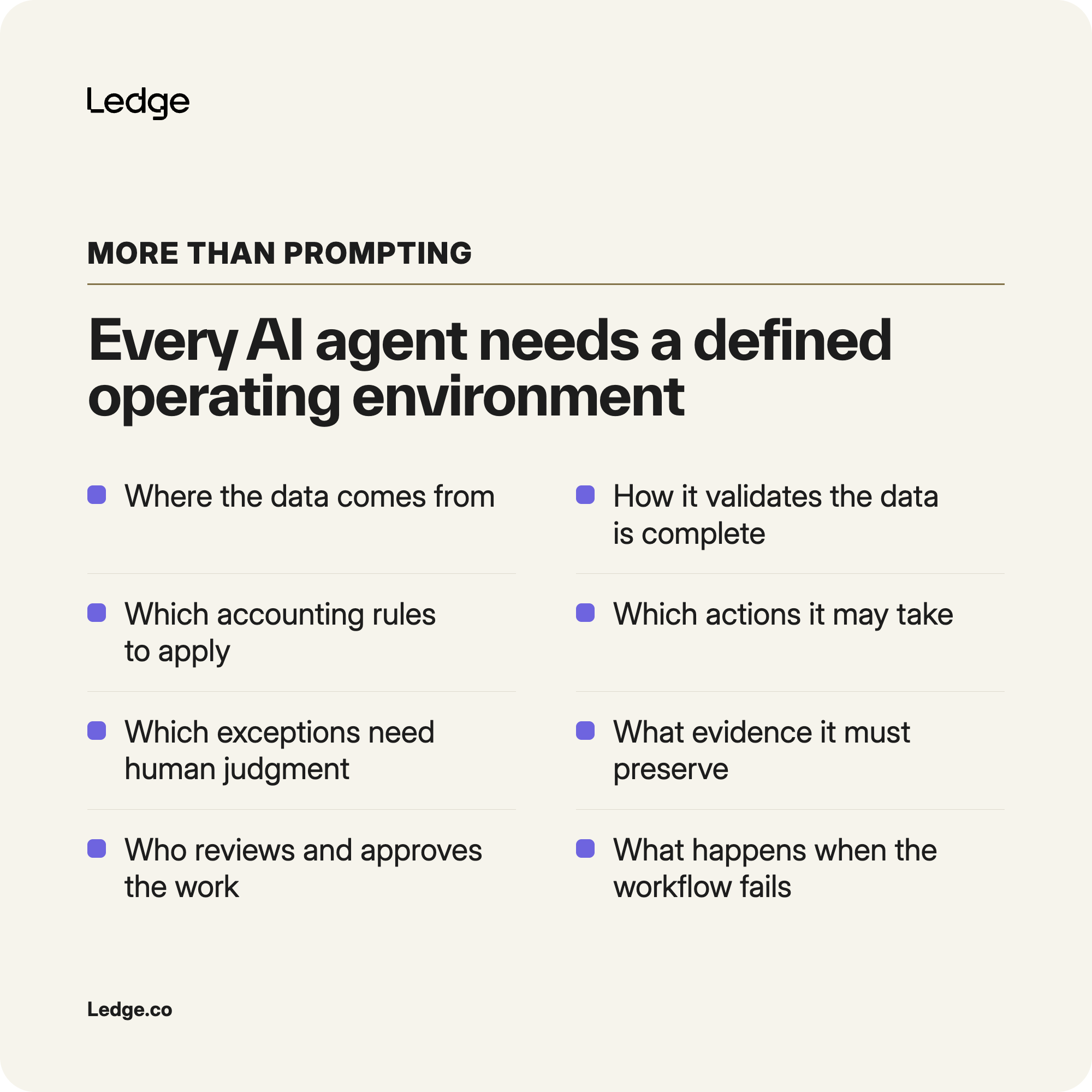
A durable AI accounting agent therefore needs more than a prompt. It needs a repeatable operating environment that defines:
- Where the data comes from
- How the agent validates that the data is complete
- Which accounting rules it should apply
- Which actions it is permitted to take
- Which exceptions require human judgment
- What evidence it must preserve
- Who reviews and approves the work
- What happens when part of the workflow fails.
The goal is not to automate every decision. It is to give the agent enough structure to own the repeatable work while keeping accountants in control of review, judgment, and approval.
That is why systems design comes before agent design.
The system that keeps your AI agents working
A reliable AI accounting agent depends on several connected components that allow the agent to access information, complete the task, handle exceptions, and produce work that human accountants can review and audit.
The model may provide the reasoning layer, but the agent still needs to connect to the systems where financial data is created, processed, reconciled, and reviewed. Depending on the workflow, that may include the ERP, banks, payment processors, billing platforms, expense systems, payroll tools, data warehouses, spreadsheets, and document storage systems.
Those integrations allow the AI agent to:
- Retrieve the correct source data
- Compare information across systems
- Apply accounting rules to live transactions
- Identify discrepancies and exceptions
- Assemble supporting documentation
- Prepare outputs for review
- Update the relevant accounting workflow
The first challenge you’re likely to encounter is that these systems do not always structure or describe information in the same way. Transaction identifiers may differ across platforms. Data may arrive at different times. Fields may be missing, duplicated, or formatted inconsistently. An agent therefore needs more than access. It needs a reliable integration layer that can normalize data, preserve context, detect missing inputs, and maintain a clear connection between the source records and the resulting accounting work.
The system also needs to account for changes across the stack. APIs may be updated, permissions may expire, report formats may change, and new entities or payment channels may be added. A workflow that depends on a fragile connection can break even when the underlying AI model is still working as expected.
Building an AI accounting agent is an integration and systems-design project across the company’s fintech infrastructure.
Start with one recurring accounting workflow
Once you understand the system an AI accounting agent requires, the next step is to choose the workflow it will support.
Start narrowly. Rather than attempting to automate the entire month-end close, identify one recurring task with a defined beginning, a recognizable output, and enough volume to justify automation.
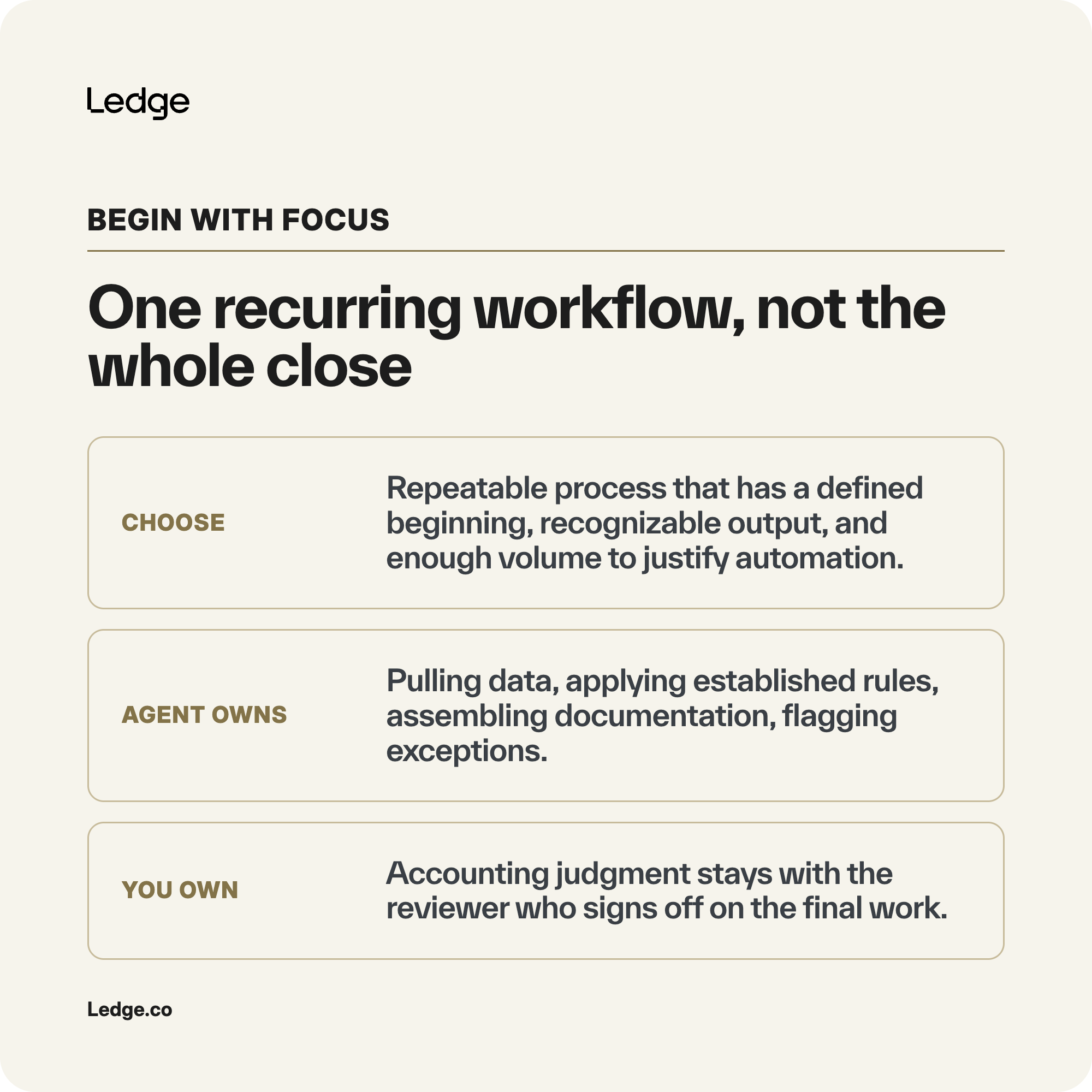
The best starting workflows are generally repetitive but not entirely mechanical. They contain work an agent can own—such as gathering data, applying established rules, preparing documentation, or identifying exceptions—while leaving accounting judgment and approval with the appropriate reviewer.
Before building anything, map the workflow from beginning to end. Document what initiates the task, which systems are involved, what information the accountant uses, which rules are applied, where exceptions occur, what evidence must be preserved, and who approves the final work.
This gives you the operating requirements for the AI agent. Without that map, you may build an AI agent that can produce the expected output but cannot reliably participate in the actual accounting process.
Map the systems, data, and integrations involved
Once you have selected a recurring workflow, identify every system, file, and data source the agent will need to complete it.
For many accounting processes, that means integrating across the fintech stack. The agent may need to retrieve information from the ERP, bank accounts, payment processors, billing platforms, expense systems, payroll tools, spreadsheets, data warehouses, or document repositories.
Map the workflow from source to final output:
- Where does the data originate?
- Which systems must be compared?
- How does the information move between them today?
- Which fields or identifiers connect the records?
- Where are supporting documents stored?
- Which system contains the final accounting record?
- Where should the agent’s work be reviewed and approved?
This exercise often reveals that the accounting task is not contained within a single spreadsheet or platform. A cash reconciliation, for example, may require bank data, payment processor records, ERP transactions, internal matching rules, and supporting documentation from several locations.
The agent therefore needs more than access to a model. It needs reliable integrations that can retrieve the correct data, preserve the relationships between records, and detect when an input is missing, incomplete, outdated, or formatted differently than expected.
You should also account for how those connections may change over time. Authentication credentials expire. APIs are updated. Reports gain new columns. New entities, accounts, or payment channels are added.
Documenting these dependencies before you build helps you understand both the technical scope of the agent and the ongoing work required to keep it operating month over month.
Plan for exceptions, review, and auditability
An AI accounting agent should not be designed around the assumption that every transaction will fit the expected pattern.
Recurring accounting workflows contain exceptions. A payment may be split across invoices. A supporting document may be missing. A transaction may appear in one system but not another. A new entity, account, vendor, or payment channel may introduce a scenario the agent has not encountered before.
The system needs clear rules for how to handle those situations.
Before building, define:
- Which exceptions the agent can resolve using established rules.
- Which exceptions require additional information.
- Which exceptions must be escalated to an accountant.
- When the agent should stop rather than produce an uncertain result.
- What context the reviewer needs to resolve the issue.
- How the final decision should be documented.
A reliable AI accounting agent should not be rewarded for always producing an answer. It should be able to recognize when the available data or accounting logic is insufficient and route the work to the appropriate reviewer.
The review experience also needs to be designed into the workflow.
An accountant should be able to see the source data, the rule or calculation applied, the proposed result, the supporting documentation, and any unresolved exceptions. The reviewer should not need to reconstruct the agent’s work from scratch.
The system should also preserve an audit trail showing:
- Which data the agent accessed.
- Which version of the workflow or rules it used.
- Which actions it completed.
- Which exceptions it identified.
- Which output it proposed.
- Who reviewed, changed, or approved the work.
- When each step occurred.
This is what turns the agent’s output into reviewable accounting work rather than an isolated AI-generated answer.
The objective is not to remove accountants from the process. It is to allow the agent to manage more of the repetitive preparation while giving accountants a clear, controlled way to apply judgment and approve the final work.
Realistically estimate the cost to build and maintain the system
Once you have defined the workflow, integrations, ownership boundaries, and review requirements, estimate the full cost of building the agent.
Do not limit the estimate to the cost of a ChatGPT, Claude, or Gemini subscription. Model access is only one component of the system.
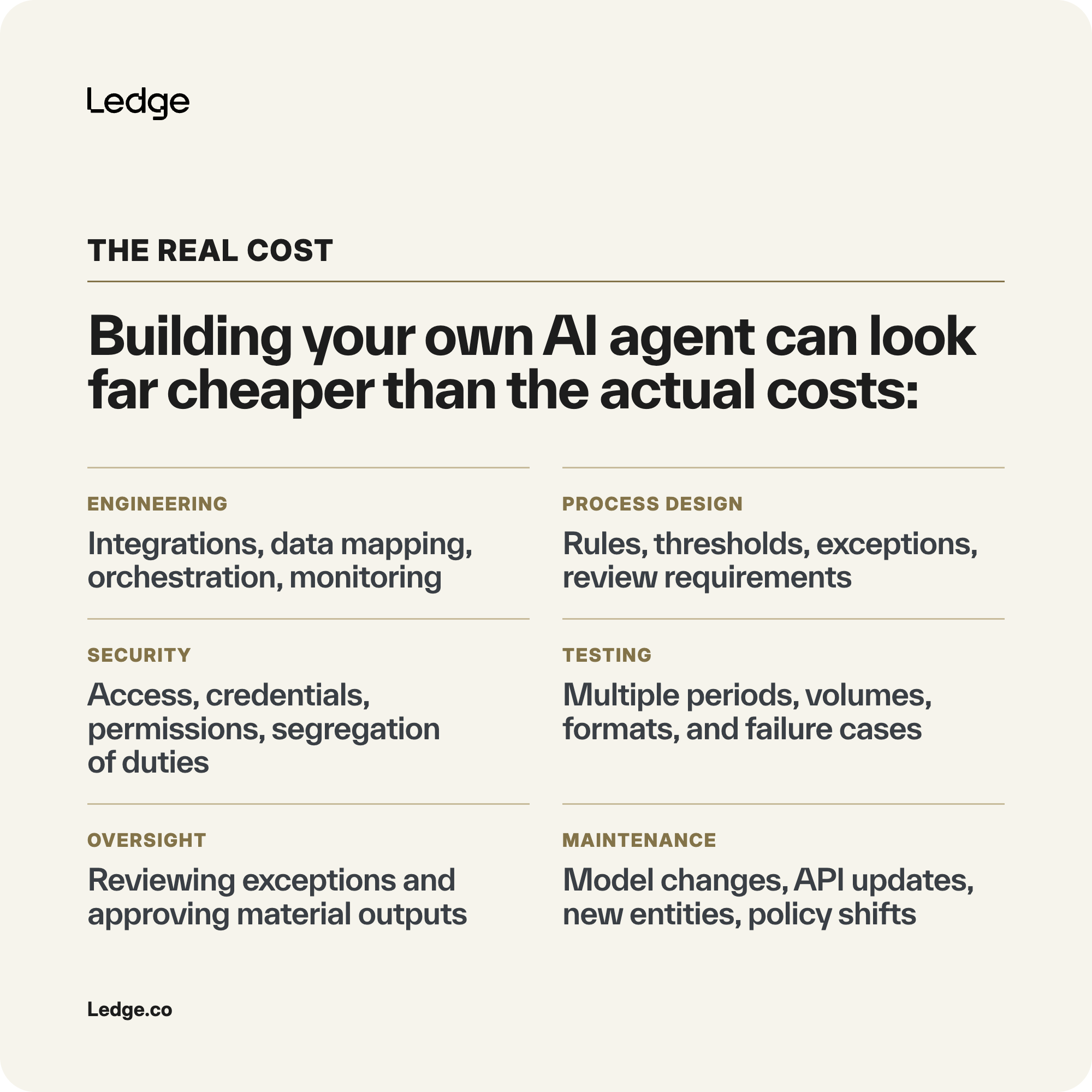
The larger investment may include engineering, accounting process design, security review, testing, monitoring, and ongoing maintenance.
Engineering and integration costs
The AI accounting agent may require integrations across the fintech stack, including the ERP, banks, payment processors, billing platforms, expense systems, payroll tools, spreadsheets, data warehouses, and document repositories.
Engineering work may include:
- Authentication and credential management
- API connections
- Data mapping and normalization
- Workflow orchestration
- Structured output validation
- Error handling and retry logic
- Logging and monitoring
- Interfaces for review and approval
- Connections to working papers or close checklists
These costs increase as the workflow expands across more systems, entities, accounts, or transaction types.
Accounting process design
Accountants must translate the existing workflow into explicit instructions, rules, thresholds, exceptions, and review requirements.
That work can be more involved than expected, particularly when the process depends on undocumented knowledge, spreadsheet conventions, or decisions made from experience.
The team may need to document:
- Matching rules
- Materiality thresholds
- Account-specific procedures
- Required supporting evidence
- Approval requirements
- Escalation criteria
- Known edge cases
- Completion standards
This is essential design work, not simply preparation for writing a better prompt.
Security, compliance, and control costs
Connecting an AI accounting agent to financial systems may require involvement from IT, security, legal, compliance, and internal audit.
The organization may need to evaluate:
- Which data the model can access
- How credentials are stored
- Whether the agent has read or write permissions
- How access is granted and revoked
- How prompts, outputs, and logs are retained
- Whether the workflow maintains segregation of duties
- How the agent affects existing internal controls
- Which third-party systems or subprocessors are involved
The time these teams spend reviewing and governing the system is part of the cost, even when it does not appear in the AI provider’s invoice.
Testing and validation
A successful demonstration is not enough to establish that the agent is ready for production.
The system should be tested across multiple periods and conditions, including:
- Different transaction volumes
- Changed file formats
- Missing or incomplete inputs
- Known exceptions
- Duplicate records
- Unusual transactions
- Integration failures
- Permission changes
- Updated accounting rules
The accounting team must also confirm that the output is complete, accurate, traceable, and suitable for review.
Human oversight
The AI accounting agent may reduce preparation work, but accountants will still need to review exceptions, validate material outputs, and approve controlled actions.
The cost of that review depends heavily on how the system presents the work.
If the reviewer receives the source records, proposed result, supporting documentation, and audit trail in one place, the agent may meaningfully reduce the time required.
If the reviewer must locate the evidence and recreate the analysis independently, the system may simply shift work from preparation to validation.
Ongoing maintenance
The agent will require continued support after deployment.
Models change. APIs are updated. Permissions expire. Reports gain new columns. New entities are added. Accounting policies and close procedures evolve.
Someone must own:
- Regression testing
- Integration monitoring
- Rule and prompt updates
- Access reviews
- Incident response
- Documentation
- User support
- Changes to source systems
- Changes to the accounting workflow
The relevant cost is therefore not only what it takes to build the agent. It is what it takes to keep the system operating reliably month over month.
Opportunity cost
Internal teams should also consider what they are giving up to build and maintain the agent.
Engineering resources assigned to accounting infrastructure cannot be used for the company’s core product or customer-facing systems. Accounting leaders documenting, testing, and troubleshooting the workflow have less time for the close, analysis, controls, and strategic finance work.
Because these costs are distributed across several departments, a DIY agent can appear much less expensive than it actually is.
The better question is not:
How much does the model cost?
It is:
What will it cost to build, secure, validate, review, and maintain the complete accounting system around it?
Test whether the agent can work month over month
An AI accounting agent should not be evaluated only on whether it can complete the task once.
The real test is whether it can continue performing the work as the reporting period changes.
A controlled demonstration may use a clean spreadsheet, a familiar transaction population, and carefully prepared instructions. The person running the test may also provide missing context, correct formatting issues, or intervene when the output is not quite right.
That can show that the model is capable of supporting the task. It does not yet show that the workflow is repeatable.
The next month may introduce:
- A higher transaction volume
- A different report structure
- New vendors or customers
- Partial or duplicate payments
- Missing documentation
- A new entity or bank account
- Foreign-currency activity
- A changed approval threshold
- An unfamiliar exception
- A delayed or unavailable source system
The agent should be tested against these kinds of changes before the workflow becomes operational.
For each test, evaluate more than the final answer. Confirm that the agent:
- Retrieved the complete data population
- Used the correct reporting period
- Applied the intended accounting rules
- Identified missing or changed inputs
- Escalated exceptions appropriately
- Preserved supporting evidence
- Produced a clear audit trail
- Avoided unauthorized or duplicate actions
- Routed the work to the correct reviewer
- Left the workflow in a recoverable state if it failed
A strong test should also include deliberately incomplete or incorrect inputs. The objective is to determine whether the agent can recognize that it should not proceed.
The goal is not to prove that the system works under ideal conditions. It is to understand how it behaves when the workflow changes in the ways real accounting processes inevitably do.
Plan for what happens if the AI accounting agent breaks
Every production system eventually encounters a failure.
A credential may expire. An integration may become unavailable. A report may change format. A required document may be missing. The agent may encounter an exception that was not included in the original test set.
The question is not whether the workflow will ever break. It is whether the system will fail safely and make recovery manageable.
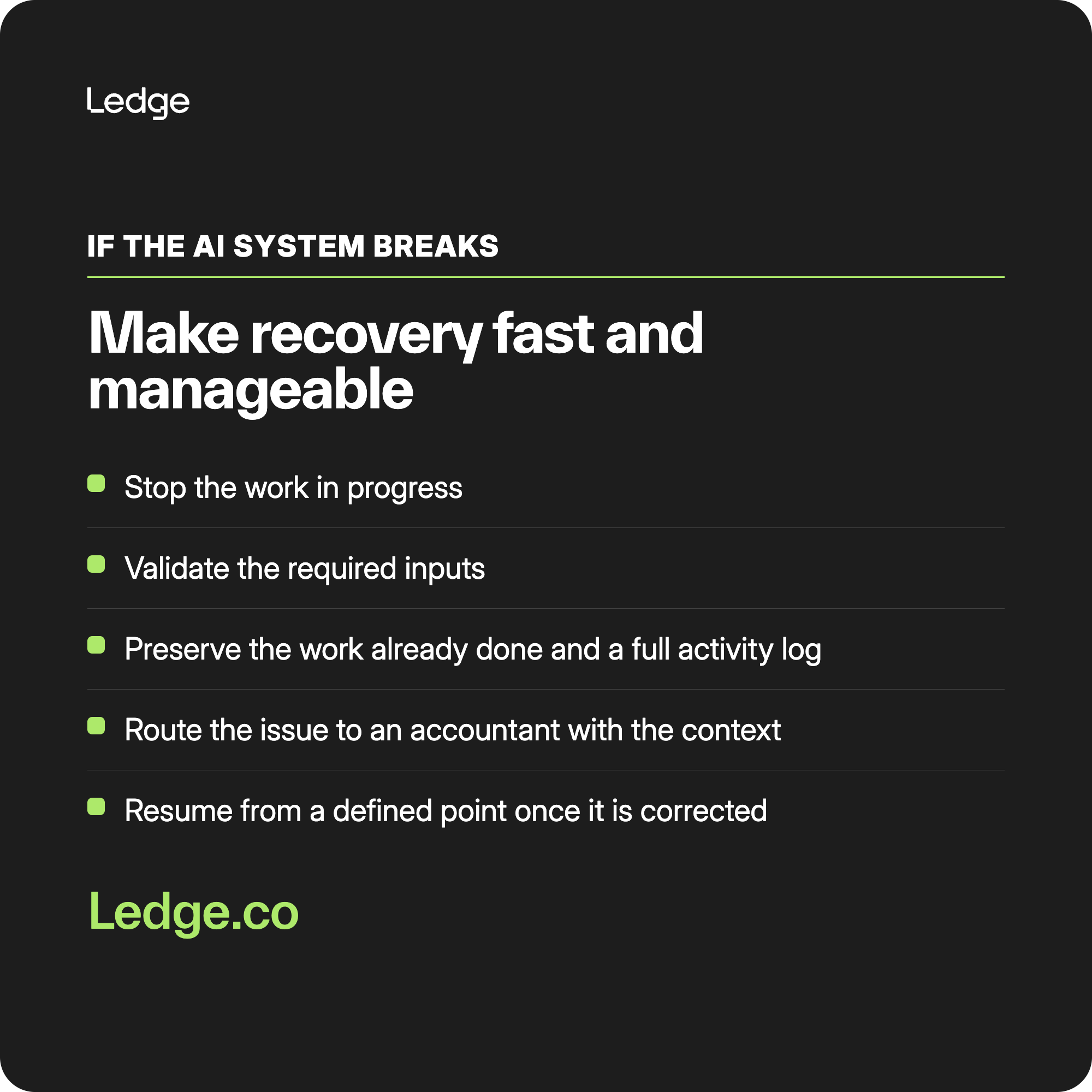
In the best-case scenario, the AI agent stops, identifies the problem, preserves the work already completed, and routes the issue to an accountant with the relevant context.
In a poorly controlled system, the failure may be less obvious.
The AI agent might:
- Process only part of the transaction population
- Use an outdated file
- Apply the wrong matching rule
- Duplicate completed work
- Mark a task complete without the required evidence
- Generate a proposed entry from incomplete information
- Continue running after an upstream integration has failed
- Produce a plausible output that cannot be traced back to its sources
These failures can be more costly than an agent that simply stops working because the accounting team may not immediately know which results can still be trusted.
When something breaks, the team may need to determine:
- When the failure began
- Which accounts, entities, or transactions were affected
- Whether the source data was complete
- Which workflow, prompt, rule set, or model version was used
- What actions the agent completed
- Whether anything was written back to a source system
- Which outputs need to be recreated
- Whether prior work must be reviewed again
Recovery behavior should therefore be designed before deployment.
The system should be able to:
- Validate required inputs before beginning
- Detect missing or changed data structures
- Stop when it cannot complete the work safely
- Preserve a detailed activity log
- Prevent duplicate actions during retries
- Show which steps were completed
- Separate affected work from unaffected work
- Route failures to the appropriate owner
- Resume from a defined point after the issue is corrected
The most important risk is not necessarily that the agent stops.
It is that the agent continues producing work after the conditions have changed, without clearly signaling that the output may no longer be reliable.
Build for the recurring accounting operation
A general-purpose model can be a useful place to begin experimenting with AI.
It can help accounting teams identify promising use cases, understand how LLMs work with financial data, and explore where automation may save time.
But a production accounting agent requires more than a successful prompt.
It requires integrations across the fintech stack, clearly defined accounting logic, permissions, controls, exception handling, human review, an audit trail, monitoring, and a plan for maintenance and recovery.
The first step is therefore not to begin building immediately.
It is to design the system that will allow the agent to perform the work reliably, securely, and transparently month over month.
A successful test is not the same as a reliable accounting workflow
The goal is not simply to prove that AI can complete an accounting task.
It is to create a controlled, repeatable process that accountants can trust, review, and use again next month.
A successful test is not the same as a reliable accounting workflow.
To create an agent that can support real accounting work, you need to design the system around it: the integrations, accounting logic, permissions, exception handling, review process, audit trail, monitoring, and maintenance required to keep it working as conditions change.
That is the difference between an agent that produces one impressive result and one that can take on recurring work month over month.