


- Reviewing AI-generated accounting work requires a different approach than preparing it manually. Accountants must learn to evaluate results, verify supporting evidence, and exercise professional judgment without recreating every step.
- Human judgment remains essential. AI can prepare journal entries, reconciliations, working papers, and other accounting outputs, but accountants remain responsible for determining whether the results are accurate, reasonable, and appropriate for approval.
- Start by understanding the scope and verifying source data. Confirm that the output covers the correct accounting period, entities, and accounts, and that the underlying financial information is complete and reliable.
- Focus reviews on material exceptions and unusual activity. Investigate discrepancies, unsupported assumptions, unexpected movements, and potential errors that AI systems may have missed.
- Every approval should be supported by traceable evidence. Reviewers should be able to explain the accounting logic, verify important calculations, and defend their decisions to managers or auditors.
- Different accounting workflows require different review procedures. Journal entries, working papers, flux analysis, cash application, and reconciliations each introduce distinct risks and validation requirements.
- Establish consistent review standards across your team. Adapt the checklists to your organization's accounting policies, materiality thresholds, internal controls, and approval procedures to build confidence in AI-prepared work over time.
How to review AI accounting outputs for accuracy, integrity
Ritika Strauss
//
Published:
November 5, 2026
//
Updated:
November 19, 2026
Article

Company name
About the company


Thank you! Your submission has been received!
Oops! Something went wrong while submitting the form.
See Ledge in action
Key Takeaways
Using AI, automation tools can help your accounting team prepare working papers, run flux analyses, complete reconciliations, and apply cash efficiently. But the final output still needs thoughtful human review. That's not always easy.
Moving from preparing the work yourself to reviewing and approving AI-generated work can feel like a major change. When you build something from the ground up, you know where the numbers came from and how each step was completed. Reviewing work produced by AI asks you to develop a different kind of confidence: knowing what to check, when to dig deeper and when you have enough evidence to approve the result.
That need for confidence is reflected in industry research. In a 2025 Deloitte poll of more than 3,300 finance and accounting professionals, nearly 60% said they trust AI agents to make decisions only within defined frameworks, leaving judgment calls to humans. Similarly, a 2026 survey commissioned by Sage and conducted by IDC found that 71% of finance leaders would reject an AI tool that was 99% accurate if it couldn't explain its answers, underscoring the importance of transparency and traceability in building trust.
For accounting teams, the challenge is learning how to exercise that judgment without having to recreate every step of the work.
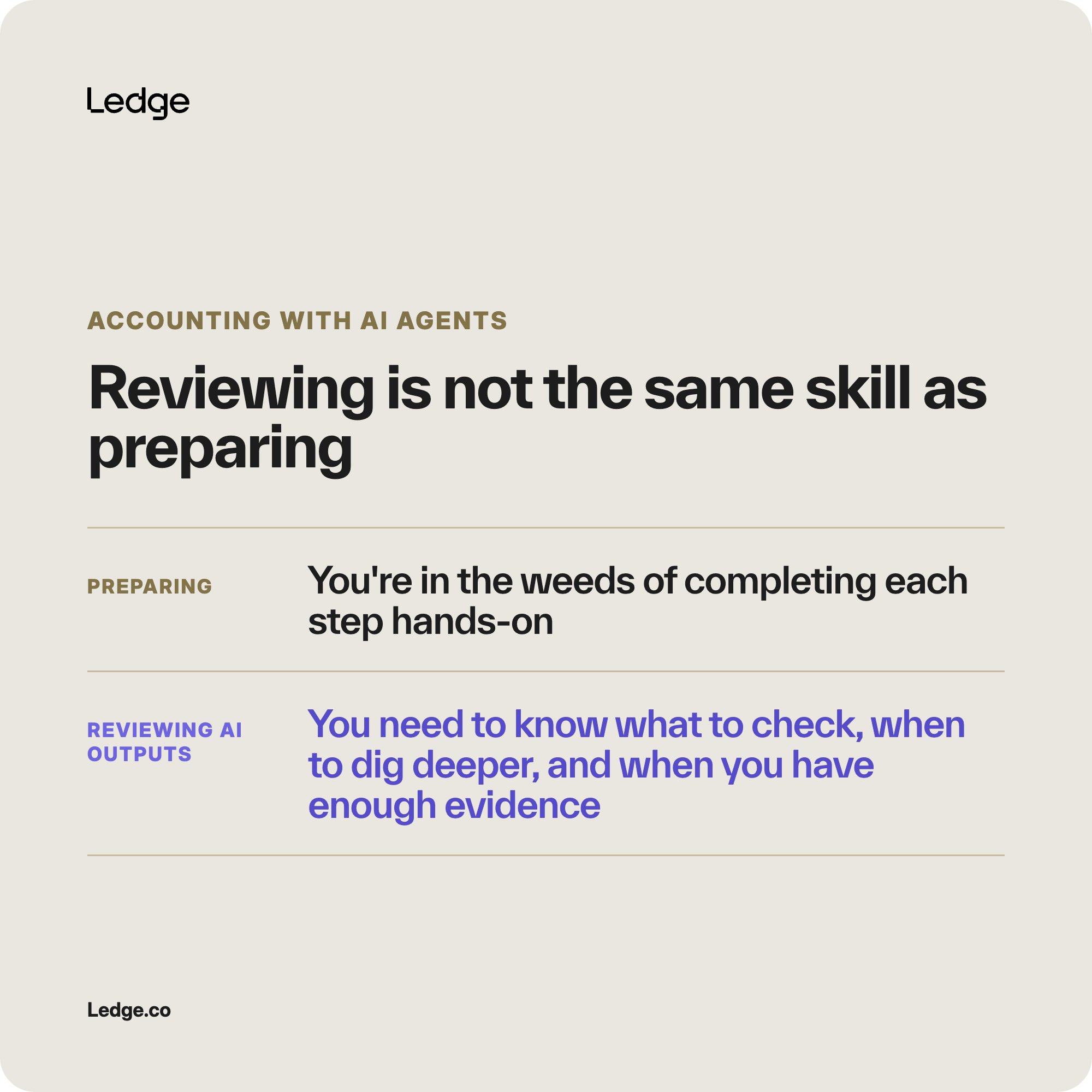
That shift takes time and practice. You are not expected to trust every output automatically or recreate the entire process by hand.
The review standards and checklists below can help you and your team navigate the transition. You can adapt the standards below to your workflows, accounting policies, risk levels, materiality thresholds, approval structure and documentation requirements. As your team gains experience, you can continue updating it based on the exceptions, risks and lessons you encounter.
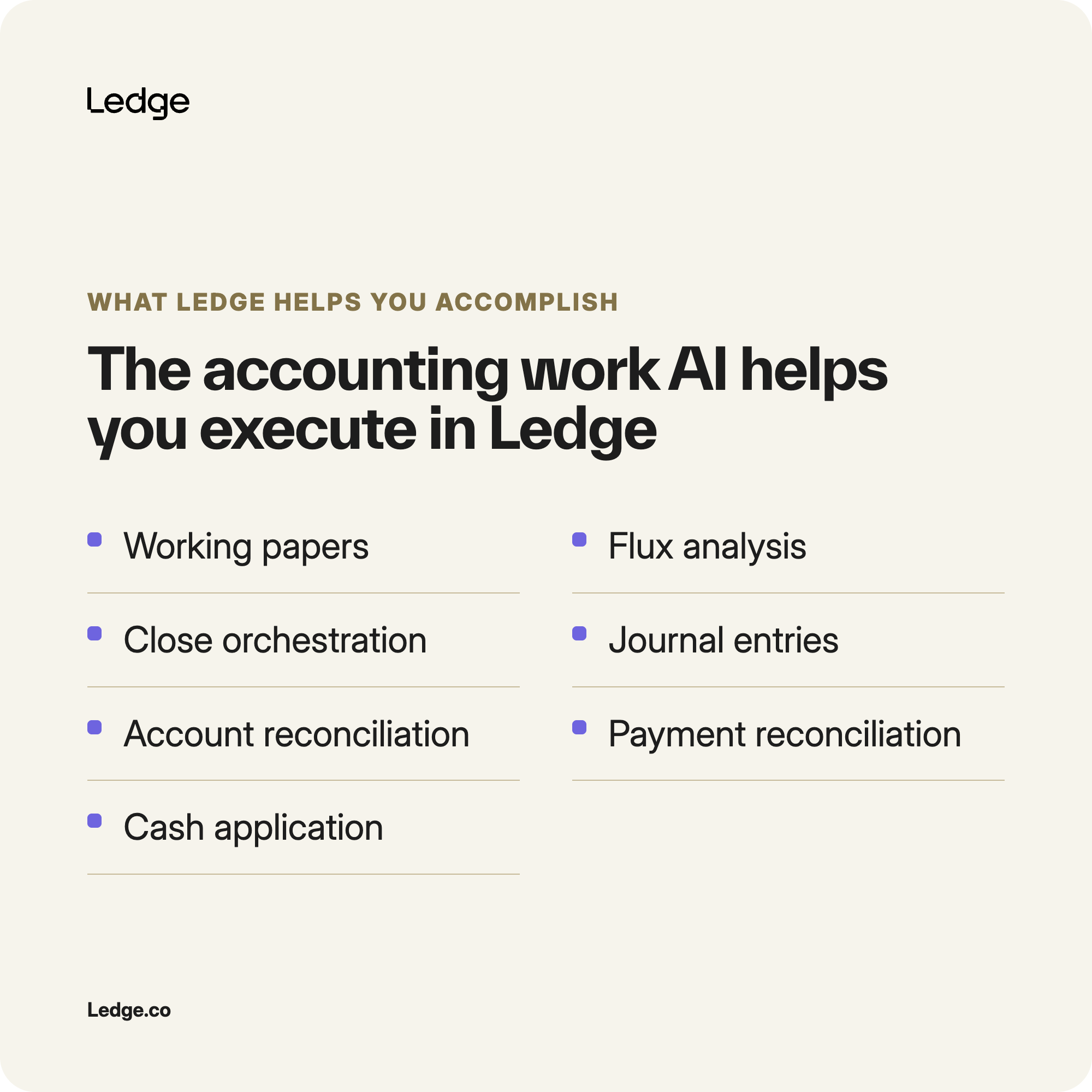
Below, you'll find guidance for the key accounting tasks that AI systems can help your team execute:
- Working papers
- Flux analysis
- Close orchestration
- Journal entries
- Account reconciliation
- Payment reconciliation
- Cash application
For managers and team leads, these standards can also help establish consistent review expectations and build confidence across the team. We've also published a companion article, Practical tips for accountants learning to review AI-generated work, to share directly with your accountants.
Standards for reviewing AI-generated accounting work
This section covers the core review skills you’ll use across different types of accounting workflows you're reviewing and approving.
Understand the output. Before reviewing AI-prepared work, confirm that you understand its purpose, scope and the accounting procedures involved. Identify the accounting period, entity and accounts included, along with what the AI system was asked to prepare. Make sure you understand which accounting policies, rules or procedures should apply.
Check the underlying data. Verify that the source data is complete and comes from the correct systems, files and accounts. Check for missing, duplicated or incomplete records, and confirm that dates, entities, currencies and account mappings are accurate. Any manual inputs or adjustments should be clearly identified.
Review the result. Evaluate whether the output makes sense given the underlying business activity. Review balances, calculations and classifications for reasonableness and consistency with accounting policies. Investigate material changes from prior periods, examine the assumptions used to produce the result, and look for unusual transactions, patterns or amounts that may require further attention.
Investigate exceptions. Review all exceptions flagged by the AI system, while also looking for issues it may have missed. Each exception should be resolved, documented or escalated as appropriate. Confirm that corrections are captured in the audit trail and identify recurring exceptions that may indicate broader workflow or control issues.
Confirm the supporting evidence. Make sure the output can be traced back to reliable source data. Verify that required invoices, contracts, reports, and working papers are available and consistent with the final result. Calculations and allocation methods should be explainable, with enough documentation for another reviewer or auditor to follow the work independently.
Apply professional judgment. Evaluate the work based on the evidence rather than relying solely on the AI system's output. Investigate anything that appears incorrect, consider whether additional business context is needed, and challenge unclear or unsupported assumptions. You should be comfortable explaining why the final result is reasonable and appropriate.
Check your authority. Confirm that the item falls within your approval authority and meets applicable materiality and approval thresholds. Make sure any required secondary reviews have been completed and escalate decisions that fall outside your responsibilities to the appropriate person.
Document the decision. Record the review steps performed, including any exceptions investigated, corrections made and professional judgments applied. Clearly identify the final version of the work and document whether it was approved, rejected or returned for changes.
Before you approve. Before approving AI-prepared accounting work, consider whether you understand what was prepared and why, whether the result makes sense, and whether it can be traced to reliable supporting evidence. Confirm that all meaningful exceptions have been addressed and that you can explain and defend your approval decision.
Approval should reflect a well-supported professional judgment. You do not need to recreate every preparation step, but you should understand the output, investigate material issues and document the evidence supporting your decision.
Accounting workflow checklists
The checklists below are designed to help accounting teams review common workflows supported by AI agents. Adapt them to your accounting policies, risk levels, materiality thresholds, approval structure and documentation requirements. You can save the images and/or print them to help with establishing the right protocols for your team.
Journal entries
As AI helps to prepare proposed journal entries, the reviewer remains responsible for determining whether the entry is appropriate. Your review should cover both the mechanics of the entry and the accounting judgment behind it.
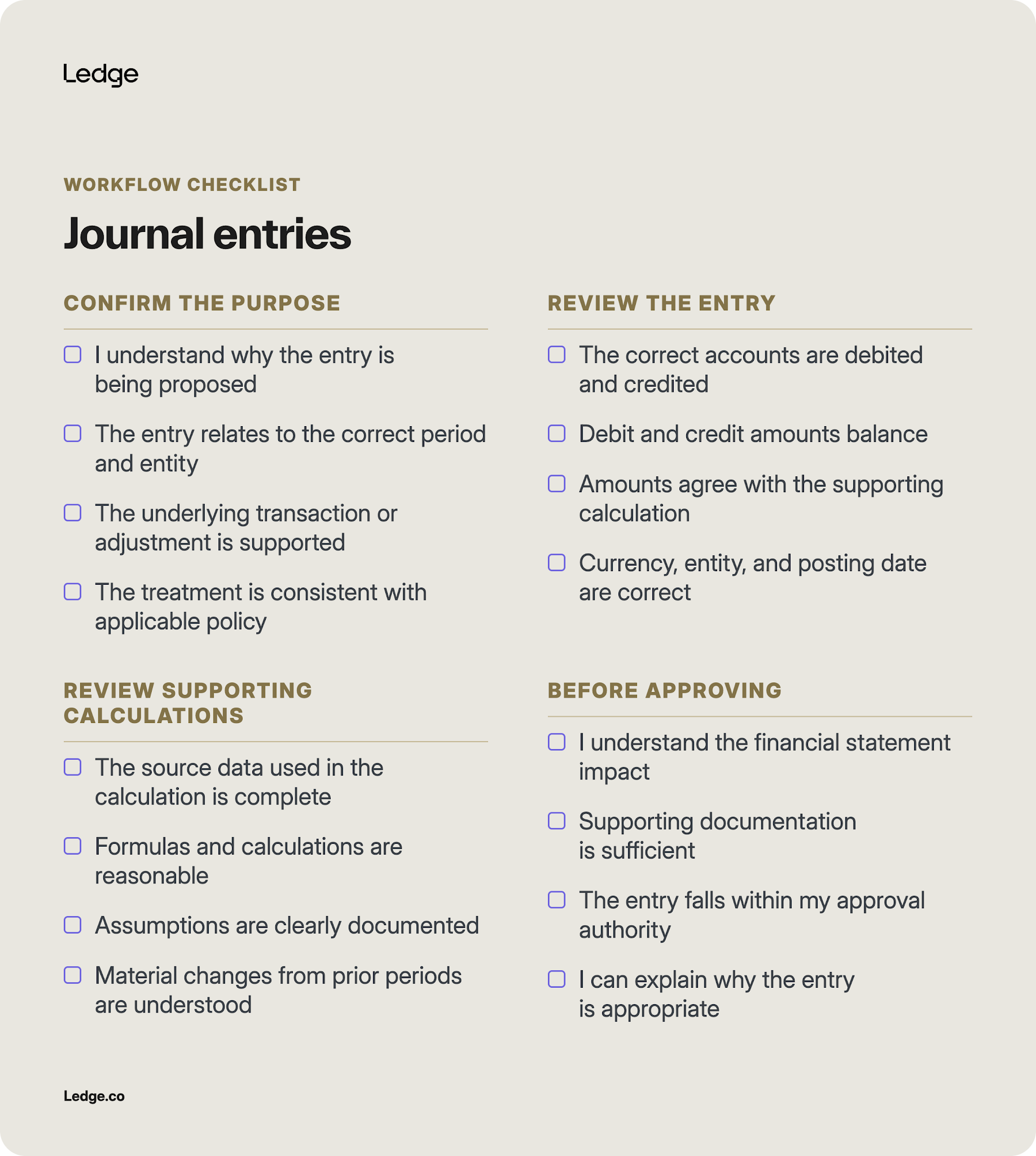
Confirm the purpose. Before approving an AI-prepared journal entry, make sure you understand why the entry is being proposed and which transaction or adjustment it represents. Confirm that it relates to the correct accounting period and entity, is supported by the underlying business activity, and follows applicable accounting policies.
Review the entry. Verify that the correct accounts are being debited and credited, that the amounts balance, and that they agree with the supporting calculations. Check account classifications, currency and entity assignments, and the proposed posting date. The journal entry description should clearly explain the purpose of the entry and provide enough context for future reviewers.
Review supporting calculations. Confirm that the source data used to prepare the entry is complete and that formulas, calculations and assumptions are reasonable and documented. For estimates, accruals and allocations, verify that the appropriate accounting methodology has been applied consistently. Investigate material changes from prior periods and confirm that any differences can be explained.
Before approving. Consider the journal entry's impact on the financial statements and whether the supporting documentation provides sufficient evidence for approval. Confirm that significant estimates or judgments have received the appropriate level of review and that the entry falls within your approval authority. You should be able to explain the accounting treatment, substantiate the amounts and defend the decision to approve the entry.
Working papers
Working papers provide the evidence, calculations and documentation behind accounting conclusions. AI-generated working papers should be reviewed not only for numerical accuracy, but also for whether another reviewer or auditor can understand how the conclusion was reached.
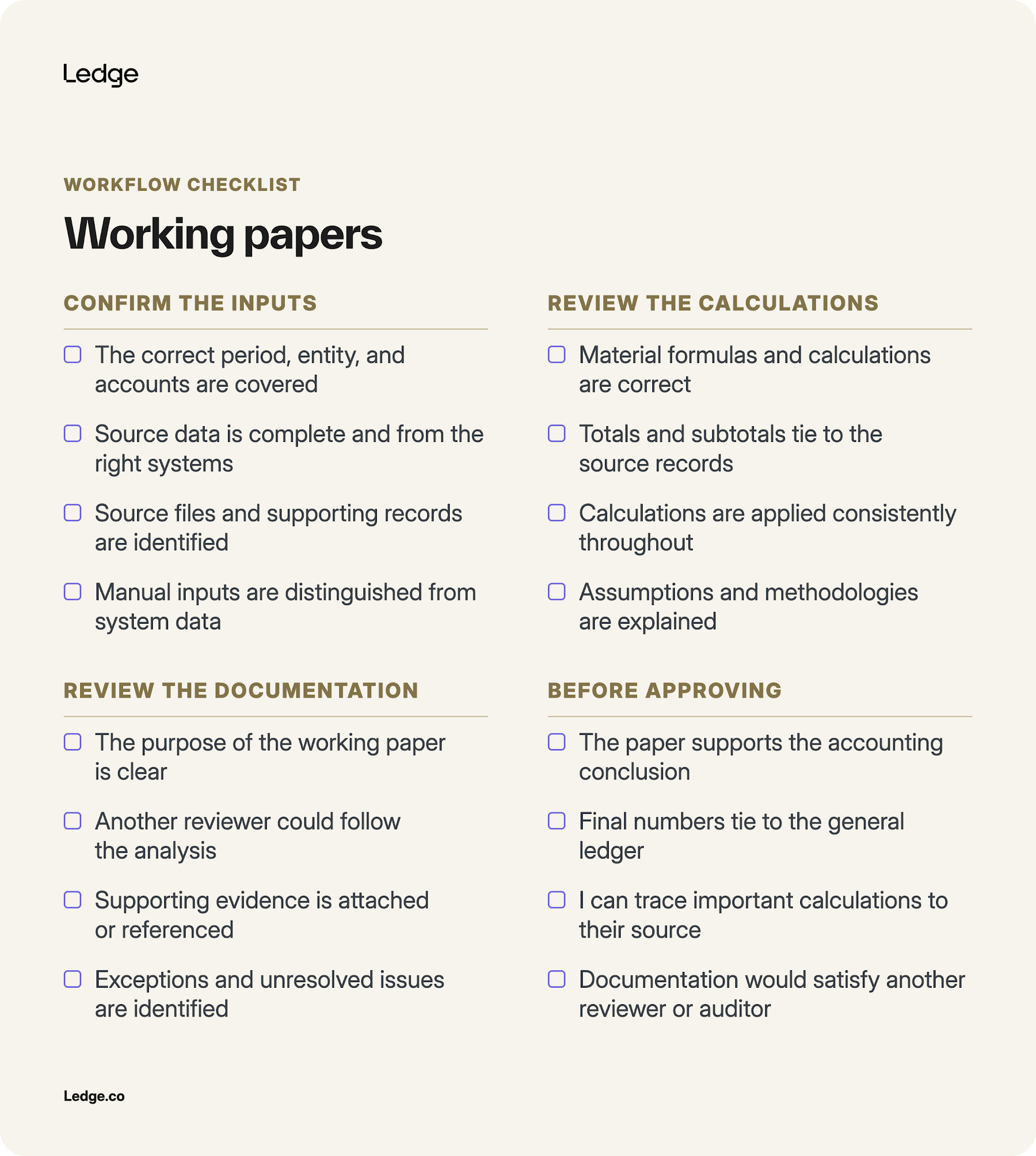
Confirm the inputs. Before approving an AI-prepared working paper, verify that it covers the correct accounting period, entity and accounts. Confirm that the source data is complete and comes from the appropriate systems, with all supporting files and records clearly identified. Manual inputs should be distinguishable from system-generated data so reviewers can understand where information originated and how it was used.
Review the calculations. Check that material formulas and calculations are accurate and that totals and subtotals agree with the relevant source records. Verify that calculations are applied consistently throughout the working paper and that any assumptions or methodologies are clearly explained. Changes from prior-period methodologies should be documented and supported by an appropriate rationale.
Review the documentation. Confirm that the working paper clearly communicates its purpose, analysis and accounting conclusions. Supporting evidence should be attached or referenced, with material judgments, exceptions and unresolved issues documented. Another reviewer should be able to follow the analysis without recreating the work, and the final approved version should be clearly distinguishable from earlier drafts.
Before approving. Evaluate whether the working paper provides sufficient support for the accounting conclusion and whether the final amounts reconcile to the general ledger or other relevant financial records. Confirm that important calculations can be traced to their sources and that the documentation is complete enough to support an independent review or audit. You should be comfortable explaining how the working paper supports the final accounting treatment.
Flux analysis
Flux analysis helps accounting teams understand material changes in balances or financial results between periods. AI can identify movements and help generate explanations, but reviewers should confirm that those explanations reflect the actual business activity behind the numbers.
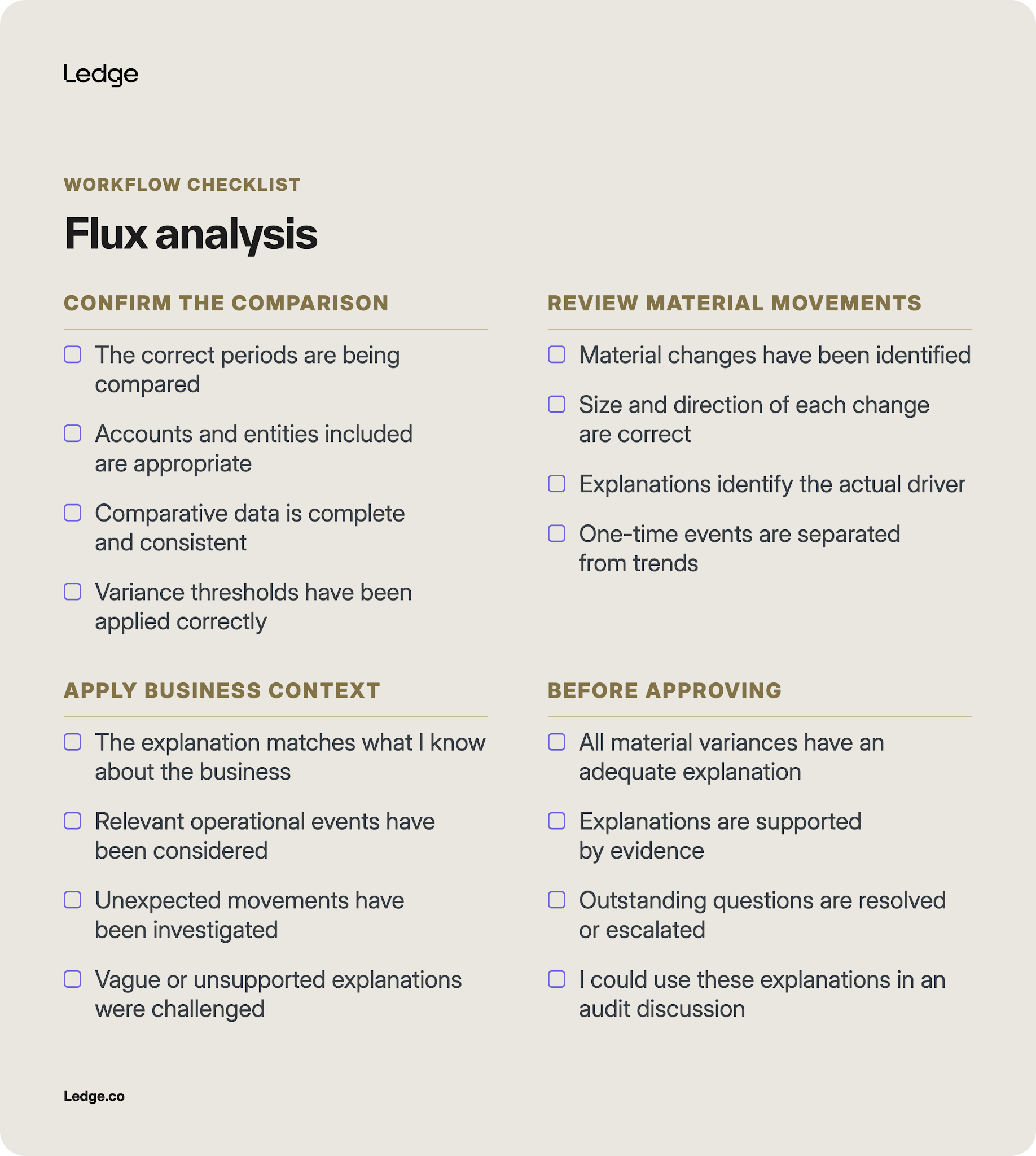
Confirm the comparison. Before approving an AI-prepared flux analysis, verify that the correct accounting periods, accounts and entities are being compared. Confirm that comparative data is complete and consistent between periods and that materiality or variance thresholds have been applied correctly. Any differences in the scope or basis of comparison should be clearly identified.
Review material movements. Check that all material variances have been identified and that the size and direction of each movement are calculated correctly. Review the explanations to confirm that they identify the underlying business drivers and are supported by transactions or other evidence. Distinguish one-time events from recurring trends, and identify movements resulting from reclassifications or accounting adjustments.
Apply business context. Evaluate whether the explanations align with your understanding of the business and its operating activities. Consider relevant events that may have influenced financial performance and investigate unexpected movements. Challenge explanations that appear vague, speculative or unsupported, and look for additional contributing factors when a single explanation does not fully account for the variance.
Before approving. Confirm that all material variances have adequate, evidence-based explanations and that outstanding questions have been resolved or escalated. The analysis should provide a clear and defensible account of what changed, why it changed and whether the movement requires further attention. You should be comfortable relying on these explanations in management discussions, financial reporting and audit reviews.
Cash application
Cash application involves matching incoming payments to the appropriate customer accounts, invoices or receivables. AI can automate much of the matching process, but reviewers should pay particular attention to uncertain matches, partial payments and unapplied cash.
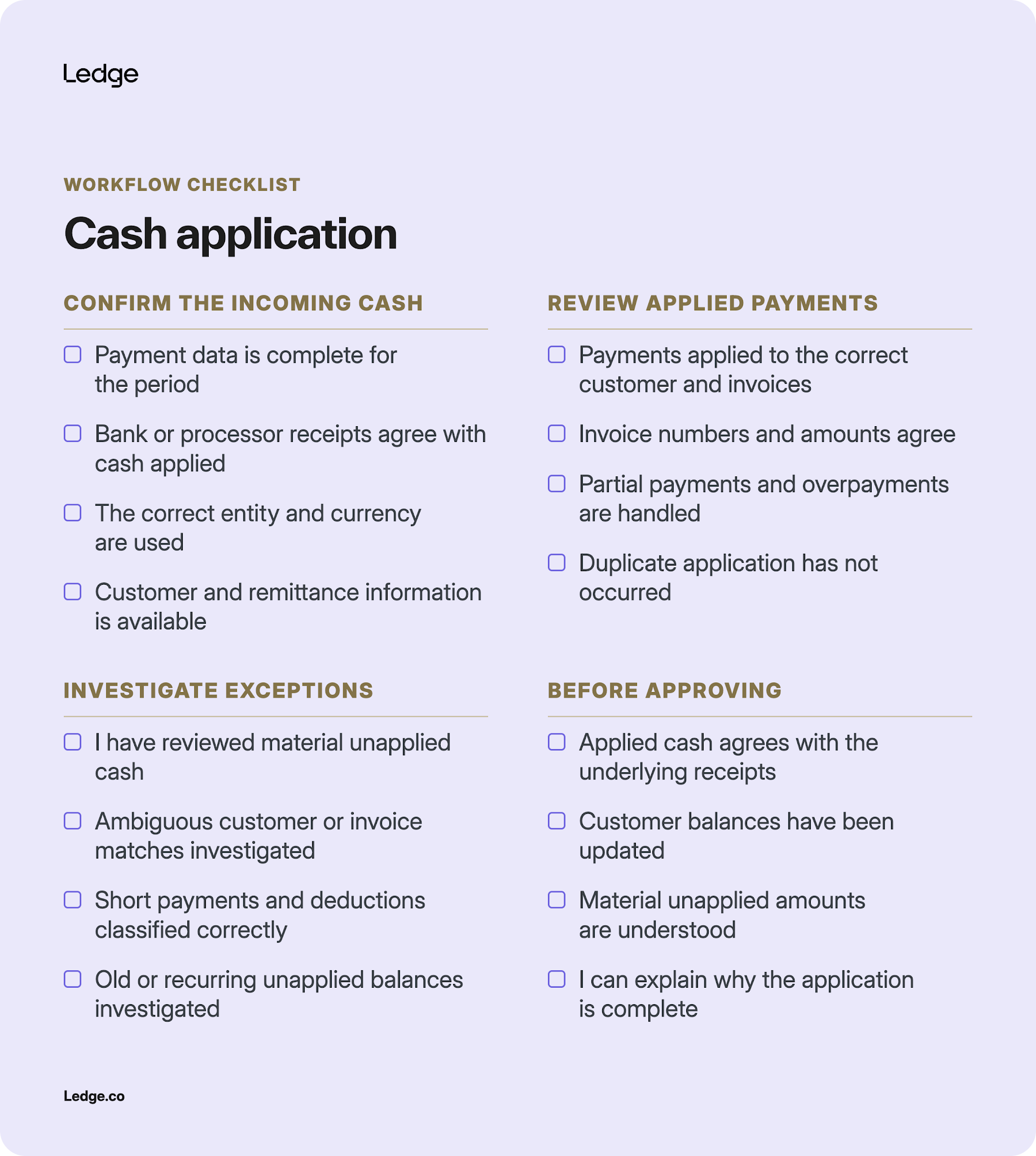
Confirm the incoming cash. Before approving AI-prepared cash application, verify that payment data is complete for the accounting period and that bank or payment processor receipts agree with the cash being applied. Confirm that the correct entity and currency are being used and that customer and remittance information is available where expected.
Review applied payments. Check that payments have been matched to the correct customers and invoices, with invoice numbers, amounts and other identifying information agreeing with the supporting records. Verify that partial payments, overpayments and payments covering multiple invoices have been handled and allocated appropriately. Review the results for duplicate applications or other errors that could affect customer balances.
Investigate exceptions. Review material unapplied cash and investigate ambiguous customer or invoice matches. Confirm that short payments, deductions and foreign currency differences have been classified and treated appropriately. Payments with insufficient remittance information should be escalated when necessary, and older or recurring unapplied balances should be investigated to identify underlying issues.
Before approving. Confirm that applied cash agrees with the underlying receipts and that customer balances have been updated correctly. Material unapplied amounts should be understood, with exceptions resolved, documented or escalated as appropriate. You should be able to explain why the cash application is complete, accurate and supported by the available evidence.
Payment reconciliation
Payment reconciliation involves matching payment activity across sources such as payment processors, bank accounts and the ERP. Your review should confirm that transactions have been matched appropriately and that meaningful differences have been investigated.
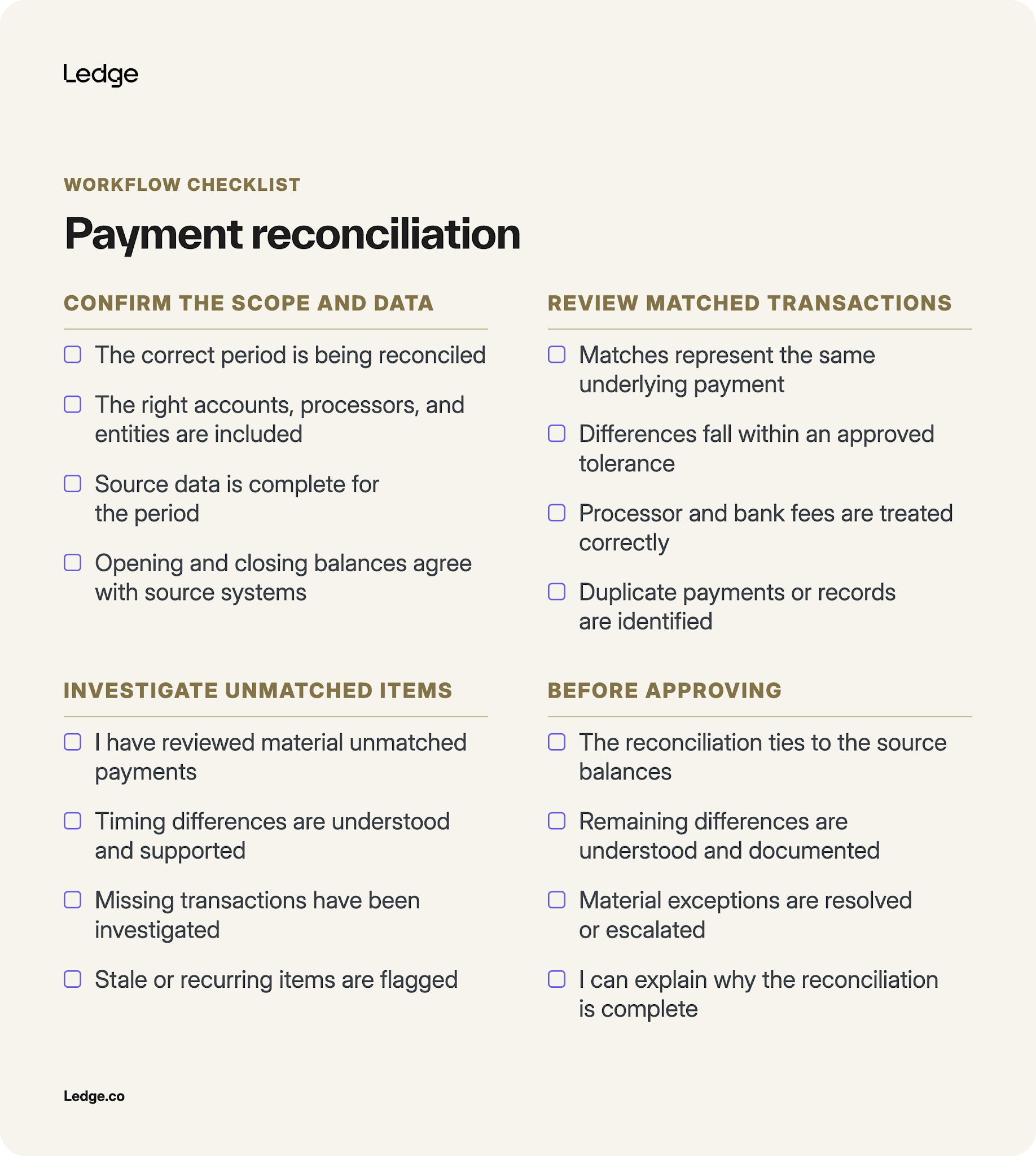
Confirm the scope and source data. Before approving an AI-prepared payment reconciliation, verify that it covers the correct accounting period, entities, bank accounts, payment processors and ERP accounts. Confirm that source data is complete and that opening and closing balances agree with the relevant systems. Check that transaction dates, currencies and identifiers are accurate and consistent across sources.
Review matched transactions. Verify that matched transactions represent the same underlying payment and that amounts agree or fall within approved tolerances. Review timing differences to confirm they are reasonable, and check that processor fees, bank fees and other expected deductions have been treated correctly. Pay particular attention to matches based on non-exact criteria and confirm that duplicate payments or records have been identified and addressed.
Investigate unmatched items. Review material unmatched payments and investigate missing transactions, timing differences and unexpected discrepancies. Confirm that timing differences are supported by the underlying payment activity and that unresolved items are documented or escalated appropriately. Stale or recurring unmatched transactions should receive additional scrutiny to identify potential processing errors or broader reconciliation issues.
Before approving. Confirm that the reconciliation agrees with the relevant source balances and provides a complete, reasonable account of payment activity for the period. Any remaining differences should be understood, supported by evidence and documented. Material exceptions should be resolved or appropriately escalated, and you should be able to explain why the reconciliation is accurate and ready for approval.
Account reconciliation
Account reconciliation involves comparing a general ledger balance with the records, schedules or other evidence that support it. Your review should establish that the balance is accurate and that reconciling items are legitimate, understood and appropriately treated.
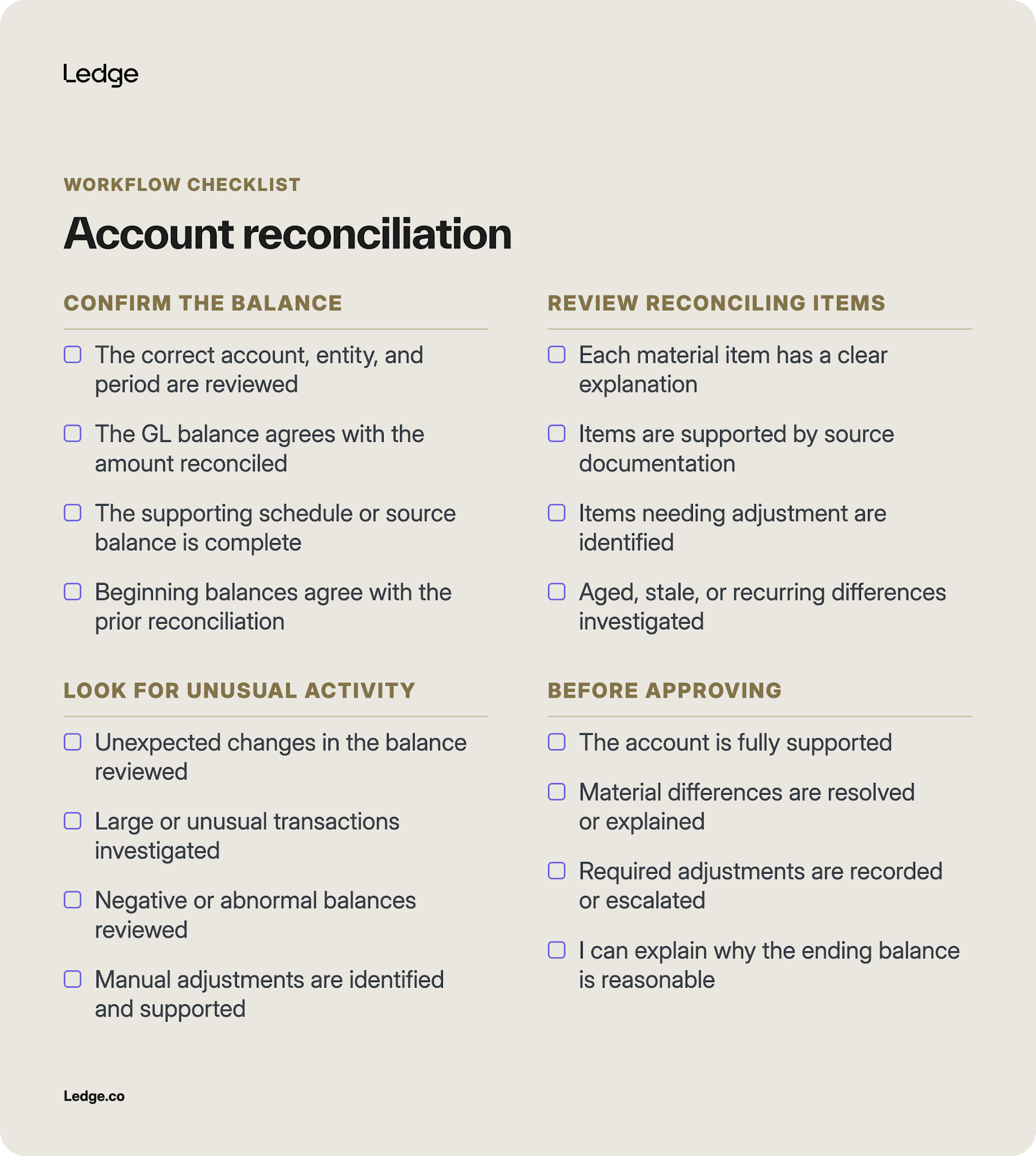
Confirm the balance. Before approving an AI-prepared account reconciliation, verify that it covers the correct account, entity and accounting period. Confirm that the general ledger balance agrees with the amount being reconciled and that supporting schedules or source records are complete. Where applicable, beginning balances should agree with the prior approved reconciliation, and changes during the period should be consistent with the underlying account activity.
Review reconciling items. Examine material reconciling items to confirm that each has a clear explanation and is supported by appropriate documentation. Review timing differences for reasonableness and identify any items requiring an accounting adjustment. Pay particular attention to aged or stale reconciling items, and investigate recurring differences that may indicate broader process or control issues.
Look for unusual activity. Review unexpected balance movements, large or unusual transactions, and negative or abnormal balances where relevant. Confirm that manual adjustments are clearly identified and supported by evidence. Consider whether the ending balance is consistent with your understanding of the business and investigate activity that appears inconsistent with expectations.
Before approving. Confirm that the account balance is fully supported and that material differences have been resolved or adequately explained. Required adjustments should be recorded or escalated to the appropriate reviewer. You should be able to explain why the ending balance is accurate, reasonable and supported by the reconciliation.
A final question before approval
Across any AI-prepared accounting workflow, the standard is whether you have enough reliable evidence to make and defend an informed approval decision. You do not need to reproduce every preparation step, but you should understand the work, evaluate its accuracy and investigate meaningful exceptions.
Before approving, consider whether you understand what was prepared and why, whether the result makes sense, and whether you can trace it to reliable supporting evidence. Confirm that significant exceptions have been investigated and that important assumptions and professional judgments are documented.
The ultimate test is whether you could explain and defend your approval decision to another reviewer or auditor.
Protect human accounting judgment
The goal is not to recreate every step the AI completed. It is to build a review process that gives you confidence in the result: understanding what was prepared, checking the underlying evidence, investigating meaningful exceptions and knowing when something needs a closer look. That same foundation applies across journal entries, working papers, reconciliations, flux analysis and cash application.
As your team becomes more comfortable reviewing AI-generated work, these steps can become part of the normal close process rather than a separate layer of oversight. The review may become faster over time, but the standard stays the same: approve the work when you have enough evidence to understand, explain and stand behind the result.
Adapt these standards to your organization's policies
These standards are intended as general guidance and should be adapted to your organization’s specific accounting policies, internal controls, risk tolerance, materiality thresholds, approval procedures and documentation requirements.
Use this resource as a starting point for developing or refining your own review procedures. Before implementing them, seek review and approval from the appropriate internal stakeholders and professional advisors, including accounting, audit, legal or compliance experts as applicable.
Your organization’s established policies and applicable accounting and regulatory requirements should always take precedence.
Frequently asked questions (FAQ)
1. How should accountants review automated accounting work?
Start by confirming the output’s purpose, scope, and applicable accounting policies. Then verify the source data is complete, assess whether results make sense against business activity, and investigate flagged exceptions as well as issues the system may have missed. Finally, confirm the work traces to supporting evidence, check your approval authority, and document your decision.
2. Do accountants need to recreate automated work before approving it?
Not on an ongoing basis, but teams should start with a parallel close period. During that period, accountants prepare the work as usual and compare it against the AI output to validate accuracy and build reviewer confidence. After that, reviewers don’t need to reproduce every step. They should understand the output, check the underlying evidence, investigate meaningful exceptions, and be able to defend their approval decision.
3. Who is responsible for a journal entry prepared using automation or AI?
The reviewer. AI can prepare proposed journal entries, but the person approving remains responsible for determining whether each entry is appropriate. That includes the mechanics, such as accounts, amounts, entity, and posting date, and the accounting judgment behind them, including whether estimates and allocations follow policy and fall within the reviewer’s approval authority.
4. What should reviewers check in an automated reconciliation?
Confirm the scope, periods, and source balances first. Then verify that matched transactions represent the same underlying activity, with extra scrutiny on matches made on non-exact criteria. Investigate unmatched items, timing differences, and fees, and give stale or recurring reconciling items additional attention, since they can signal broader process or control issues.
5. How should accountants evaluate AI-generated flux analysis explanations?
Check that all material variances were identified and calculated correctly, then confirm each explanation names a real business driver supported by transactions or other evidence. Challenge explanations that seem vague, speculative, or incomplete, and separate one-time events from recurring trends. The explanations should hold up in management discussions and audit reviews.
More resources
Disclaimer: This content is provided for general educational and informational purposes only and should not be relied upon as accounting, financial, legal, tax, or other professional advice. Readers should consult their organization's internal subject matter experts and qualified professional advisors before making decisions based on this information. Any examples, estimates, or performance outcomes are illustrative only, and actual results will vary depending on an organization's specific circumstances, systems, controls, and implementation.
See how to automate your month-end close in weeks, not months
Set up a personalized demo with Ledge