

If your manager or team lead is asking you to spend less time preparing reconciliations, journal entries and other month-end close tasks, and more time reviewing AI-generated work, you may be wondering what this means for your role.
The goal is to expand your team's capabilities, building on the accounting knowledge, skills and judgment you already bring to your work. Still, the transition may not feel easy. Moving from preparing the work yourself to reviewing what AI has prepared requires a different way of thinking, and there's a learning curve. You'll need to develop confidence in knowing what to check, when to investigate further and when there's enough evidence to approve the result.
Developing that confidence takes time and practice. You should continue to question AI-generated outputs, examine the details and apply your professional judgment. The difference is in how you use those skills as more of the preparation work becomes automated.
The following guidance is written for accountants making this transition, with practical tips for reviewing and approving AI-generated work responsibly. If you're an accounting manager or team lead, you can share this articledirectly with your team to help them quickly ramp on their review skills.
Recognize that reviewing is a different skill than preparing
When you prepare a reconciliation, journal entry or working paper yourself, you follow the process from beginning to end. You gather the source data, perform calculations, apply accounting rules and confirm that the numbers tie out.
When AI handles the preparation, you're starting with a completed output. Your job is to evaluate whether the result is accurate, reasonable and supported by evidence.

That means asking questions such as:
- Does the result make sense given what happened in the business?
- Is the underlying data complete and reliable?
- Were the appropriate accounting policies and procedures followed?
- Are there unusual transactions or unexpected changes that need a closer look?
- Is there enough supporting evidence to approve the work?
- Are there unresolved issues that require further investigation or escalation?
As you get familiar with reviewing AI-generated work, draw on your experience preparing similar tasks. Think about the checks you would normally perform, the errors you've encountered and the information you would need to feel confident in the result.
Your preparation experience gives you a valuable foundation for reviewing. The skill you're developing is knowing how to apply that knowledge to work you didn't prepare yourself.
Start with familiar, lower-risk work
When you're first learning to review AI-generated work, start with accounting processes you already know well. Familiarity gives you a useful point of comparison. You know what the finished work should look like, which exceptions tend to come up and where mistakes are most likely to happen.
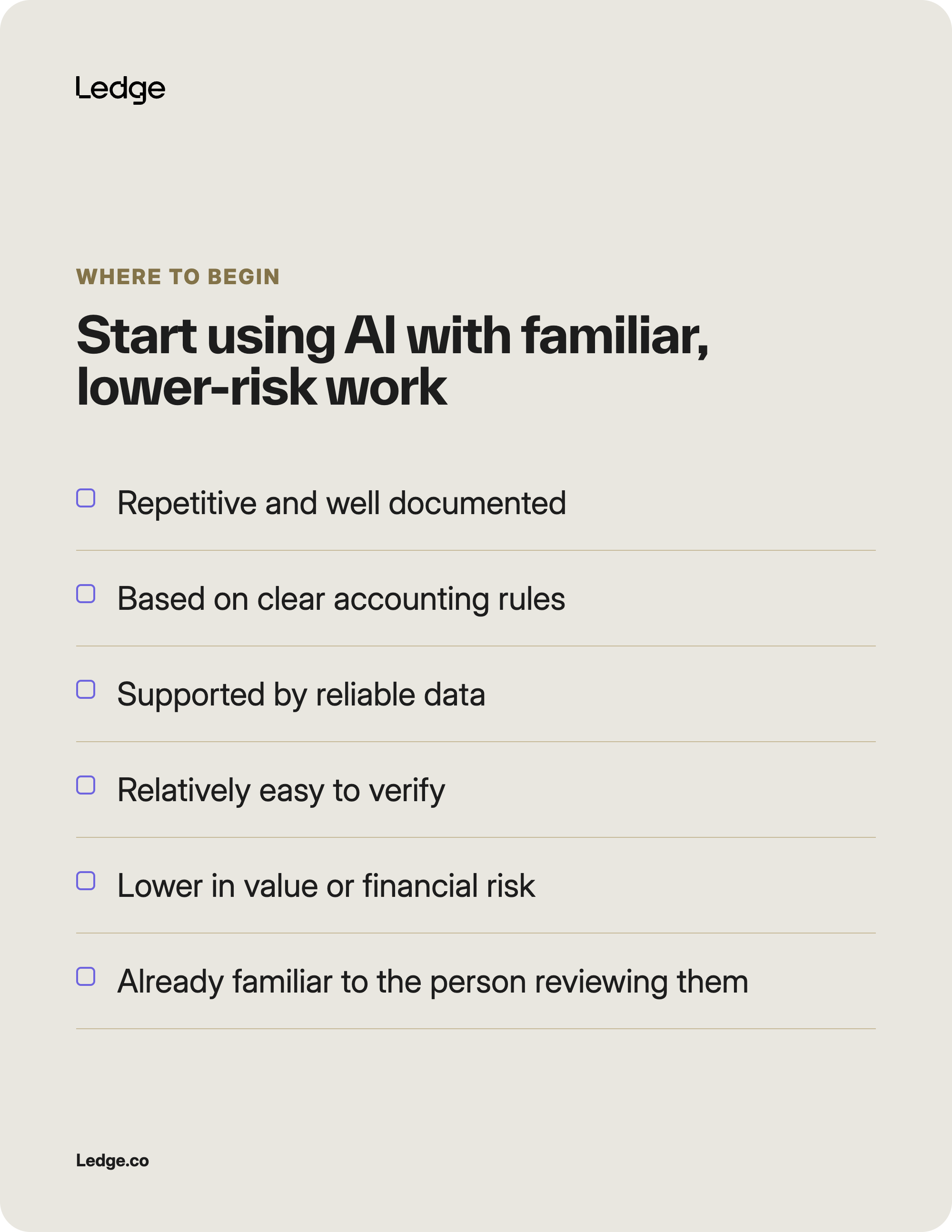
Good starting points include workflows that are:
- Repetitive and well documented
- Governed by clear accounting rules
- Supported by reliable source data
- Easy to check against existing records
- Lower in value or financial risk
- Already familiar to you
For example, you might start by reviewing a straightforward payment reconciliation, where you can verify matches against bank and processor records. As you gain experience, you can move toward more complex tasks involving estimates, unusual transactions or significant accounting judgment.
Starting with simpler work gives you a lower-risk environment to practice reviewing AI-generated outputs, investigate exceptions and build confidence in your decisions. The same standards for accuracy, documentation and approval still apply.
Know what to look for when reviewing AI-generated work
“Review the output” can feel like a vague instruction, especially when you're used to preparing the work yourself.
You might be tempted to perform a quick reasonableness check or, at the other extreme, redo the entire process manually to make sure nothing was missed. Neither approach gives you a complete picture of whether the work is ready for approval.

Before starting your review, make sure you understand:
- Which data points and calculations need to be verified
- What supporting documentation should be available
- Which variances fall within acceptable thresholds
- What types of exceptions require further investigation
- When an item should be corrected, returned or escalated
- What needs to be documented before approval
- Which decisions require additional approval from a manager or controller
If your team's review expectations aren't clear, ask your manager or controller to walk you through them. Reviewing a few examples together can help you understand what a complete review looks like and how to handle situations that require judgment.
A structured review checklist can also help you build consistent habits. As you become more familiar with the workflow, you'll get better at recognizing which details need attention and when you have enough evidence to make a well-supported decision.
Focus on validating rather than recreating the work
When reviewing AI-generated work, your first instinct might be to redo the calculations yourself. That's understandable, especially when you're responsible for approving the result and want to make sure nothing was missed.
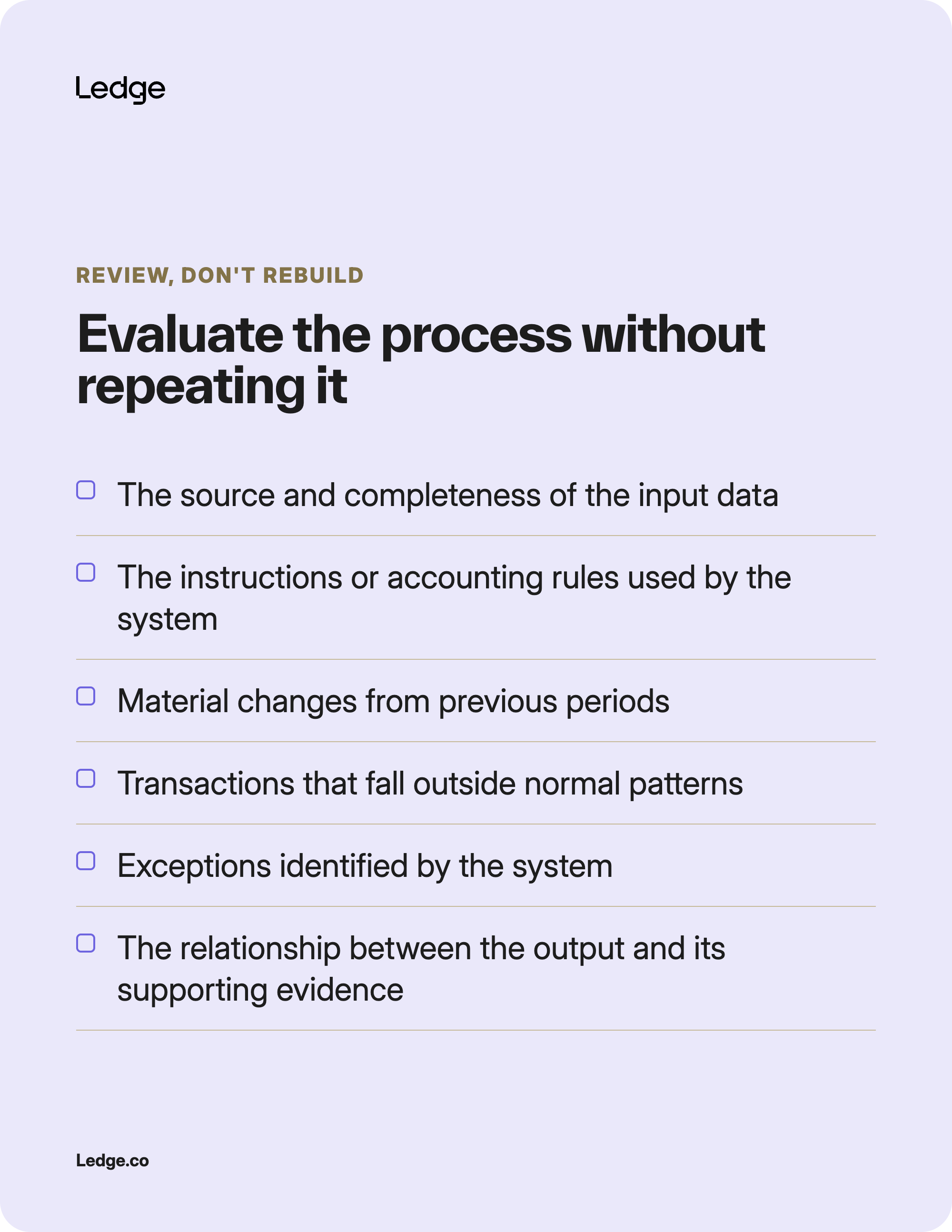
However, recreating every step manually defeats much of the purpose of automation. Instead, focus on verifying that the work was completed correctly and that the results are supported by reliable evidence.
Depending on the workflow, your review may include checking:
- The source and completeness of the input data
- The accounting rules and instructions applied by the AI system
- Material changes from previous periods
- Transactions that fall outside normal patterns
- Exceptions identified by the system
- Corrections or changes made after the initial review
- Whether the final output agrees with its supporting documentation
Think of this as evaluating whether the process and its results are reliable. You may still need to recalculate specific amounts or investigate individual transactions, particularly when something looks unusual or involves significant judgment.
The goal is to direct your attention toward the areas that need verification, rather than automatically repeating work the system has already completed. Your organization's review and control requirements should guide how much independent checking is necessary.
Make sure you can trace the work back to its source
Before approving AI-generated work, you should be able to understand how the system reached its conclusion. That means having access to the underlying evidence, rather than receiving a final number without context.
For a proposed journal entry, that might include:
- Source transactions, invoices, contracts or supporting files
- Calculations, allocation methods and account mappings
- Relevant accounting policies and assumptions
- Similar entries from previous periods
- Records of changes and prior approvals
Being able to trace an output back to its source makes it easier to investigate discrepancies, explain your decisions and support an audit. If important evidence is missing, request it before moving forward.
Learn from exceptions
Exceptions are opportunities to strengthen your accounting judgment. When something unusual appears, investigate what happened, why the system flagged it and whether the proposed treatment is appropriate.
Ask yourself whether the correct accounting rules were applied, whether additional business context is needed and how similar situations should be handled in the future.
Discuss unfamiliar exceptions with colleagues and share recurring issues with your team. Over time, this experience will help you recognize patterns, spot potential errors and identify opportunities to improve the workflow.
Build your skills and responsibilities gradually
You don't need to begin by independently approving complex accounting work. Start by comparing AI-generated outputs with previously completed work, reviewing routine transactions and documenting exceptions.
As you become more comfortable, you can progress toward making approval recommendations, handling more complex workflows and approving items within your authorized thresholds.
Continue strengthening your accounting fundamentals along the way. Review supporting calculations, study relevant policies and ask questions about how transactions affect the financial statements. Understanding how the work is prepared will make you a more effective reviewer.
Speak up and help improve the process
Your experience with day-to-day accounting work gives you valuable insight into where AI-assisted workflows may need improvement.
If you notice recurring errors, missing information or unclear assumptions, raise them with your team. You can help identify additional checks, suggest better rules and flag situations that require human judgment.
You should also feel comfortable questioning an AI-generated result, requesting additional evidence or escalating a concern. Your responsibility is to make a well-supported decision, even when that means pausing the workflow.
Adapt this guidance to your organization's needs
Every accounting team works differently. The tips in this article is a starting point, and your review process should reflect your organization's accounting policies, internal controls, materiality thresholds and approval requirements.
Work with your manager or controller to understand what you're responsible for reviewing, what evidence you need and when to escalate an issue. Your organization's established procedures should always take precedence, and any changes to review practices should be evaluated by the appropriate accounting, audit or compliance advisors before implementation.
Moving toward a different kind of ownership
As AI takes on more repetitive preparation work, your accounting expertise becomes increasingly important in evaluating results, investigating exceptions and making informed decisions.
Building confidence in these responsibilities takes practice. With reliable evidence, clear review standards and opportunities to learn, you can develop the skills to review AI-generated work effectively while continuing to strengthen your accounting foundation.