


AI can help your accounting team prepare working papers, run flux analyses, complete reconciliations, and apply cash efficiently. But the final output still needs thoughtful human review.
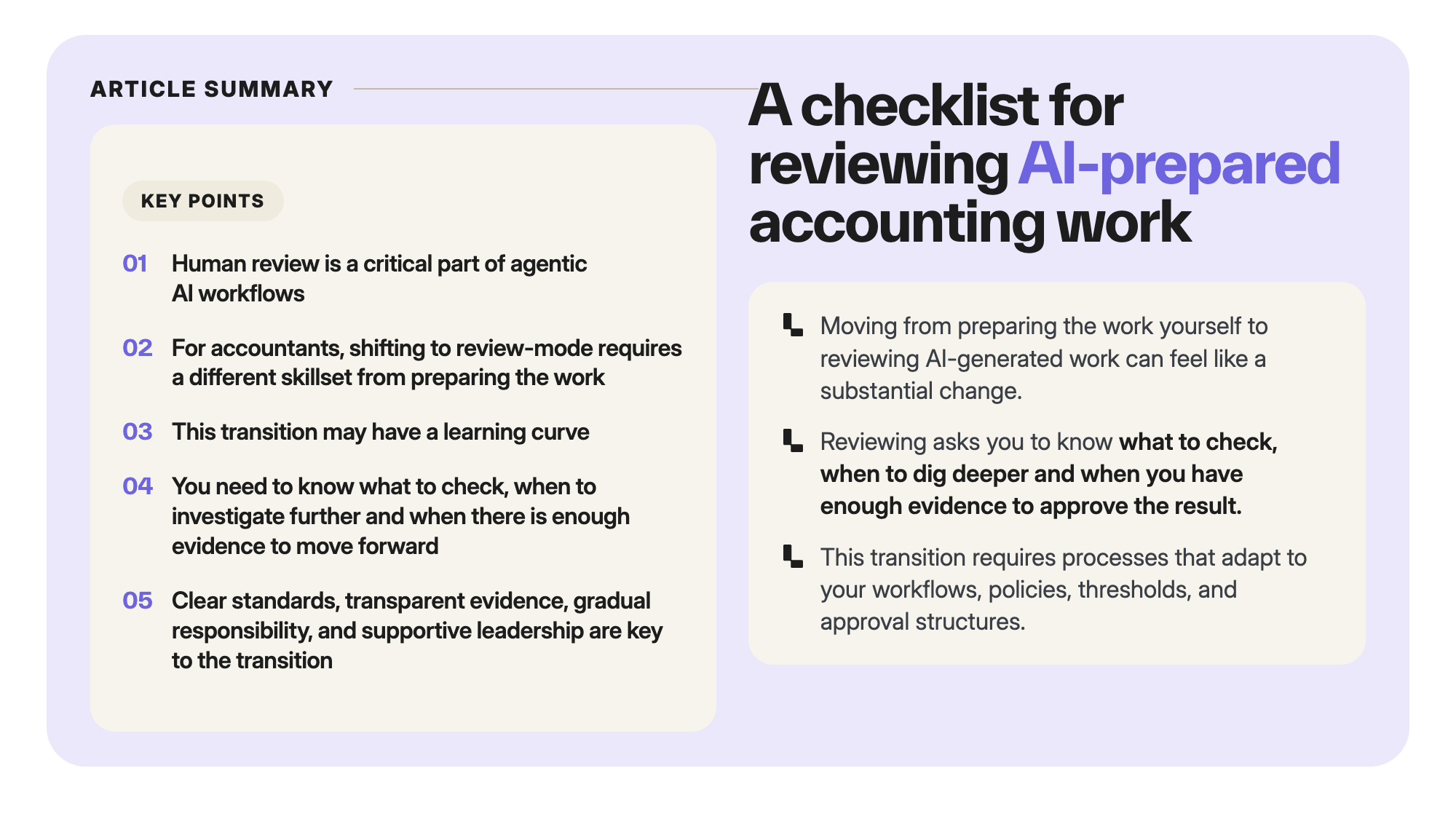
Moving from preparing the work yourself to reviewing and approving AI-generated work can feel like a major change. When you build something from the ground up, you know where the numbers came from and how each step was completed. Reviewing work produced by AI asks you to develop a different kind of confidence: knowing what to check, when to dig deeper and when you have enough evidence to approve the result.
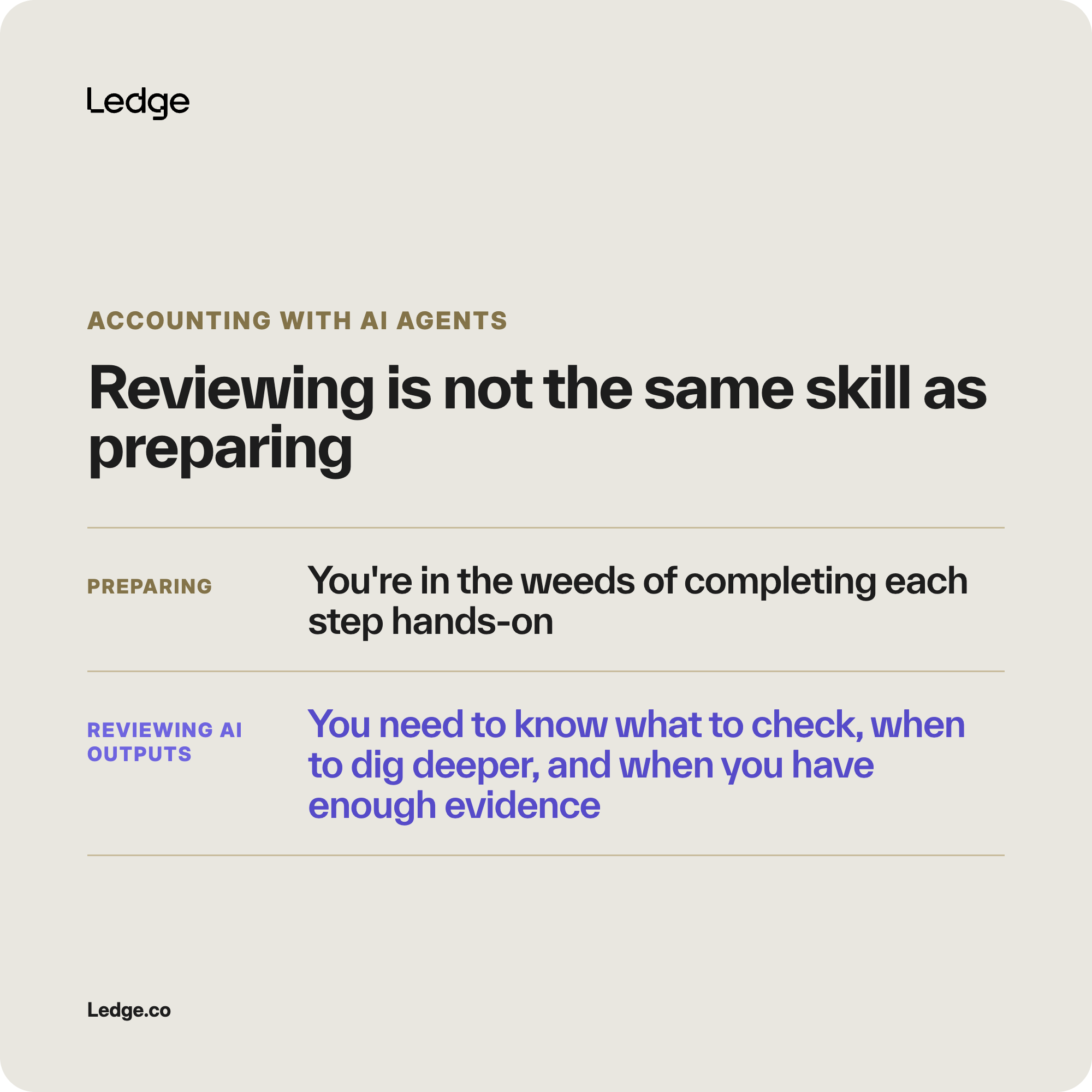
That shift takes time and practice. You are not expected to trust every output automatically or recreate the entire process by hand.
The checklists below can help you and your team navigate the transition. You can adapt it to fit your workflows, accounting policies, risk levels, materiality thresholds, approval structure and documentation requirements. As your team gains experience, you can continue updating it based on the exceptions, risks and lessons you encounter.
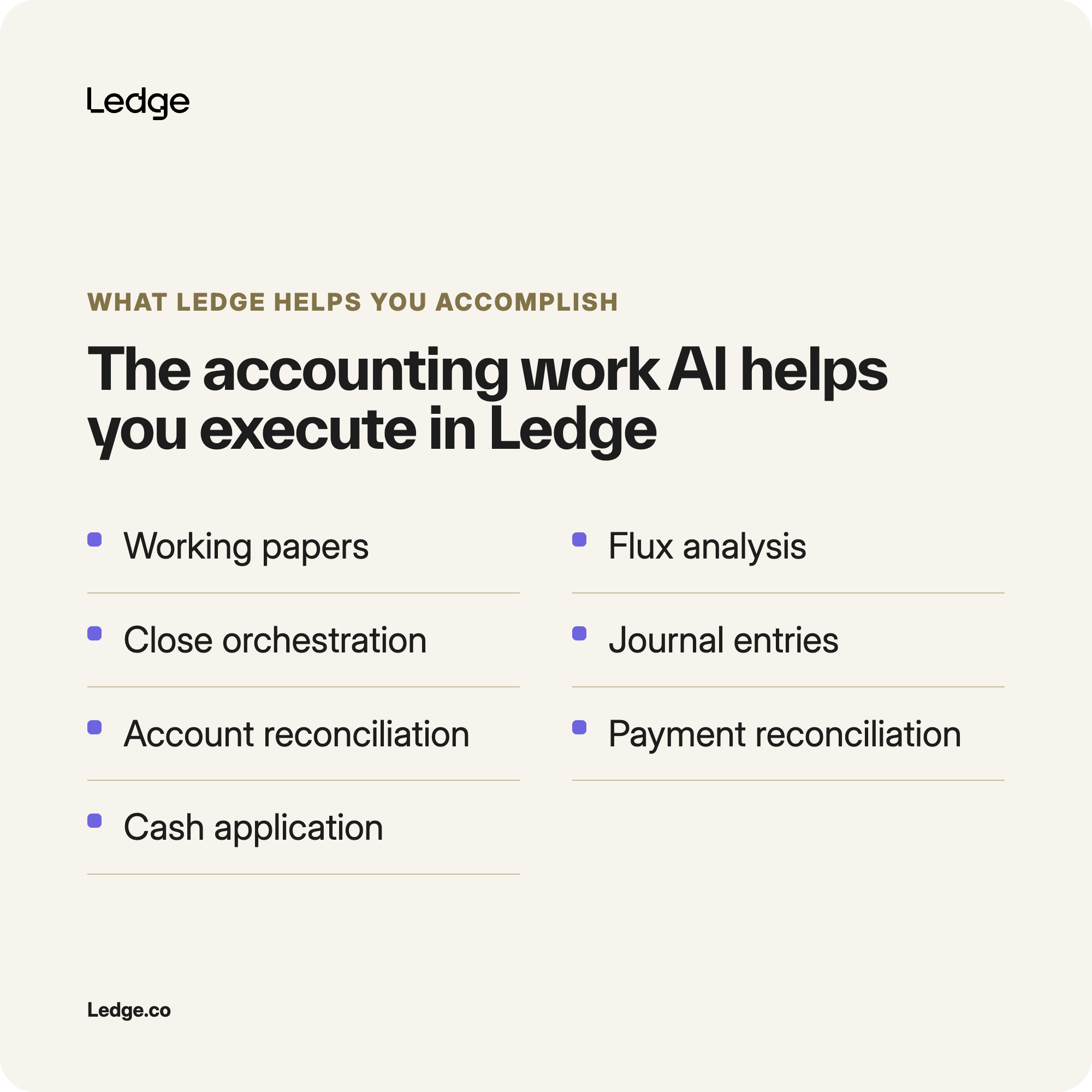
Below, you'll find checklists for the key accounting tasks that Ledge helps you execute:
- Working papers
- Flux analysis
- Close orchestration
- Journal entries
- Account reconciliation
- Payment reconciliation
- Cash application
High-level process checklist
This section covers the core review skills you’ll use across different types of accounting workflows you're reviewing and approving.
Understand the output
- I understand the purpose of this work
- I know which accounting period, entity and accounts are included
- I understand what the AI system was asked to prepare
- I know which accounting policy, rule or procedure should apply
Check the underlying data
- The source data is complete for the period being reviewed
- The data comes from the correct systems, files and accounts
- I have checked for missing, duplicated or incomplete records
- The dates, entities, currencies and account mappings appear correct
- Any manual inputs or adjustments are clearly identified
Review the result
- The final output makes sense based on the underlying business activity
- Balances, calculations and classifications appear reasonable
- Material changes from the prior period have been explained
- The output is consistent with relevant accounting policies
- I have reviewed any assumptions used to produce the result
- I have checked for unusual transactions, patterns or amounts
Investigate exceptions
- I have reviewed every exception flagged by the system
- I have looked for important issues the system may not have flagged
- Each exception has been resolved, documented or escalated
- Corrections made during the review are visible in the audit trail
- Repeated exceptions have been raised as possible workflow or control issues
Confirm the supporting evidence
- I can trace the output back to its source data
- Required invoices, contracts, reports or working papers are attached
- The supporting evidence agrees with the final output
- Any calculations or allocation methods can be explained
- The documentation would allow another reviewer or auditor to follow the work
Apply professional judgment
- I am not approving the work only because the system produced it
- I have paused to investigate anything that does not look right
- I have considered whether additional business context is needed
- I have challenged assumptions that appear unclear or unsupported
- I am comfortable explaining why this output is reasonable
Check your authority
- This item falls within my approval authority
- Materiality and approval thresholds have been met
- Any required secondary review has been completed
- Items outside my authority have been escalated to the appropriate person
Document the decision
- My review steps are documented
- Any exceptions, corrections and judgments are explained
- The final version is clearly identified
- I have recorded whether the work was approved, rejected or returned for changes
Before you approve
Ask yourself:
- Do I understand what was prepared and why?
- Does the result make sense?
- Can I trace it back to reliable evidence?
- Have all meaningful exceptions been resolved?
- Can I explain and defend my approval decision?
Approve the work only when you have enough evidence to make a well-supported decision. You do not need to recreate every preparation step, but you should understand the output, investigate what matters and document your judgment.
Accounting workflow checklists
The checklists below are designed to help accounting teams review common workflows supported by AI agents. Adapt them to your accounting policies, risk levels, materiality thresholds, approval structure and documentation requirements.
Journal entries
AI can help prepare proposed journal entries, but the reviewer remains responsible for determining whether the entry is appropriate. Your review should cover both the mechanics of the entry and the accounting judgment behind it.
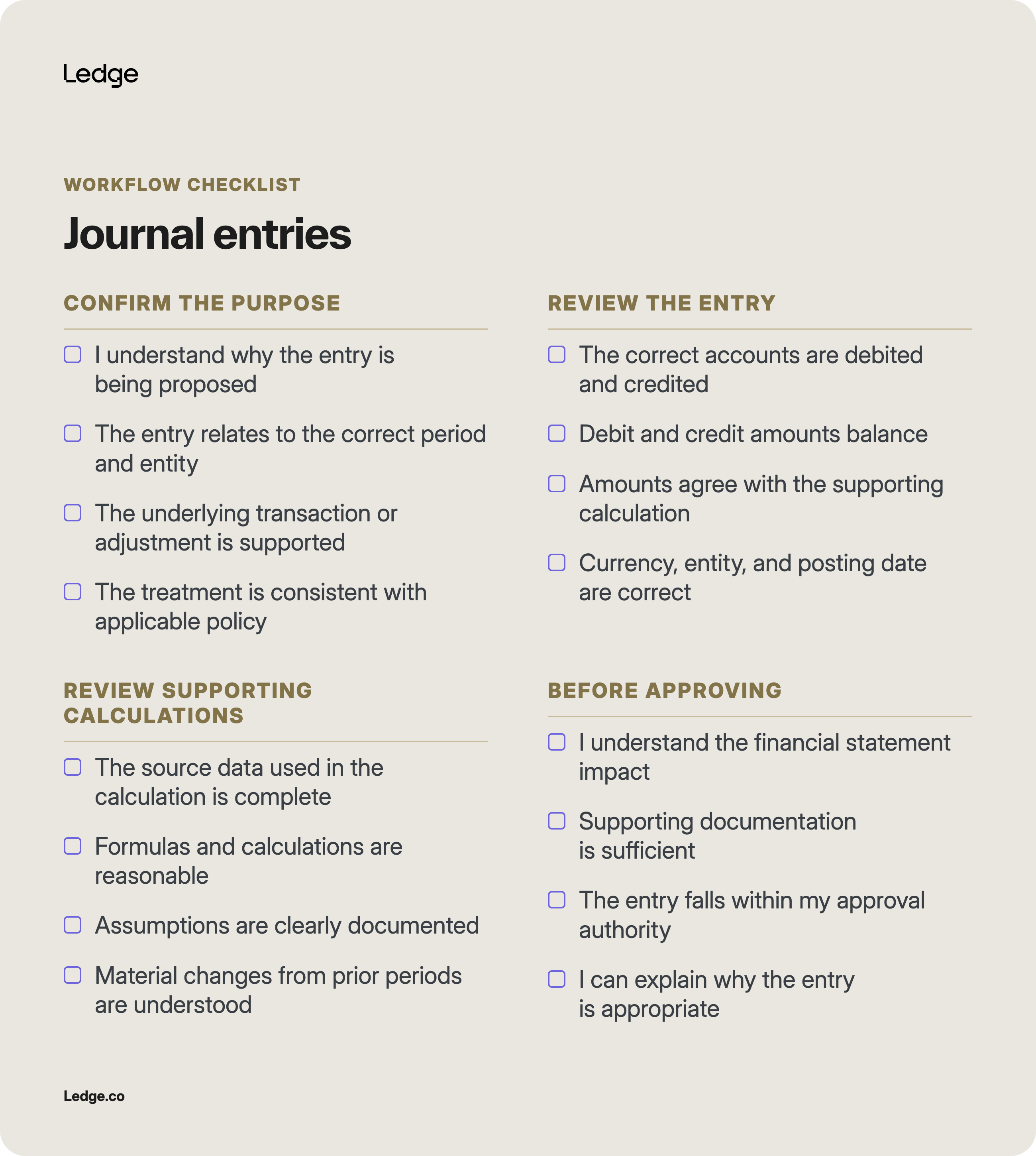
Confirm the purpose
Iunderstand why the journal entry is being proposed- The entry relates to the correct period and entity
- The underlying transaction or adjustment is supported
- The accounting treatment is consistent with applicable policy
Review the entry
- The correct accounts are being debited and credited
- Debit and credit amounts balance
- The amounts agree with the supporting calculation
- Account classifications are appropriate
- Currency and entity assignments are correct
- The posting date is appropriate
- The journal entry description clearly explains the purpose of the entry
Review supporting calculations
- The source data used in the calculation is complete
- Formulas and calculations are reasonable
- Assumptions are clearly documented
- Estimates, accruals or allocations follow the appropriate methodology
- Material changes from prior periods are understood
Before approving
- I understand the financial statement impact of the entry
- Supporting documentation is sufficient
- Any significant judgment or estimate has received the appropriate level of review
- The entry falls within my approval authority
- I can explain why the journal entry is appropriate
Working papers
Working papers provide the evidence, calculations and documentation behind accounting conclusions. AI-generated working papers should be reviewed not only for numerical accuracy, but also for whether another reviewer or auditor can understand how the conclusion was reached.
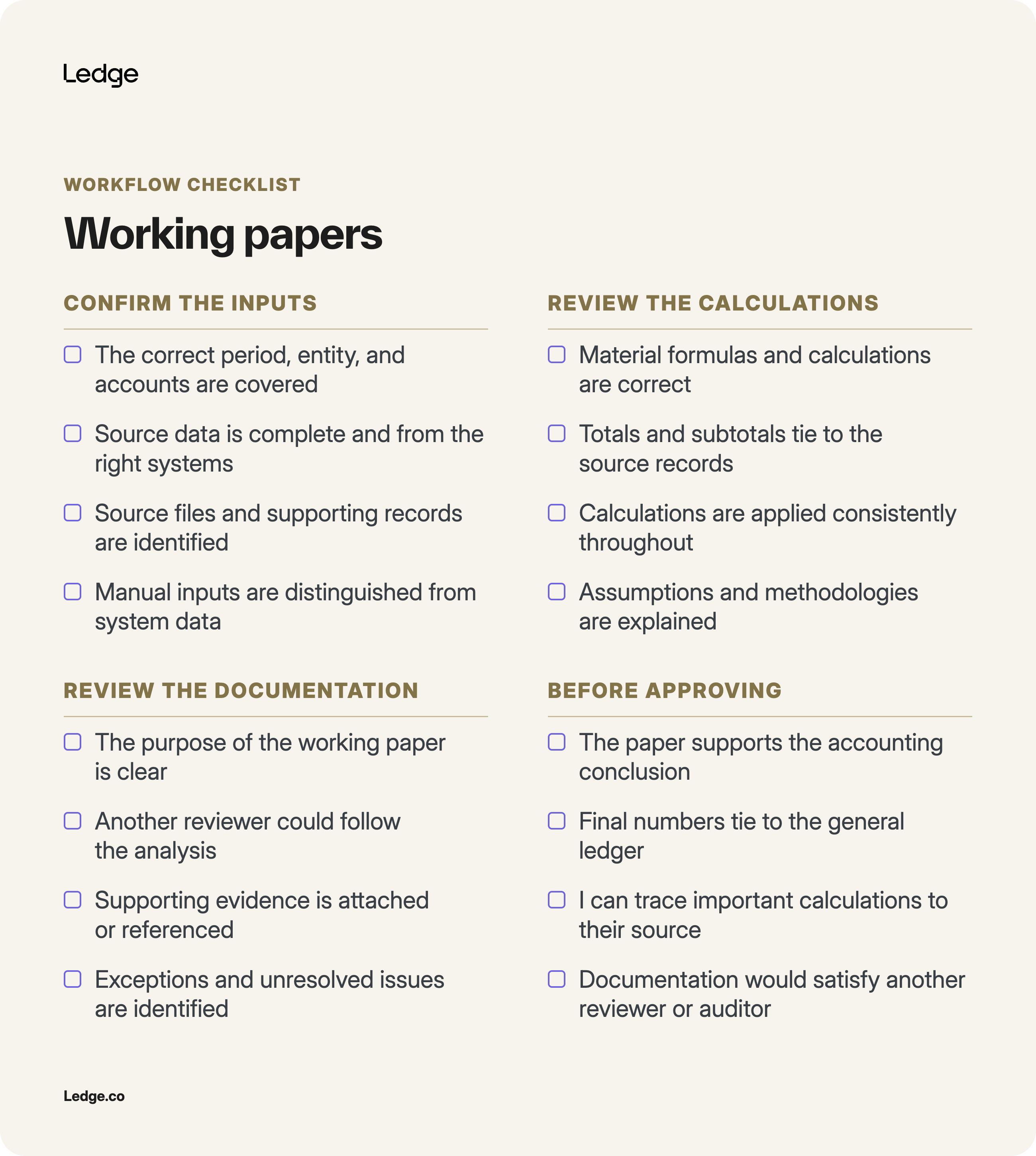
Confirm the inputs
- The working paper covers the correct period, entity and accounts
- Source data is complete and comes from the appropriate systems
- Source files and supporting records are clearly identified
- Manual inputs are clearly distinguished from system-generated data
Review the calculations
- Material formulas and calculations are correct
- Totals and subtotals tie to the relevant source records
- Calculations are applied consistently throughout the working paper
- Assumptions and methodologies are clearly explained
- Changes from the prior-period methodology are documented
Review the documentation
- The purpose of the working paper is clear
- Another reviewer could follow the analysis without recreating it
- Supporting evidence is attached or referenced
- Material judgments and conclusions are documented
- Exceptions and unresolved issues are clearly identified
- The final version can be distinguished from earlier versions
Before approving
- The working paper supports the accounting conclusion
- The final numbers tie to the general ledger or other relevant output
- I can trace important calculations to their source
- The documentation would be sufficient for another reviewer or auditor
Flux analysis
Flux analysis helps accounting teams understand material changes in balances or financial results between periods. AI can identify movements and help generate explanations, but reviewers should confirm that those explanations reflect the actual business activity behind the numbers.
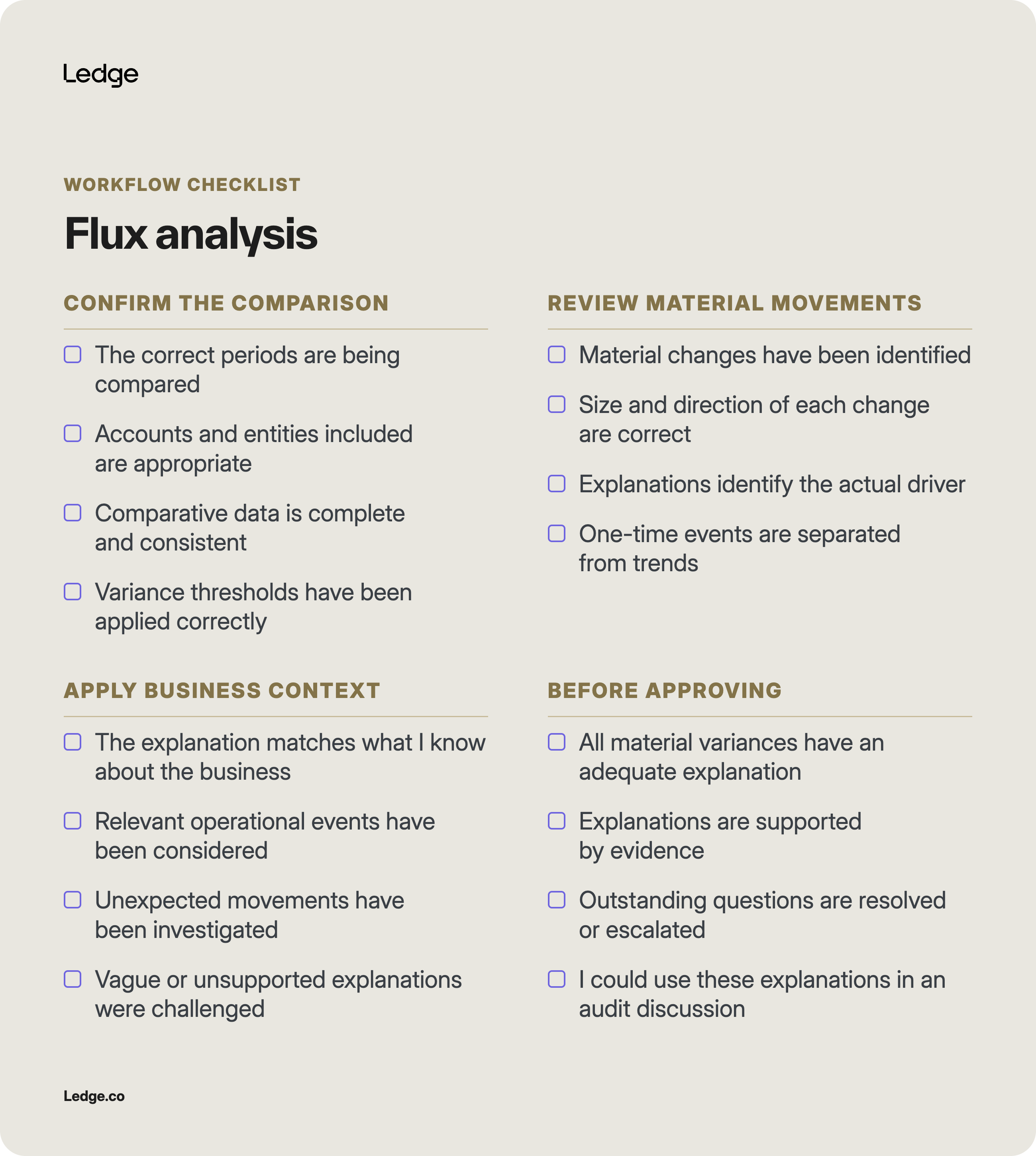
Confirm the comparison
- The correct periods are being compared
- The accounts and entities included in the analysis are appropriate
- Comparative data is complete and consistent between periods
- Materiality or variance thresholds have been applied correctly
Review material movements
- Material changes have been identified
- The size and direction of each change are calculated correctly
- The explanation is supported by underlying transactions or business activity
- The explanation identifies the actual driver rather than simply restating the numerical change
- One-time events are distinguished from recurring trends
- Changes caused by reclassifications or accounting adjustments are identified
Apply business context
- The explanation is consistent with what I know about the business
- Relevant operational events have been considered
- Unexpected movements have been investigated
- I have challenged explanations that appear vague, speculative or unsupported
- Multiple drivers are identified when one explanation does not fully account for the variance
Before approving
- All material variances have an adequate explanation
- Explanations are supported by evidence
- Outstanding questions have been resolved or escalated
- I would be comfortable using these explanations in management, audit or financial reporting discussions
Cash application
Cash application involves matching incoming payments to the appropriate customer accounts, invoices or receivables. AI can automate much of the matching process, but reviewers should pay particular attention to uncertain matches, partial payments and unapplied cash.
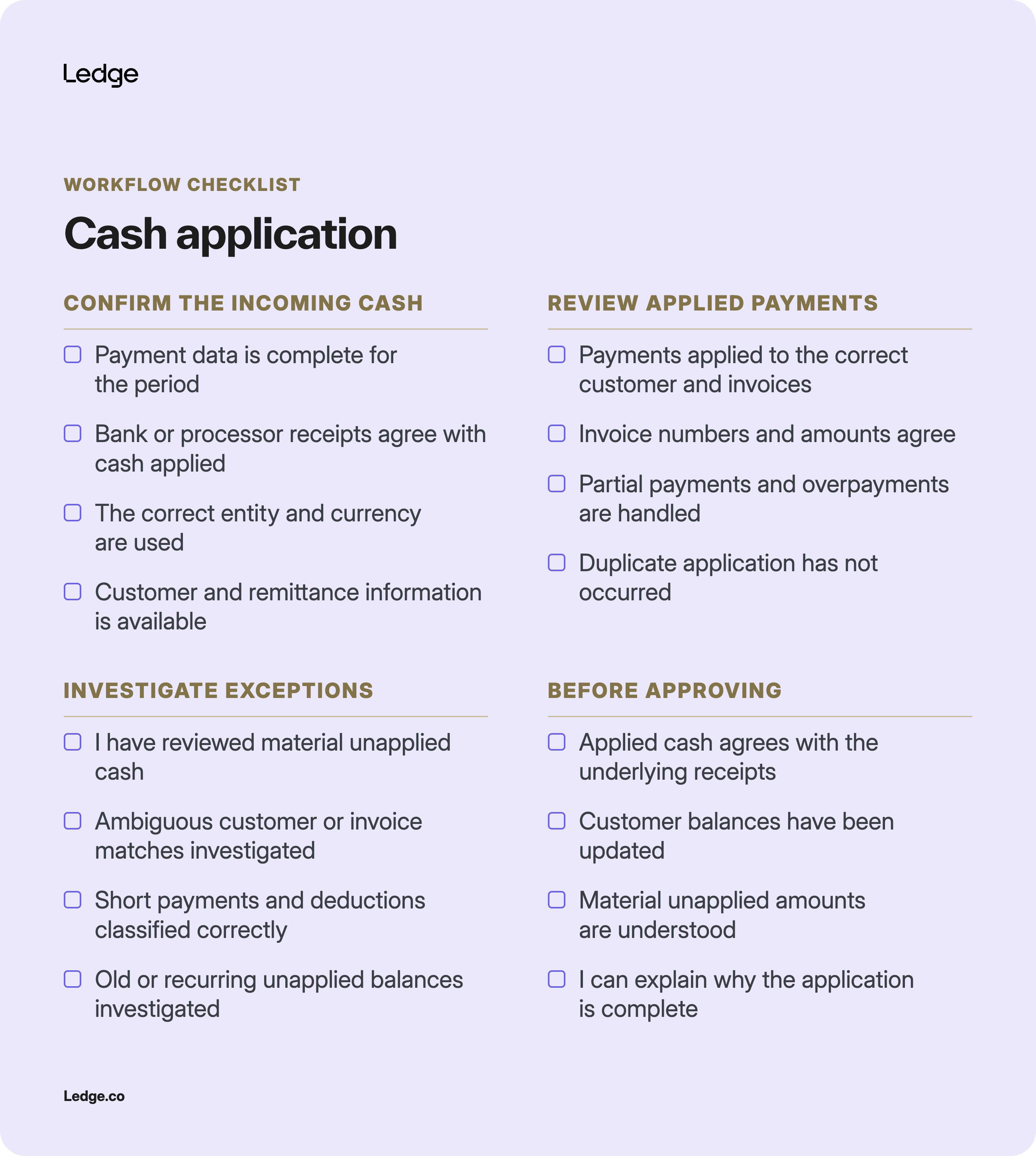
Confirm the incoming cash
- The payment data is complete for the period
- Bank or processor receipts agree with the cash being applied
- The correct entity and currency are being used
- Customer and remittance information is available where expected
Review applied payments
- Payments have been applied to the correct customer
- Payments have been applied to the correct invoice or invoices
- Invoice numbers, amounts and other matching information agree
- Partial payments have been treated appropriately
- Overpayments have been identified
- A single payment covering multiple invoices has been allocated correctly
- Duplicate application has not occurred
Investigate exceptions
- I have reviewed material unapplied cash
- Ambiguous customer or invoice matches have been investigated
- Short payments and deductions have been appropriately classified
- Payments without sufficient remittance information have been escalated where necessary
- Foreign currency differences are treated correctly
- Old or recurring unapplied balances have been investigated
Before approving
- Applied cash agrees with the underlying receipts
- Customer balances have been updated appropriately
- Material unapplied amounts are understood
- Exceptions have been resolved, documented or escalated
- I can explain why the cash application is complete and reasonable
Payment reconciliation
Payment reconciliation involves matching payment activity across sources such as payment processors, bank accounts and the ERP. Your review should confirm that transactions have been matched appropriately and that meaningful differences have been investigated.
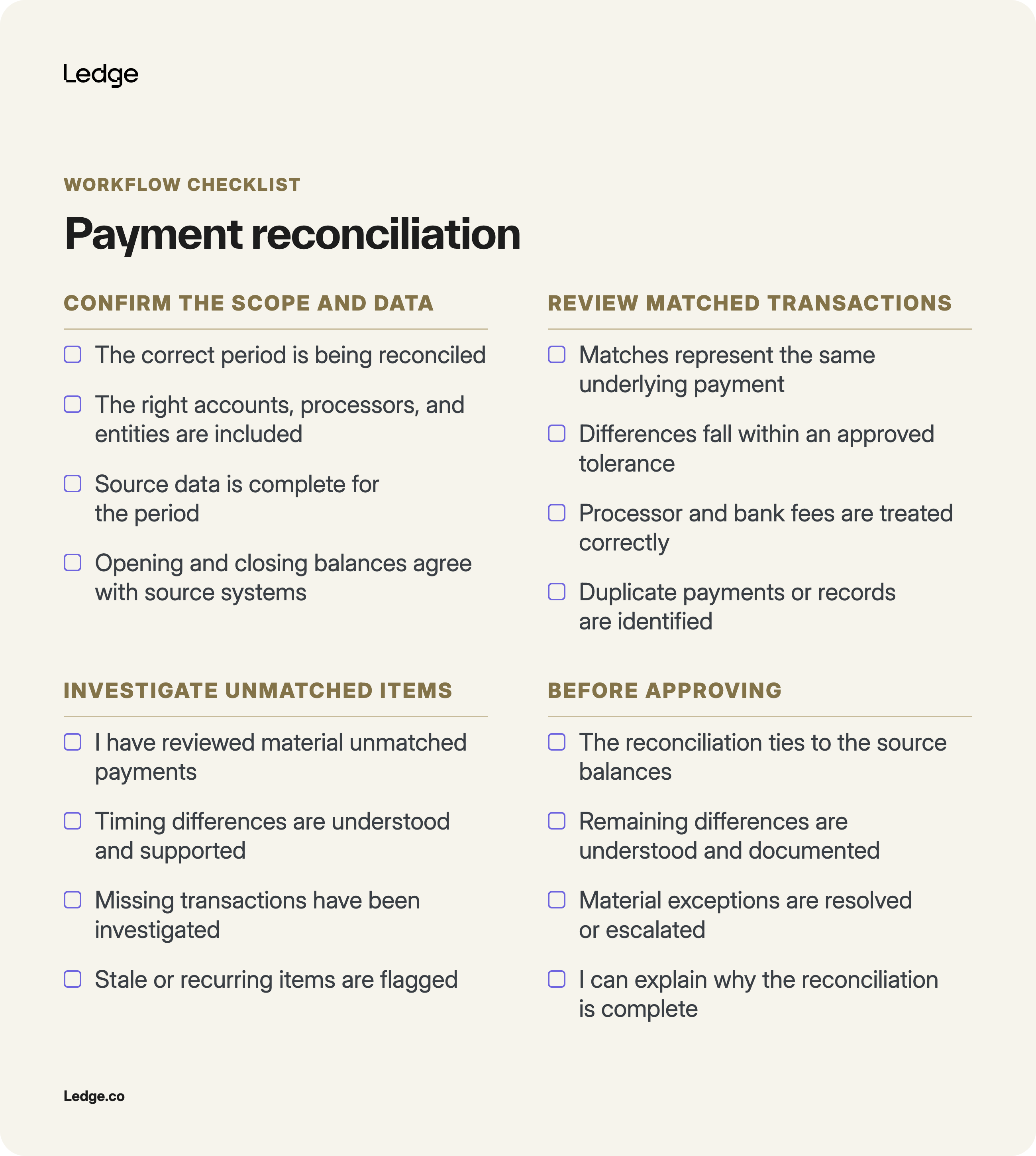
Confirm the scope and source data
- The correct period is being reconciled
- The appropriate entities, bank accounts, processors and ERP accounts are included
- Source data is complete for the period
- The opening and closing balances agree with the relevant source systems
- Dates, currencies and transaction identifiers appear correct
Review matched transactions
- Matched transactions represent the same underlying payment
- Amounts agree or any differences fall within an approved tolerance
- Date differences are reasonable
- Processor fees, bank fees or other expected deductions are treated correctly
- Matches based on non-exact criteria have been reviewed where appropriate
- Duplicate payments or duplicate records have been identified
Investigate unmatched items
- I have reviewed material unmatched payments
- Timing differences are understood and supported
- Missing transactions have been investigated
- Unexpected differences have been resolved, documented or escalated
- Stale or recurring unmatched items have been flagged for further investigation
Before approving
- I can explain why the reconciliation is complete and reasonable
- The reconciliation ties to the relevant source balances
- Remaining differences are understood and documented
- Material exceptions have been resolved or appropriately escalated
Account reconciliation
Account reconciliation involves comparing a general ledger balance with the records, schedules or other evidence that support it. Your review should establish that the balance is accurate and that reconciling items are legitimate, understood and appropriately treated.
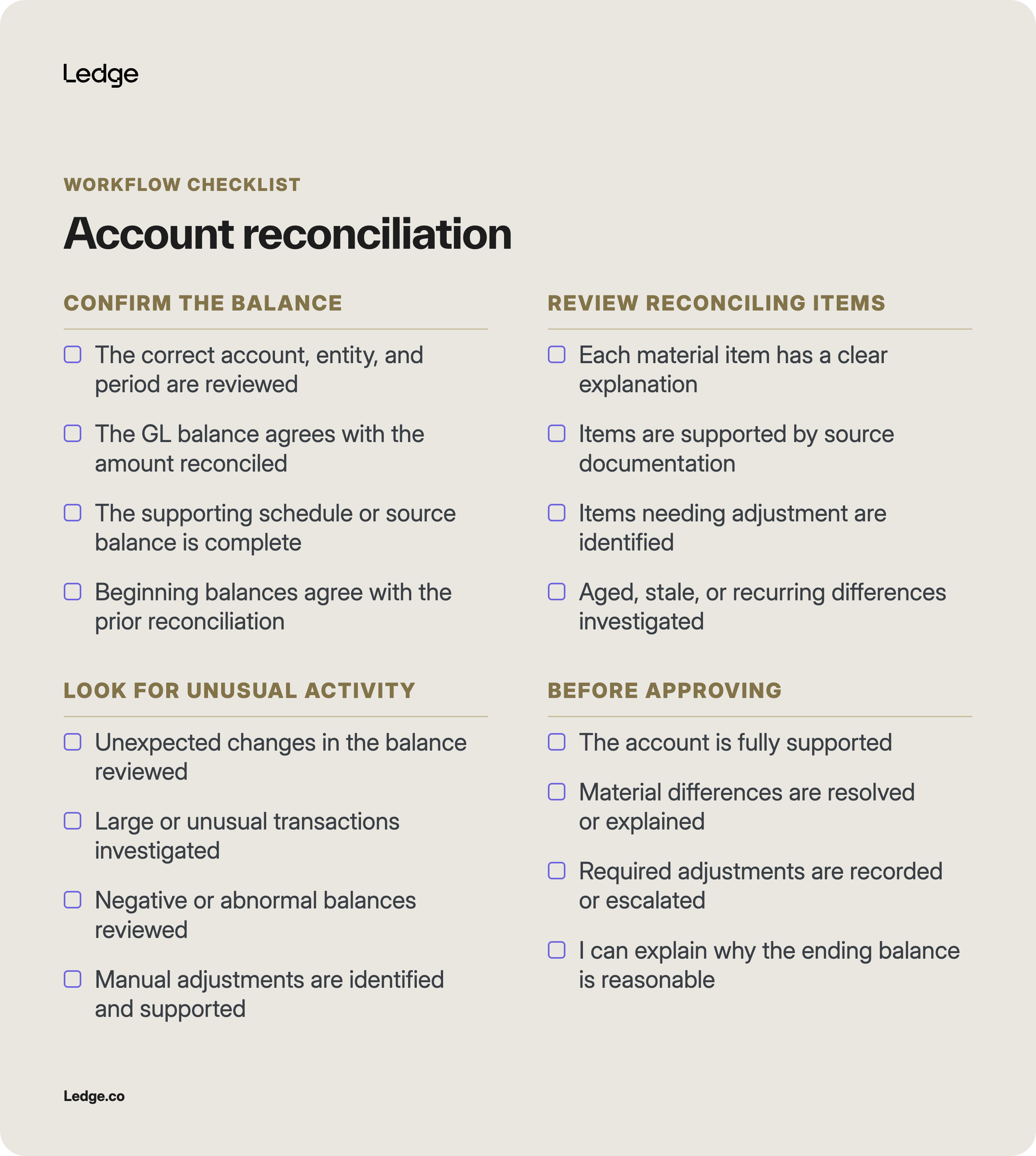
Confirm the balance
- The correct account, entity and period are being reviewed
- The general ledger balance agrees with the amount being reconciled
- The supporting schedule or source balance is complete
- Beginning balances agree with the prior approved reconciliation where applicable
- Changes during the period are consistent with underlying activity
Review reconciling items
- Each material reconciling item has a clear explanation
- Reconciling items are supported by source documentation
- Timing differences are reasonable
- Items that require an adjustment have been identified
- I have reviewed aged or stale reconciling items
- Recurring differences have been investigated as potential process or control issues
Look for unusual activity
- I have reviewed unexpected changes in the balance
- Large or unusual transactions have been investigated
- Negative or abnormal balances have been reviewed where relevant
- Manual adjustments are clearly identified and supported
- The balance is consistent with my understanding of the business
Before approving
- The account is fully supported
- Material differences have been resolved or explained
- Required adjustments have been recorded or escalated
- I can explain why the ending balance is reasonable
A final question before approval
Across any workflow, the standard is not whether you could reproduce every step yourself. It is whether you have enough reliable evidence to make and defend the approval decision.
Before you approve, ask:
- Do I understand what was prepared and why?
- Does the result make sense?
- Can I trace it back to reliable evidence?
- Have the meaningful exceptions been investigated?
- Have important judgments and assumptions been documented?
- Could I explain my approval decision to another reviewer or auditor?
Protect human accounting judgment
The goal is not to recreate every step the AI completed. It is to build a review process that gives you confidence in the result: understanding what was prepared, checking the underlying evidence, investigating meaningful exceptions and knowing when something needs a closer look. That same foundation applies across journal entries, working papers, reconciliations, flux analysis and cash application.
As your team becomes more comfortable reviewing AI-generated work, these steps can become part of the normal close process rather than a separate layer of oversight. The review may become faster over time, but the standard stays the same: approve the work when you have enough evidence to understand, explain and stand behind the result.