AI agents can help accounting teams automate repetitive work across the month-end close, including transaction matching, exception handling, journal-entry preparation, working papers, payment reconciliation, account reconciliation, and flux analysis.
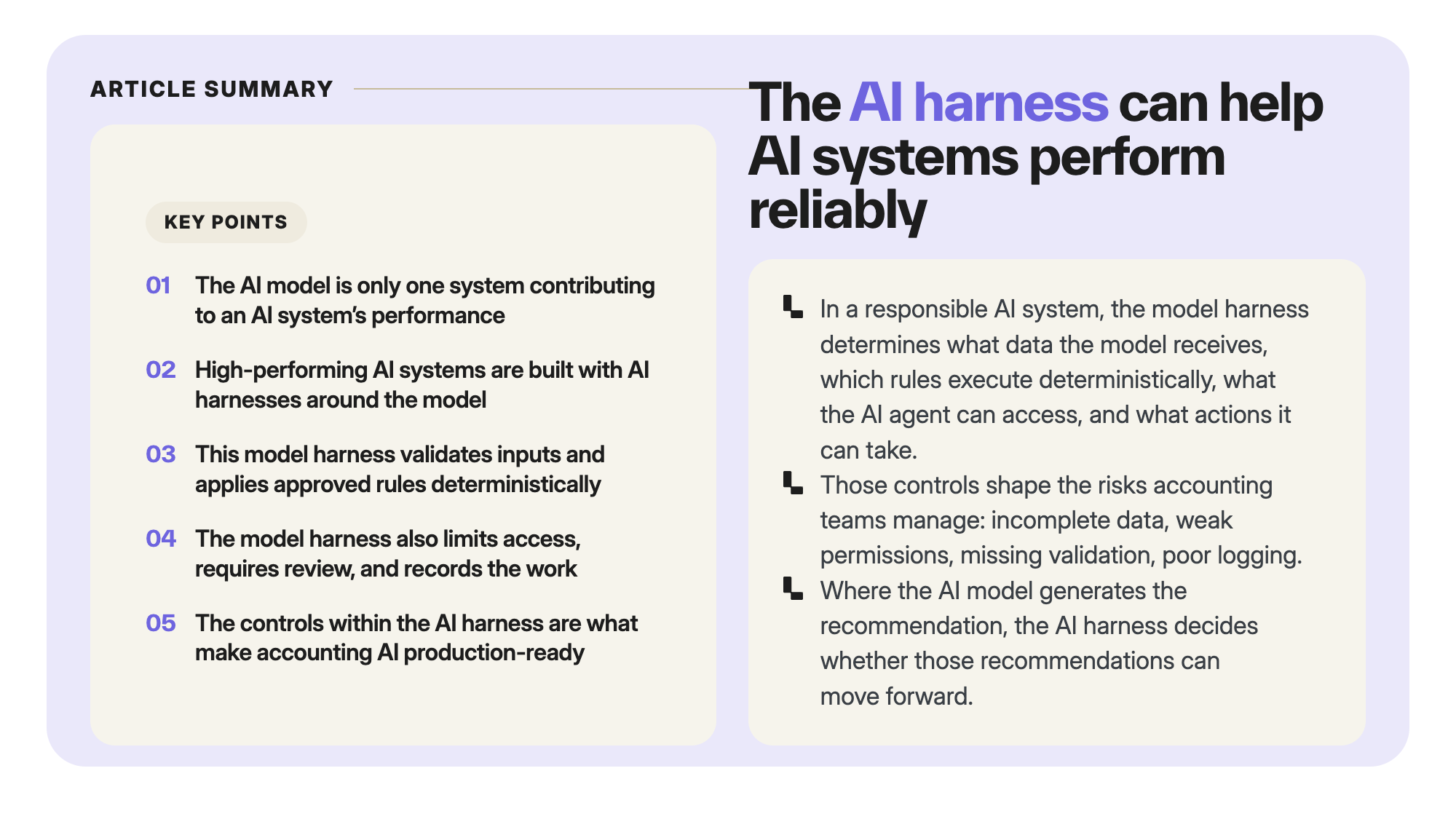
But the AI model itself is only one part of what determines whether an accounting agent performs well.
An important concept to understand is the AI harness: the control layer around the model that determines how it operates inside a real accounting workflow.
Not every AI system has a robust harness. A general-purpose model may be able to analyze information or generate a recommendation, but that does not automatically mean it can work reliably or efficiently inside the month-end close.
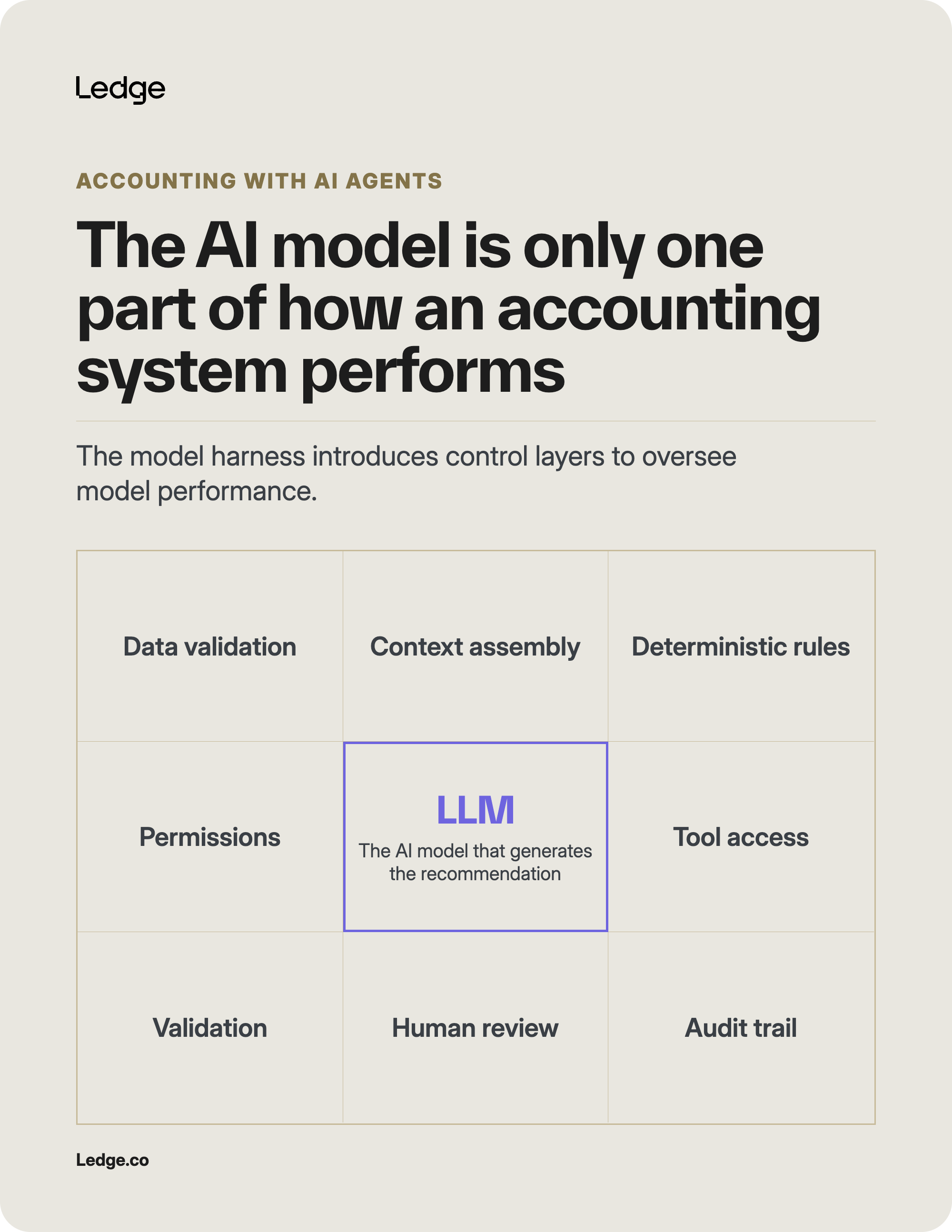
The harness is what gives the model structure. That structure determines what data the model receives, which accounting rules are applied deterministically, what tools and systems the agent can access, what actions it can take, when human review is required, how its work is validated and recorded, and how model usage and token costs are managed.
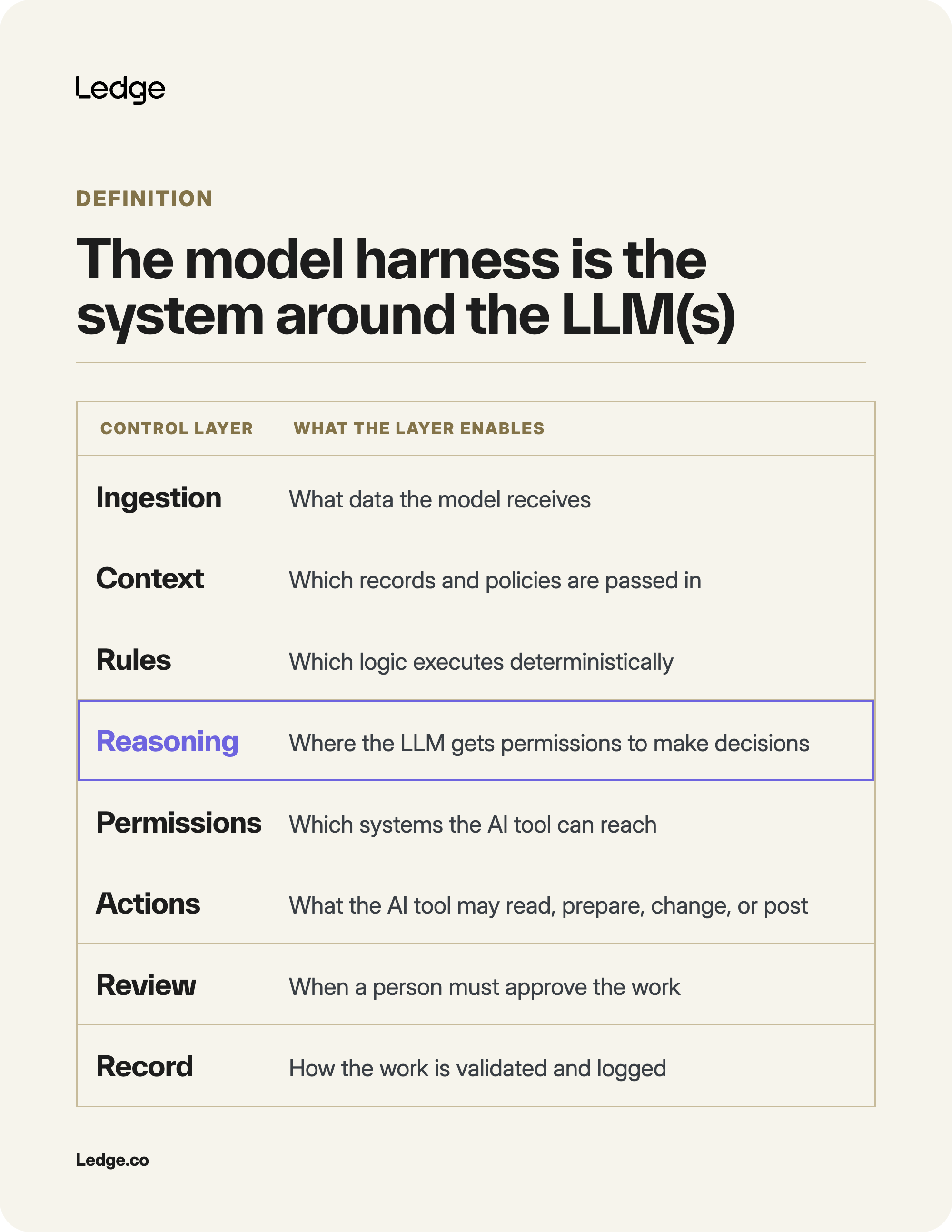
This is why leading AI infrastructure builders build the harness around the underlying models.
The value of Ledge, for instance, comes not only from the model’s reasoning capabilities, but from the controls that govern how that reasoning is used within the accounting process: which model is used for which task, how much context is passed into it, when additional model calls are necessary, where deterministic logic should take over, and how unnecessary token consumption is avoided.
Those technical architecture choices directly address both the risks AI introduces into the accounting process and how much AI costs to utilize.
A well-designed harness reduces AI risks while making AI usage more efficient. The harness controls how the model receives information, applies rules, takes action, escalates exceptions, and consumes compute. The harness is also part of what determines whether an AI agent, or multiple AI agents working together, perform safely, responsibly, and reliably.
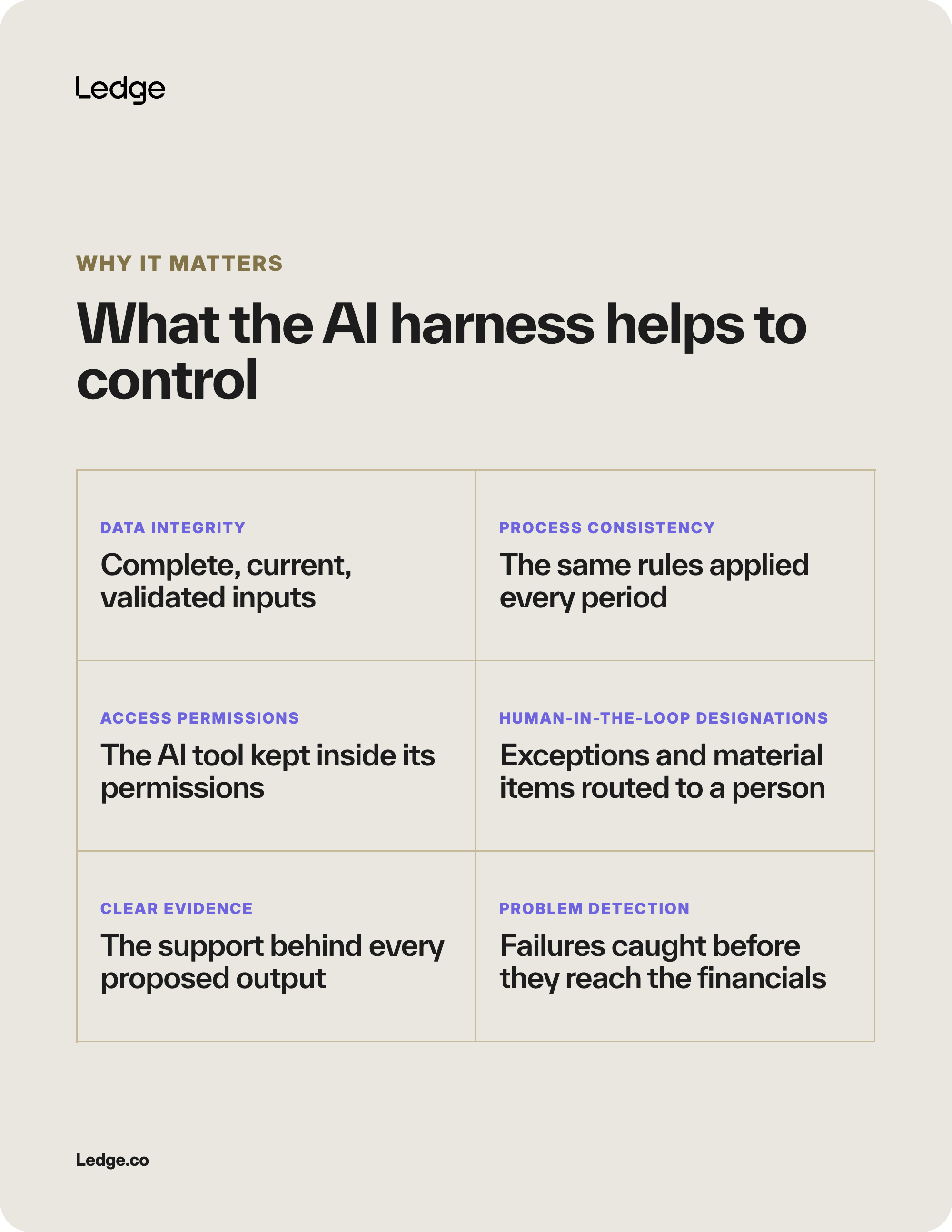
Here are the most important risks the AI harness needs to control for.
1. Incorrect or unsupported conclusions
AI models can produce answers that sound reasonable even when the underlying conclusion is incomplete or incorrect.
In accounting, that could mean:
- Suggesting the wrong transaction match
- Misclassifying an expense
- Applying the wrong accounting treatment
- Drafting an unsupported journal entry
- Misinterpreting an invoice or contract
- Explaining a variance using incomplete evidence
- Missing a material exception
The risk increases when the model is working with incomplete, inconsistent, or ambiguous information.
How the model harness controls for it
The AI harness should control what happens before and after the model produces a recommendation.
It can:
- Link conclusions to source data and supporting evidence
- Show the rules, assumptions, and calculations used
- Flag uncertain results
- Escalate unfamiliar or material items
- Prevent unsupported conclusions from moving forward automatically
- Require approval before higher-risk actions are completed
- Stop the workflow when the available information is insufficient
The AI model may generate the recommendation. The model harness determines whether that recommendation can move forward.
2. Incomplete or incorrect source data
AI can only work with the information it receives.
If the source data is incomplete, duplicated, outdated, or tied to the wrong reporting period, the AI agent may still produce a polished result.
For example, the AI agent could:
- Reconcile only part of the transaction population
- Use a prior-period report
- Miss transactions from a delayed source
- Process duplicate records
- Compare datasets covering different dates
- Use inconsistent identifiers across systems
The accounting logic may be sound while the underlying population is wrong.
How the model harness controls for it
The harness should validate inputs before the model begins working.
Checks can include:
- Reporting period
- Required source systems
- Data freshness
- Expected versus actual record counts
- Required fields
- Duplicate files or transactions
- Data structure
- Completeness of the transaction population
- Reconciliation to authoritative systems
Where possible, the AI harness should pull data directly from source systems rather than rely on manually prepared uploads.
Input validation should happen before the model begins reasoning over the data.
3. Inconsistent application of accounting rules
AI models are probabilistic. Their outputs can vary depending on context, prompting, model version, and the information available.
That flexibility is useful when the agent needs to interpret an unfamiliar transaction or review an unstructured document.
It is less useful for accounting rules that should be applied consistently.
Matching logic, calculations, materiality thresholds, approval paths, and structured system updates should behave the same way every time.
How the model harness controls for it
The harness should separate AI reasoning from deterministic execution.
Use AI reasoning for:
- Ambiguous transactions
- Unstructured documents
- New exceptions
- Explanations
- Recommendations that require review
Use deterministic logic for:
- Approved matching rules
- Calculations
- Data transformations
- Required-field checks
- Materiality thresholds
- Routing rules
- Structured system updates
Once a rule has been defined, tested, and approved, the harness should apply it consistently.
That reduces variation and makes the workflow easier to reproduce, review, and audit.
4. Excessive access and permissions
Accounting AI agents may need access to sensitive financial data and core accounting systems across your fintech stack.
They may also be able to update reconciliations, prepare journal entries, change workflow statuses, or write information back to the ERP.
Each additional permission increases the impact of a potential error.
How the model harness controls for it
The harness should enforce least-privilege access.
Permissions can be separated by action, including:
- Reading data
- Analyzing information
- Preparing proposed work
- Recommending an action
- Updating workflow status
- Writing information to the ERP
- Posting an entry
- Approving an entry
The AI agent should receive only the access required for the specific workflow.
For many use cases, that means beginning with read-only access and expanding permissions gradually.
The harness should also prevent the agent from approving its own work or bypassing segregation-of-duties requirements.
5. Missing human review
Some accounting tasks can be automated safely under predefined conditions.
Others require judgment.
Material transactions, unusual exceptions, conflicting evidence, new accounting treatments, and higher-risk system actions may require review by an accountant.
How the model harness controls for it
The AI harness should define when human review is required.
For example, it may escalate work when:
- A transaction exceeds a materiality threshold
- Required evidence is missing
- Evidence conflicts
- The model encounters an unfamiliar exception
- The proposed treatment falls outside approved rules
- A higher-risk system action is required
Lower-risk work can continue automatically when predefined conditions are met.
Higher-risk work can be routed to the appropriate reviewer.
This makes human judgment part of the workflow rather than a final check applied to every output.
6. Poor auditability
A final answer is not enough for accounting work.
Reviewers and auditors may need to understand:
- What data was used
- Which rules were applied
- Which calculations were performed
- Which exceptions were identified
- What the agent proposed
- What the agent changed
- Who reviewed the work
- Who approved it
- When each action occurred
If that information is not preserved, the work may be difficult to validate later.
How the model harness controls for it
The model harness should create an audit trail as the work happens.
That can include:
- Source records
- Supporting documentation
- Applied rules and thresholds
- Model and workflow versions
- Proposed outputs
- Exceptions
- Human corrections
- Approval records
- System changes
- Time-stamped activity
The reviewer should receive the full context behind the output rather than an isolated model response.
Auditability should be built into the workflow from the beginning.
7. Sensitive data exposure
Accounting AI agents may work with highly sensitive information, including:
- Bank transactions
- Customer and vendor records
- Payroll data
- Invoices and contracts
- Account balances
- Journal entries
- Internal forecasts
- System credentials
Giving the model access to more information than it needs creates unnecessary risk.
How the model harness controls for it
The model harness should apply data-minimization principles.
That means controlling:
- Which data sources the agent can access
- Which fields it can retrieve
- Which tools it can use
- Which systems it can modify
- How credentials and API keys are secured
- Where prompts, outputs, and activity logs are retained
- Which users can create or modify agents
- Which vendors and subprocessors handle the data
The AI agent should receive only the information required for the task it is performing.
8. Operational and integration failures
An accounting AI agent depends on more than the model.
The workflow may also rely on:
- APIs
- Credentials
- ERP connections
- Source reports
- Banks
- Payment processors
- Spreadsheets
- Cloud platforms
- Workflow logic
Any of these components can fail.
A credential may expire. An API may become unavailable. A report format may change. A source system may stop updating.
How the model harness controls for it
The harness should detect and respond to failures across the workflow.
It should be able to:
- Detect failed or incomplete steps
- Prevent downstream work when an upstream dependency fails
- Show what has already been completed
- Preserve prior results
- Prevent duplicate actions
- Alert the appropriate owner
- Resume safely from a known point
- Support a manual fallback
The accounting team should know how the close will continue if part of the workflow becomes unavailable.
9. Silent failures
Visible failures are usually easier to manage.
Silent failures are harder.
A workflow may technically complete even though:
- A source report changed structure
- A system stopped updating
- A field was mapped incorrectly
- An accounting rule became outdated
- A model or prompt change affected the output
- Part of the workflow did not complete
The output may still appear valid.
How the model harness controls for it
The harness should monitor the accounting result, not only whether the software finished running.
Checks can include:
- Expected record counts
- Data freshness
- Source availability
- Output completeness
- Exception rates
- Unusual period-over-period changes
- Required workflow steps
- Expected ranges
- Reconciliation status
A completed workflow should mean that the accounting requirements were satisfied.
10. Changes in the accounting environment
Accounting processes change over time.
A company may add new entities, update its chart of accounts, change approval thresholds, introduce new accounting policies, add financial systems, or migrate to a new ERP.
The AI infrastructure can also change.
Models, prompts, tools, integrations, and workflows evolve.
How the model harness controls for it
A production model harness needs ongoing ownership and versioning.
Teams should define responsibility for:
- Monitoring performance
- Maintaining integrations
- Reviewing permissions
- Updating accounting rules
- Incorporating policy changes
- Testing model and prompt changes
- Running regression tests
- Maintaining documentation
- Responding to incidents
- Approving material workflow changes
The accounting team should know which version of the workflow, rules, and model governed a given result.
11. Automating a poor process
AI can make an inefficient process faster.
If the existing close relies on unnecessary handoffs, duplicate spreadsheets, inconsistent rules, or unclear ownership, automation may preserve those problems.
How the model harness controls for it
Harness design should begin with the workflow itself.
Before automating a process, ask:
- Is every step necessary?
- Is the accounting rule clearly defined?
- Are multiple systems duplicating the same work?
- Can handoffs be reduced?
- Is required supporting evidence clearly established?
- Is ownership clear?
- Should the process change before it is automated?
The goal is to improve the operating model rather than reproduce the existing process with AI.
How does the model harness create better AI agents?
A high-performing accounting AI agent depends on the full system around the model.
That system should control:
- Inputs: Whether the model receives complete, current, validated information
- Context: Whether the model has the evidence and accounting context required for the task
- Reasoning: Where AI interpretation is appropriate
- Rules: Which parts of the workflow should execute deterministically
- Tools: Which systems the agent can interact with
- Permissions: What the agent can read, prepare, change, post, or approve
- Approvals: When human review is required
- Validation: What must be true before work moves forward
- Escalation: When the agent should stop and route the work for review
- Auditability: What evidence is preserved
- Monitoring: How failures and unusual results are detected
- Maintenance: How the workflow stays current as systems, policies, and models change
These controls determine how reliably the model can perform inside an accounting workflow.
The model harness determines how accounting AI performs
AI models will continue to improve.
For accounting teams, model performance is only part of the equation.
The model harness determines what information reaches the model, what rules govern the workflow, what the agent can access, what actions it can take, how its work is checked, and when an accountant needs to step in.
That makes the harness a critical part of accounting AI performance.
A high-performing harness helps the model work with the right data, applies established rules consistently, limits unnecessary access, validates outputs, catches failures, and preserves the evidence needed to review the work.
Those controls are what make accounting AI reliable for scalable, production-ready workflows.