

- Ledge achieved ISO/IEC 42001 certification in Q1 2026, following an independent audit of its AI governance, risk management, and oversight processes.
- ISO 42001 establishes a framework for responsible AI management, helping organizations assess how AI systems are developed, deployed, monitored, and continuously improved.
- AI accounting systems require more than capable language models. Reliable automation depends on accurate source data, deterministic accounting logic, controlled execution, output validation, and auditability.
- Ledge's glass-box architecture makes AI-prepared work inspectable, allowing finance teams to trace results to source records, review calculations, and verify supporting evidence.
- Human oversight remains central to financial controls. Accounting teams retain responsibility for reviewing outputs, approving journal entries, and authorizing actions.
- Certification supports, but does not replace, vendor due diligence. Finance leaders must evaluate AI systems against their organization's accounting policies, security requirements, regulatory obligations, and internal controls.
Ledge’s ISO/IEC 42001 certification explained
Ritika Strauss
//
Published:
November 17, 2026
//
Updated:
November 19, 2026
Article

Company name
About the company


Thank you! Your submission has been received!
Oops! Something went wrong while submitting the form.
See Ledge in action
Key Takeaways
As finance teams move beyond experimenting with AI toward deploying it in critical accounting workflows, expectations for security, governance, and accountability are increasing.
Ledge attained its ISO/IEC 42001 certification, the world’s first international standard for AI management systems, in Q1 2026.
The certification follows an independent external audit of Ledge's AI management system, including the governance policies, risk management processes, and oversight mechanisms supporting how our AI technology is developed, deployed, monitored, and maintained.
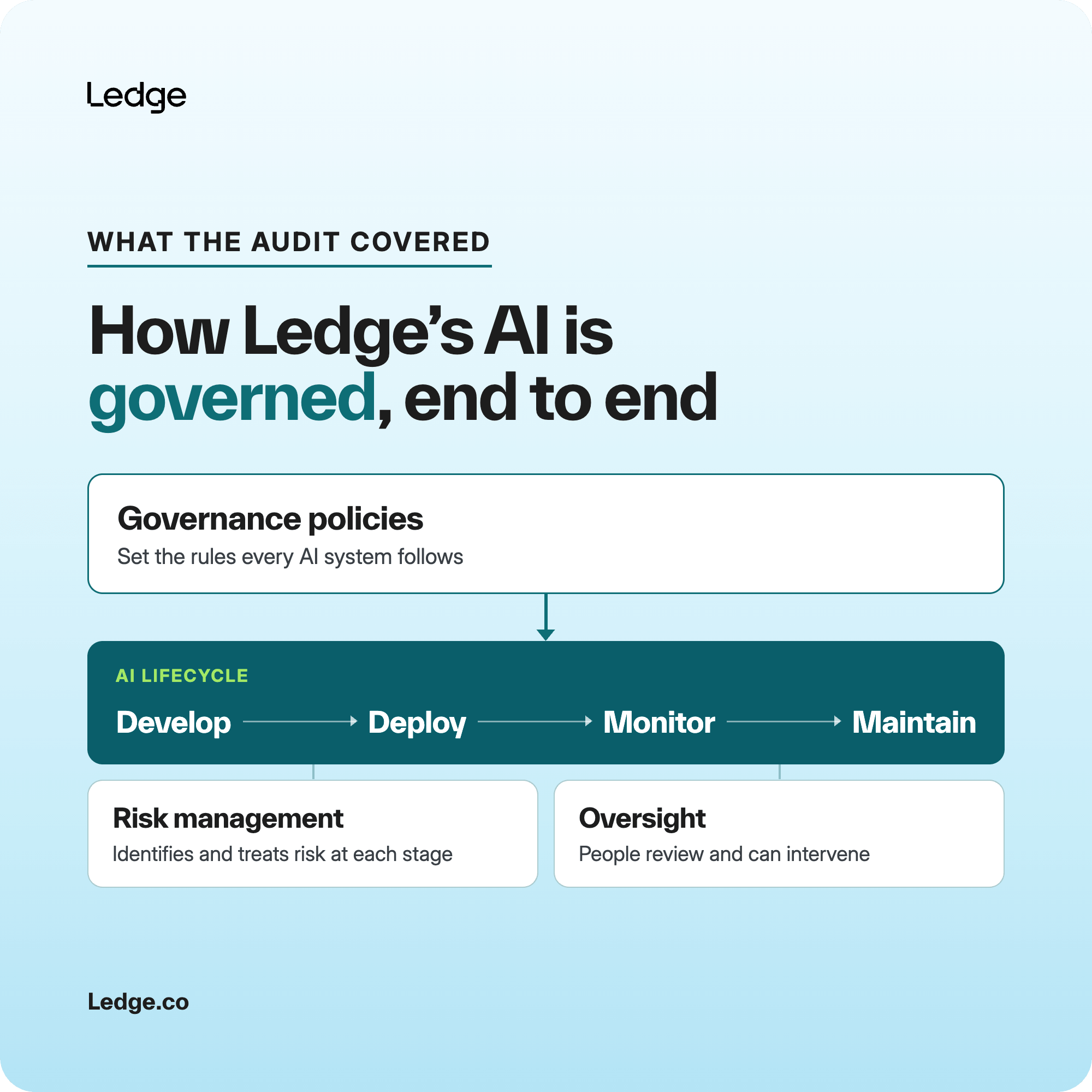
For our customers, this designation is important. It provides independent assurance that Ledge has established a structured approach to managing AI-related risks and responsibilities.
Finance teams need AI systems that can withstand scrutiny from auditors, security teams, risk analysts, and other stakeholders. For organizations choosing to adopt AI systems to help with reconciliations, journal entry preparation, and other close activities, the governance surrounding these systems becomes just as important as their technical capabilities.
Why this matters for our customers
As accounting teams explore AI for increasingly complex accounting workflows, many are recognizing the challenges of building and maintaining these systems in-house.
Automating reconciliations, preparing journal entries, and generating audit-ready workpapers requires more than connecting an AI model to financial data. These workflows depend on accurate source information, consistent accounting logic, reliable integrations, and controls that protect the integrity of financial reporting.
Building these capabilities internally also introduces ongoing responsibilities for security, monitoring, risk management, and oversight. Finance teams must consider whether they have the technical resources, governance infrastructure, and specialized expertise to maintain these systems reliably over time.
These considerations are especially important in accounting, where an incorrect output or unauthorized action can affect financial reporting, compliance, and audit readiness.
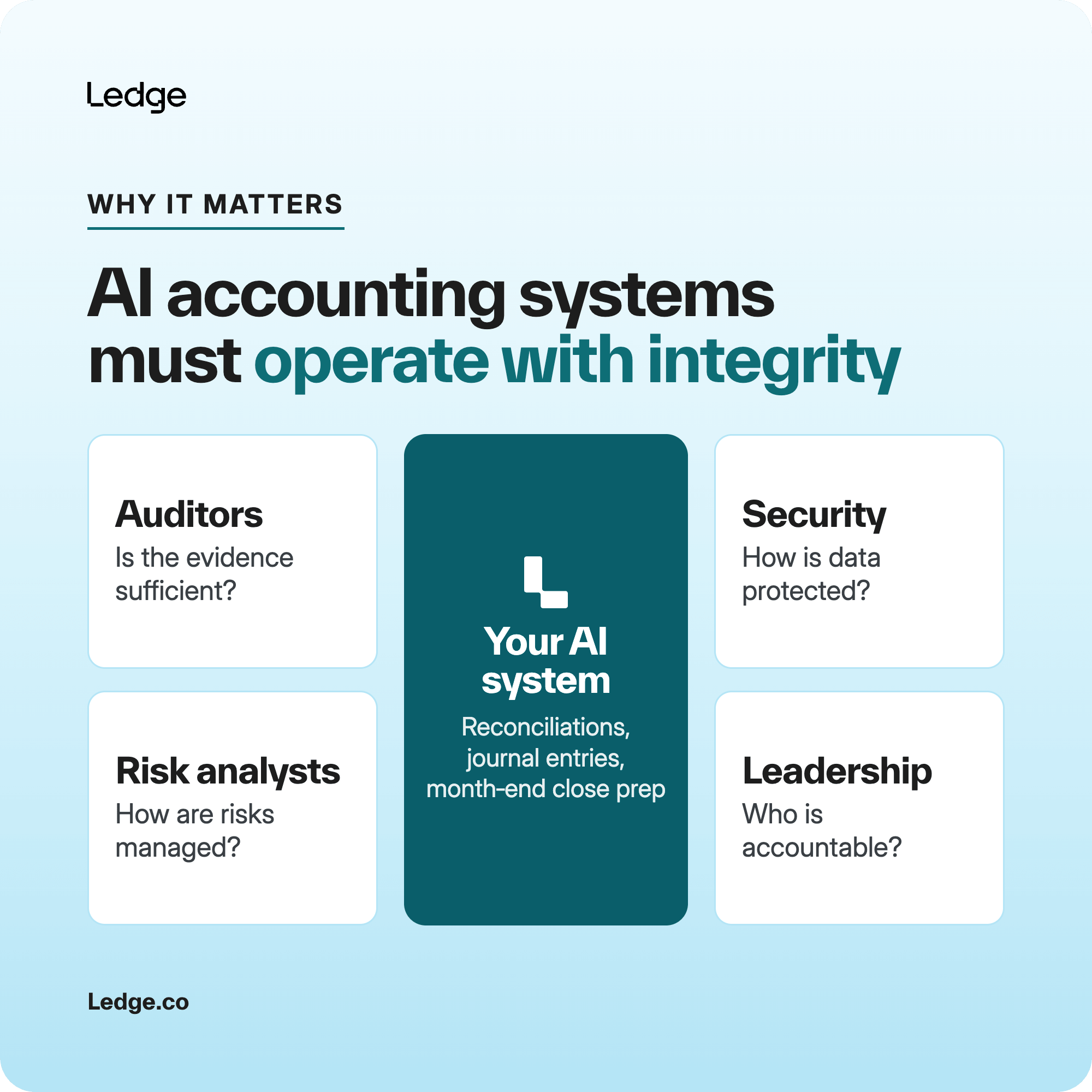
As organizations evaluate whether to build AI systems internally or work with specialized technology providers, governance is becoming an increasingly important consideration. Finance leaders need to understand how sensitive data is protected, how accounting logic is maintained, how outputs are verified, and who is accountable when something goes wrong.
This is where internationally recognized standards such as ISO/IEC 42001 become increasingly relevant, providing a structured framework for evaluating how organizations manage AI-related risks, responsibilities, and oversight.
What ISO 42001 certification means
ISO/IEC 42001 establishes requirements for creating, implementing, maintaining, and continually improving an artificial intelligence management system (AIMS).
The standard provides organizations with a framework for systematically managing the opportunities, responsibilities, and risks associated with AI.
As KPMG Switzerland explains, important considerations include risk management, AI system impact assessments, lifecycle management, and third-party supplier oversight.
For organizations adopting AI in financial operations, these requirements help establish greater confidence that technology providers have formal governance processes in place.
Key components include:
- Establishing an AI management system (AIMS): A structured framework for governing AI projects, AI models and data governance practices.
- AI risk management: Identification, assessment and mitigation of risks associated with AI, including bias, accountability and data protection.
- Ethical AI principles: Encouraging transparency, fairness and accountability in AI development and deployment.
- Continuous monitoring & improvement: A process for reviewing AI performance and refining AI governance strategies.
- Stakeholder enagement: Promoting responsible AI by involving compliance teams, AI developers and risk management professionals in decision-making processes.
How Ledge puts responsible AI into practice
Ledge was built for accounting environments where accuracy, traceability, and human judgment are essential.
Finance teams operate across its ERP, banks, payment processors, billing platforms, and spreadsheets. Each organization also has its own accounting policies, approval procedures, and internal controls. AI systems need to accommodate this complexity while maintaining the integrity of financial reporting.
Ledge addresses these requirements through a combination of its foundational technical architecture, transparent execution, and human oversight.
An AI model harness built for financial controls
The reliability of an AI accounting system depends on more than the underlying large language model (LLM). It also depends on the infrastructure surrounding that model, including how it accesses financial data, executes accounting logic, interacts with other systems, and validates its outputs.
At Ledge, our AI model harness provides this control layer. It governs how agents operate within defined accounting workflows, combining AI capabilities with deterministic logic, permissions, validation, and monitoring.
The harness is designed to address several important requirements:
- Data integrity: Agents retrieve information from connected financial systems, maintaining traceability to the underlying records.
- Controlled execution: Defined accounting rules and deterministic calculations guide how recurring tasks are performed.
- Access management: System permissions restrict what agents can access and which actions they are authorized to execute.
- Output validation: Checks and supporting evidence help identify errors, investigate exceptions, and verify results.
- Monitoring and auditability: Execution records document how workflows run, which actions are taken, and where human intervention is required.
This architecture becomes particularly important as LLMs evolve. New models and capabilities can introduce changes in system behavior, making it essential to maintain consistent accounting rules and control requirements independently of the underlying AI technology.
The model harness allows Ledge to adopt new capabilities while keeping accounting execution within a governed, reviewable environment.
Transparent, inspectable accounting workflows
Finance teams need to understand how accounting results were produced, especially when those results contribute to financial statements or audit evidence.
Ledge's glass-box approach gives accountants visibility into the work agents prepare. Rather than relying on unexplained AI-generated conclusions, workflows use defined accounting logic and produce supporting documentation that can be independently reviewed.
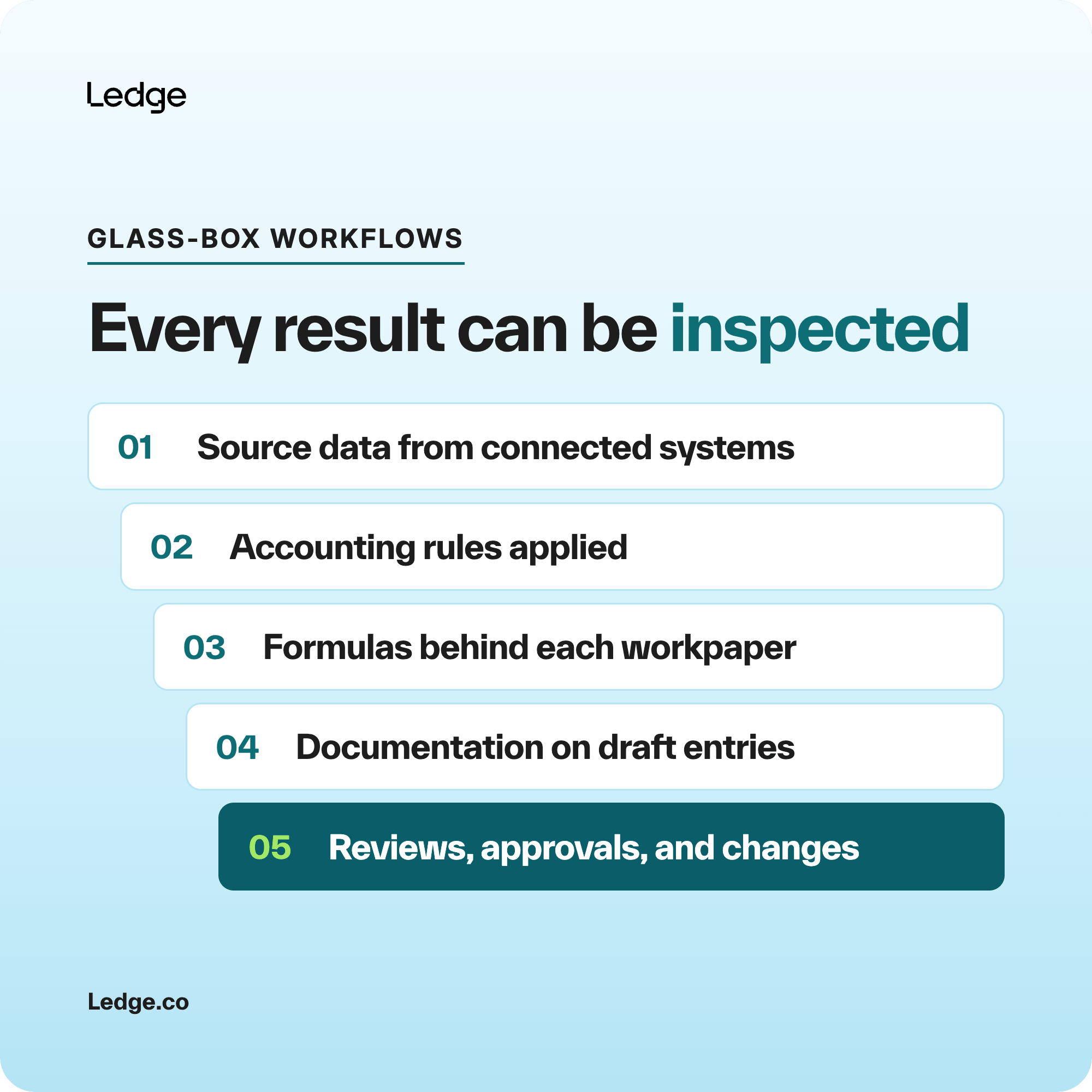
Finance teams can inspect:
- Source data retrieved from connected financial systems
- Accounting rules and logic applied to transactions
- Formulas and calculations supporting workpapers
- Documentation attached to draft journal entries
- Records of reviews, approvals, and changes
This visibility makes it easier to investigate discrepancies, verify calculations, and maintain the evidence required for internal and external reviews.
Human oversight throughout the process
AI agents within Ledge are customized by accounting teams to execute the work, while finance teams retain responsibility for reviewing results and authorizing actions.
Journal entries require human review and approval before posting. Changes to accounting logic are intentional and documented, with prior versions preserved for reference. Role-based permissions further help ensure that individuals and systems operate within their authorized responsibilities.
These safeguards allow organizations to automate preparation without transferring responsibility for financial decisions to AI.
They also give controllers and accounting leaders flexibility to establish review procedures, appropriate to their organization's risk profile.
What ISO/IEC 42001 means for Ledge's foundation and future
As AI becomes more integrated into financial operations, technology providers will need to demonstrate that their systems can remain reliable, secure, and stable as LLM capabilities evolve.
ISO/IEC 42001 provides a framework for managing that responsibility over time. Its requirements for risk assessment, defined accountability, monitoring, and continuous improvement help guide how organizations develop and manage AI systems.
For Ledge, this means evaluating new AI capabilities against established governance requirements, maintaining appropriate controls as our platform evolves, and supporting customers as they adapt automation to their own accounting environments.
Our Q1 2026 certification provides independent assurance that Ledge's AI management system meets the requirements of this international standard. It also reflects an ongoing responsibility to maintain and improve the processes supporting our technology.
Every finance organization has distinct accounting policies, regulatory obligations, and operational risks. Finance leaders should work with their internal accounting, security, compliance, and audit experts to determine how AI fits within those requirements.
As more organizations deploy AI across their accounting infrastructure, the quality of the underlying governance will become an increasingly important consideration in technology decisions.
Our focus is on making advanced AI capabilities practical for accounting teams, with the technical controls, supporting evidence, and human oversight that financial operations require.
Adapting AI governance to your organization's requirements
Every finance organization operates within a different legal, regulatory, and financial control environment. While certifications such as ISO 42001 provide a useful foundation for evaluating technology providers, they do not replace an organization's own due diligence or internal governance responsibilities.
Before implementing AI in accounting workflows, finance leaders should consult with their accounting advisors, auditors, and internal compliance and security teams to assess the risks and requirements specific to their business.
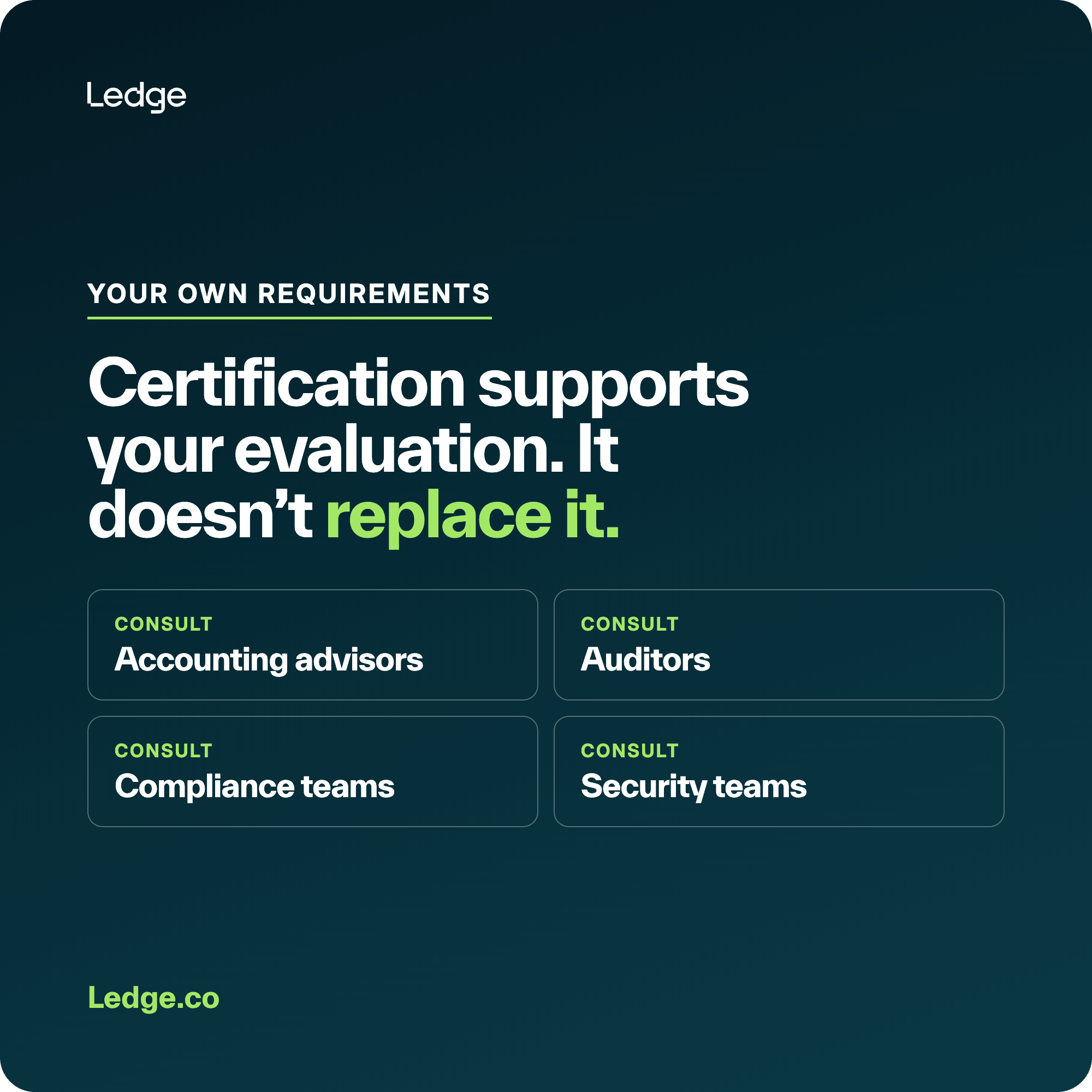
These discussions should inform decisions about data protection, regulatory obligations, access permissions, approval procedures, audit evidence, and the appropriate level of human oversight.
Ultimately, each organization is responsible for determining how AI fits within its existing control environment. Independent certification can support that evaluation, while professional expertise and judgment remain essential to making informed decisions.
Frequently asked questions (FAQ)
1. What is ISO/IEC 42001?
ISO/IEC 42001 is the first international standard for AI management systems (AIMS). It sets requirements for how an organization establishes, implements, maintains, and continually improves the policies, risk management processes, and oversight mechanisms that govern how its AI is developed, deployed, monitored, and maintained.
2. How is ISO 42001 different from SOC 2?
SOC 2 reports on a service provider’s controls over security, availability, and confidentiality of systems and data. ISO 42001 focuses specifically on how AI is governed, including risk assessment, impact assessments, lifecycle management, and accountability. For AI vendors handling financial data, the two are complementary: one addresses how data is protected, the other how AI is managed.
3. Does ISO 42001 certification mean an AI system produces accurate results?
No. ISO 42001 certifies the management system around AI, not the correctness of any individual output. Accuracy in accounting workflows depends on controls such as deterministic calculations, output validation, supporting evidence, and human review. Finance teams should ask vendors how outputs are verified, not just which certifications they hold.
4. What should finance teams ask during a security review of an AI accounting vendor?
Key questions include whether customer data is used to train AI models, how data is isolated from other customers, where it’s stored, and which LLM providers are used and under what terms. Also ask whether agent access mirrors user permissions, how actions are logged, and what approvals are required before anything posts to the ERP.
5. How do auditors review work prepared by AI agents?
Auditors need to trace results back to source data and logic. Ledge’s glass-box approach lets reviewers inspect the source data retrieved from connected systems, the accounting rules applied, the formulas behind workpapers, the documentation attached to draft journal entries, and records of reviews, approvals, and changes.
More resources
Disclaimer: This content is provided for general educational and informational purposes only and should not be relied upon as accounting, financial, legal, tax, or other professional advice. Readers should consult their organization's internal subject matter experts and qualified professional advisors before making decisions based on this information. Any examples, estimates, or performance outcomes are illustrative only, and actual results will vary depending on an organization's specific circumstances, systems, controls, and implementation.