


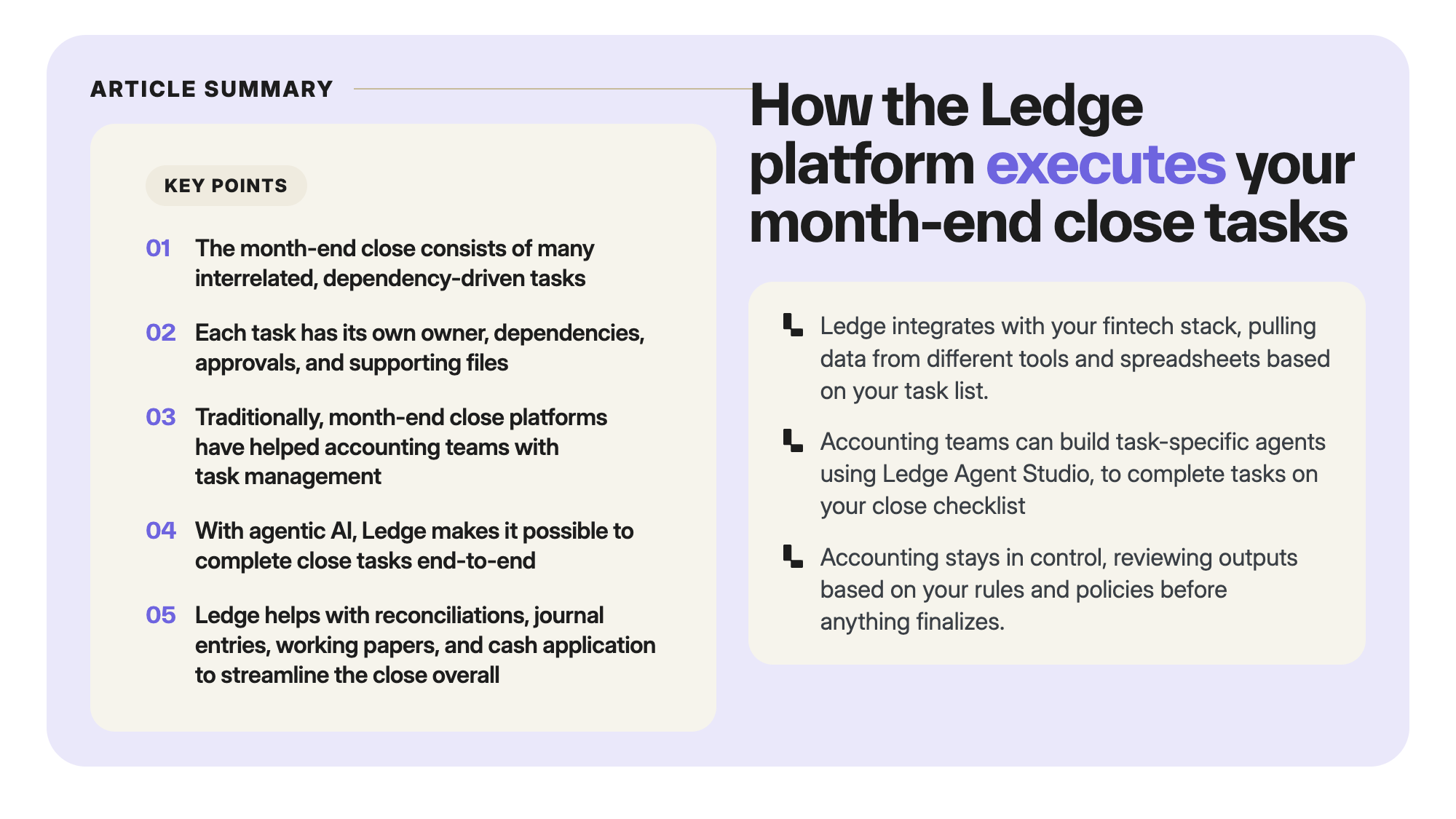
The month-end close is not one workflow. It’s many interrelated, dependency-driven tasks.
- Journal entries being prepared
- Reconciliations that are continuous
- Working papers being rebuilt
- Cash applied
- Exceptions investigated
- Reviews happening across teams
Each task has its own owner, dependencies, approvals, and supporting files.
But the close itself rarely lives in one place.
Task lists live in one tool, and spreadsheets live in folders while approvals happen in Slack or email. Meanwhile journal entries live in the ERP, and status updates happen in meetings.
Finance spends as much time coordinating the close as completing it.
- Who owns this task?
- Is this blocked?
- Did the entry post yet?
- Is this account ready for review?
AI accounting agents can help augment team process by helping get the repetitive work done.
AI accounting agents help execute tasks that finance teams establish, track dependencies, surface risks, and keep every workflow connected. Finance teams operate from one live workspace where progress, evidence, and approvals stay linked to the workflow.
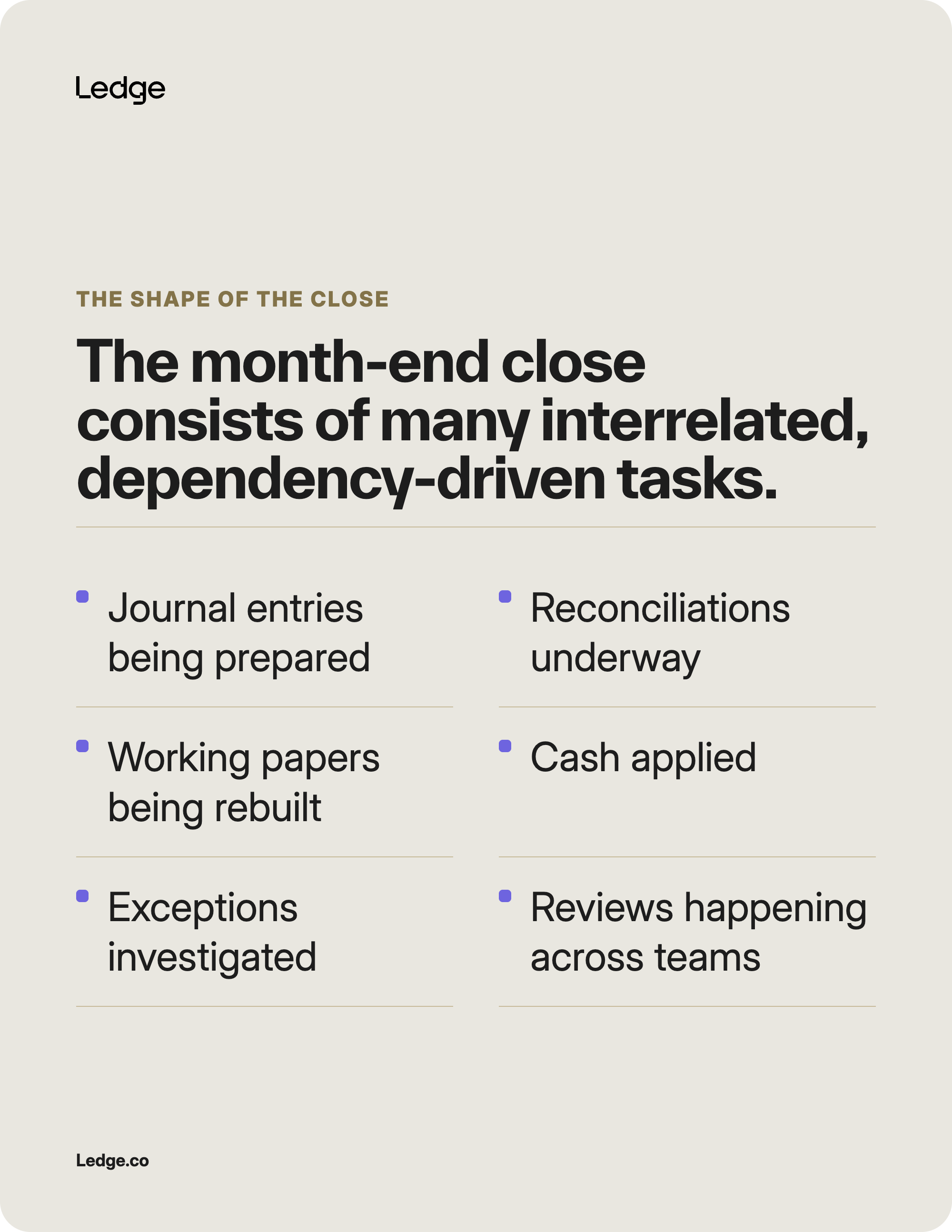
With AI agents helping with getting the work done, the close becomes visible, structured, and easier to manage.
Here are some examples for how this works in Ledge:
1. Ensure every entity, account, and task is covered
(Instead of starting the close from outdated spreadsheets)
The challenge
Most close checklists begin as spreadsheets.
Over time, entities are added. Processes change. Accounts shift ownership.
But the checklist often stays the same. The problem…
- Tasks fall through the cracks
- Ownership becomes unclear
- Teams discover missing work halfway through the close
Even experienced teams start each cycle wondering whether the checklist is complete.
How Ledge solves this
Ledge creates entity-specific close checklists that ensure full coverage across the organization.
Each task includes:
- Defined preparer and reviewer ownership
- Entity-specific responsibilities
- Central group-level tasks where needed
Finance teams maintain one centralized definition of the close while allowing local flexibility across entities.

When the organization structure changes, the checklist adapts automatically.
The close begins with confidence that every required task is accounted for.
2. Make ownership and progress clear across the team
(Instead of chasing updates during the close)
The challenge
Close visibility is often fragmented.
Managers ask for updates in meetings. Teams track progress in separate lists. Blocked tasks only surface when someone raises them.
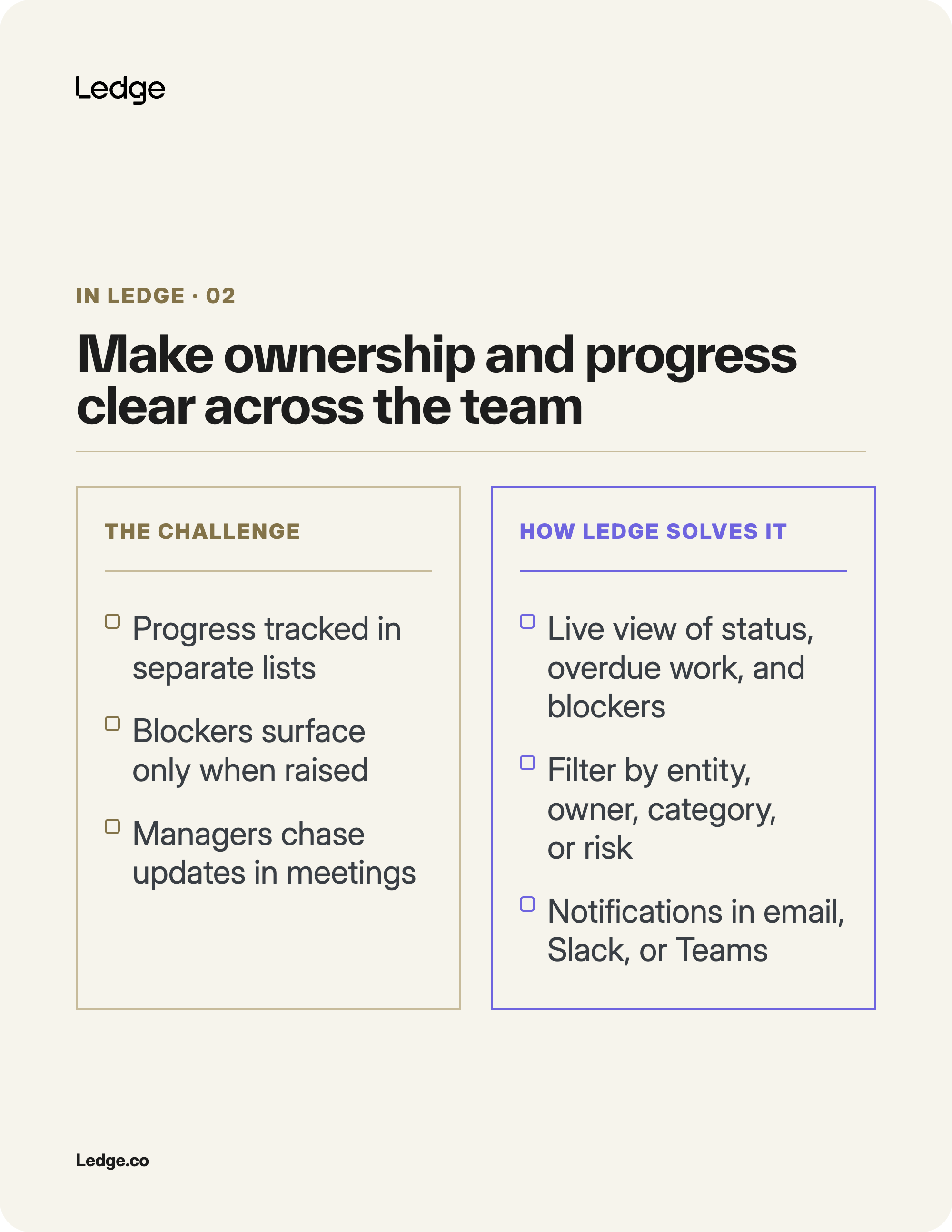
Without a shared view, coordination becomes constant.
- Who owns this reconciliation?
- Why is this task overdue?
- Is the reviewer waiting on the preparer?
These questions slow the close.
How Ledge solves this
Ledge provides live visibility into close progress across the team.
Finance can see:
- Task completion status
- Overdue work
- Blocked dependencies
- Reviewer approvals still pending
Tasks can be filtered and grouped by entity, owner, category, or risk.
Preparer and reviewer assignments are defined directly at the task level, making ownership clear from the start.
Notifications through email, Slack, or Microsoft Teams ensure work continues moving forward without manual follow-ups.
The close becomes self-coordinating.
3. Keep the close moving with dependency-aware workflows
(Instead of discovering blockers halfway through the process)
The challenge
Close tasks rarely operate independently.
Reconciliations depend on transactions being posted. Reviews depend on working papers being prepared. Consolidations depend on entities finishing their work.
When dependencies are tracked manually, tasks often start too early or wait unnecessarily.
This leads to rework, delays, and confusion about what should happen next.
How Ledge solves this
Ledge manages dependencies directly within the close workflow.
Tasks remain blocked until prerequisite work is complete.

Finance teams can clearly see:
- What work can begin immediately
- What tasks are waiting on dependencies
- Where bottlenecks are forming
AI agents monitor workflow progress and surface blocked handoffs in real time.
The close advances in the right order without constant coordination.
4. Keep documentation and approvals connected to the work
(Instead of reconstructing the audit trail later)
The challenge
Close documentation often becomes scattered across systems.
Working papers live in shared drives. Approvals appear in email threads. Supporting evidence is stored separately.
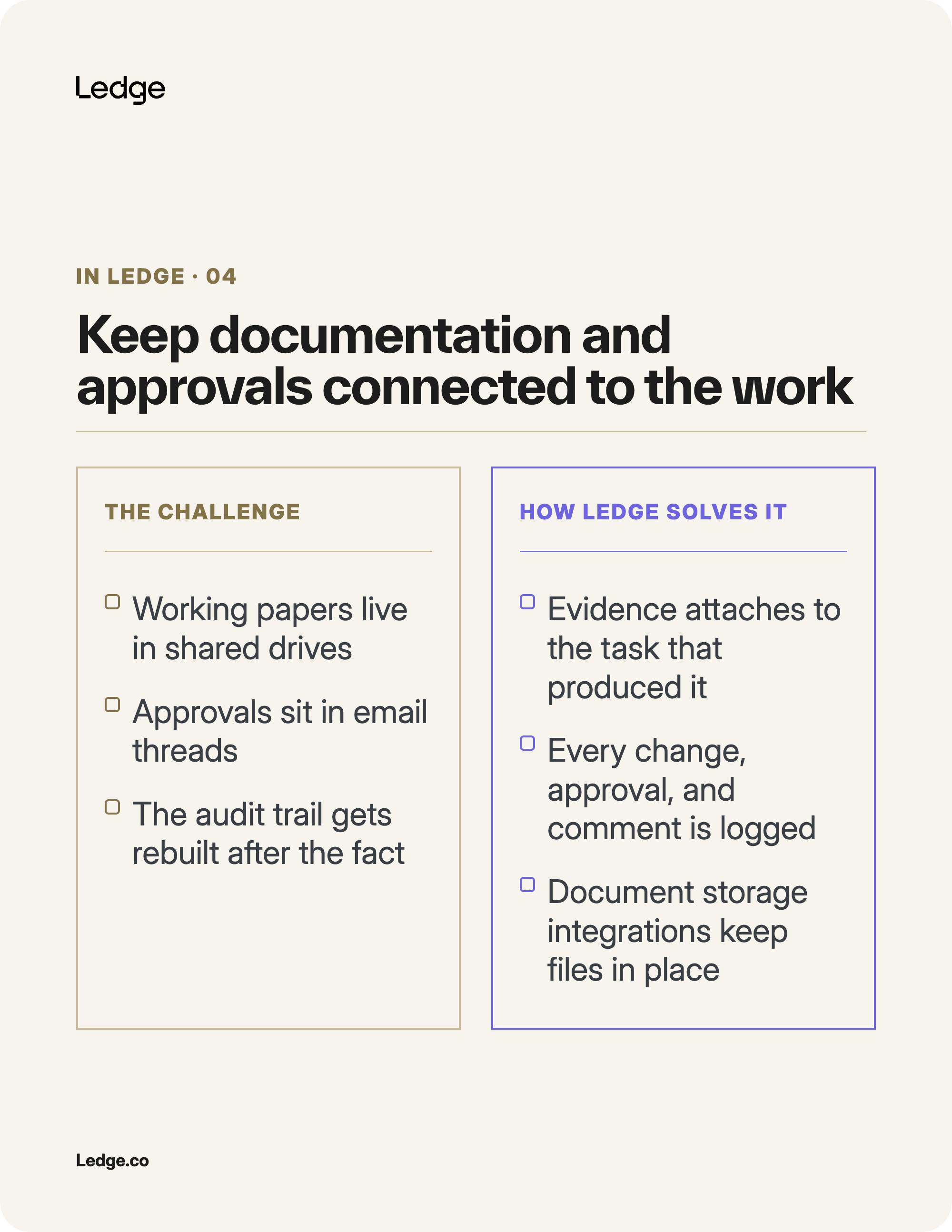
When auditors request documentation, finance teams rebuild the story after the fact.
- Which file supported this entry?
- Who approved it?
- What changed during review?
Reconstructing this trail adds unnecessary work.
How Ledge solves this
Ledge keeps documentation attached directly to the close task that produced it.
Supporting materials can include:
- Working papers
- Source reports
- Approval records
- Reviewer comments
Every task change, approval, reopening, and comment is logged automatically.
Integrations with document storage systems such as Google Drive ensure files remain accessible without duplicating work.
The full audit trail builds itself as the close progresses.
5. Maintain control without slowing the team down
(Instead of choosing between speed and compliance)
The challenge
Finance teams often feel forced to choose between efficiency and control.
More structure means more documentation work. Less structure increases risk during audit review.

Teams spend time maintaining evidence rather than completing the close.
How Ledge solves this
Ledge keeps the close both controlled and efficient. Every workflow action is recorded automatically, including:
- Task completion
- Approvals
- Reopened work
- Supporting comments
The result is a complete, defensible audit trail without additional documentation steps.
Finance teams move faster without weakening internal controls or audit readiness.
AI close orchestration changes how the close runs
Most teams try to improve close performance by pushing harder during peak days.
AI agents can improve the process itself.
Tasks, owners, dependencies, approvals, and supporting evidence all live inside one workspace. AI agents monitor progress, surface blockers, and keep workflows aligned across entities and teams.
Finance remains in control, reviewing work and approving outputs before anything finalizes.
The close becomes structured and visible from start to finish.
When coordination happens automatically, the close feels lighter—not because teams rush less, but because the process no longer depends on manual oversight.
More resources
- What to review before approving AI generated accounting work
- When not using AI becomes the bigger accounting risk
- Statistics on AI usage in accounting (2026 data)