


- AI will change accounting jobs, but automation does not necessarily mean replacement. Repetitive tasks may require fewer manual hours, while responsibilities involving judgment, oversight, analysis, and decision-making become more important.
- Accounting roles will evolve at every organizational level. Practitioners may focus more on reviewing exceptions, managers on designing workflows, controllers on governance, and senior leaders on organizational strategy.
- Entry-level accountants will need new pathways into the profession. Opportunities in financial engineering, data analysis, reporting, data validation, and automation can help early-career professionals develop valuable technical skills and accounting judgment.
- Your greatest advantage is your accounting expertise and organizational insight. Understanding financial processes, internal controls, business dynamics, and how to evaluate AI-generated work will help you remain valuable as technology advances.
What is an AI harness? An example from an accounting use case
Ritika Strauss
//
Published:
November 16, 2026
//
Updated:
November 19, 2026
Article

Company name
About the company


Thank you! Your submission has been received!
Oops! Something went wrong while submitting the form.
See Ledge in action
Key Takeaways
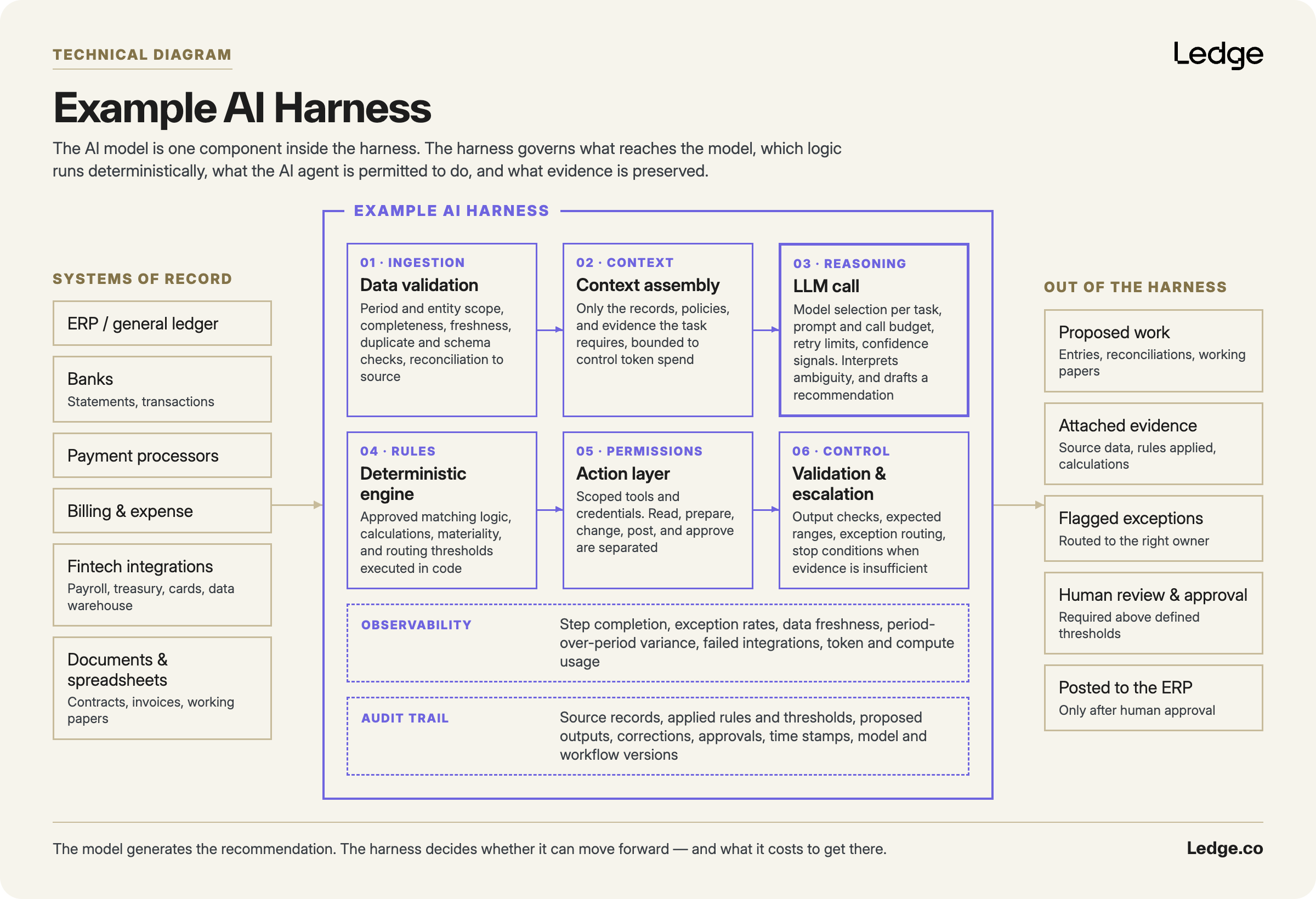
An AI harness is the software layer that surrounds an AI model and turns it into a working system. The model supplies the reasoning. The harness controls everything else: what information the model sees, which tools it can use, what it is allowed to do, how its output is checked, and what happens next.
The term borrows from the equipment used to put an animal’s strength to work. A horse is powerful on its own, but the harness is what connects that power to a plow or a cart and lets a driver steer it. An AI harness plays the same role for a model: it directs raw capability toward a specific job, within limits someone has defined.
The concept isn’t unique to accounting. Any AI product that does real work, from a coding assistant that edits files to a support agent that issues refunds, pairs a model with a harness. That’s why two products built on the same underlying model can behave very differently. The difference is usually in the harness.
A harness typically includes:
- Context management: what information is gathered and passed to the model at each step, and what is left out
- Tools and integrations: the systems the model can read from or act on, such as databases, files, APIs, or an ERP
- Instructions and rules: the standing guidance, policies, and deterministic logic that govern the work
- Orchestration: how a task is broken into steps, which model handles each step, and when the model is called at all
- Guardrails and permissions: limits on what the model can access and do
- Validation and escalation: checks on the model’s output, and rules for when a person needs to step in
- Logging and memory: a record of what happened, and what carries forward to the next run
Put simply, the model answers the question, “What should happen here?” The harness answers, “What is this model allowed to see and do, and how do we know it did it right?”
Why the AI harness matters as much as the model
Many of the teams we talk with have already experimented with general-purpose AI, whether through a quick internal build, a consultant-built pilot, or a team member prompting a chatbot. The early results are often impressive. The trouble starts when the same setup has to run every month, against live data, under audit. Pilots that looked promising turn out to be fragile, and no one can quite explain why an output changed from one run to the next.
This challenge extends well beyond accounting. Gartner predicts that more than 40% of agentic AI projects will be canceled by the end of 2027, citing escalating costs, unclear business value, and inadequate risk controls. Getting an AI model to perform a task is only the beginning. Getting it to perform reliably within a business process is a different engineering challenge.
The harness is what gives the model structure. That structure determines what data the model receives, which accounting rules are applied deterministically, what tools and systems the agent can access, what actions it can take, when human review is required, how its work is validated and recorded, and how model usage and token costs are managed.
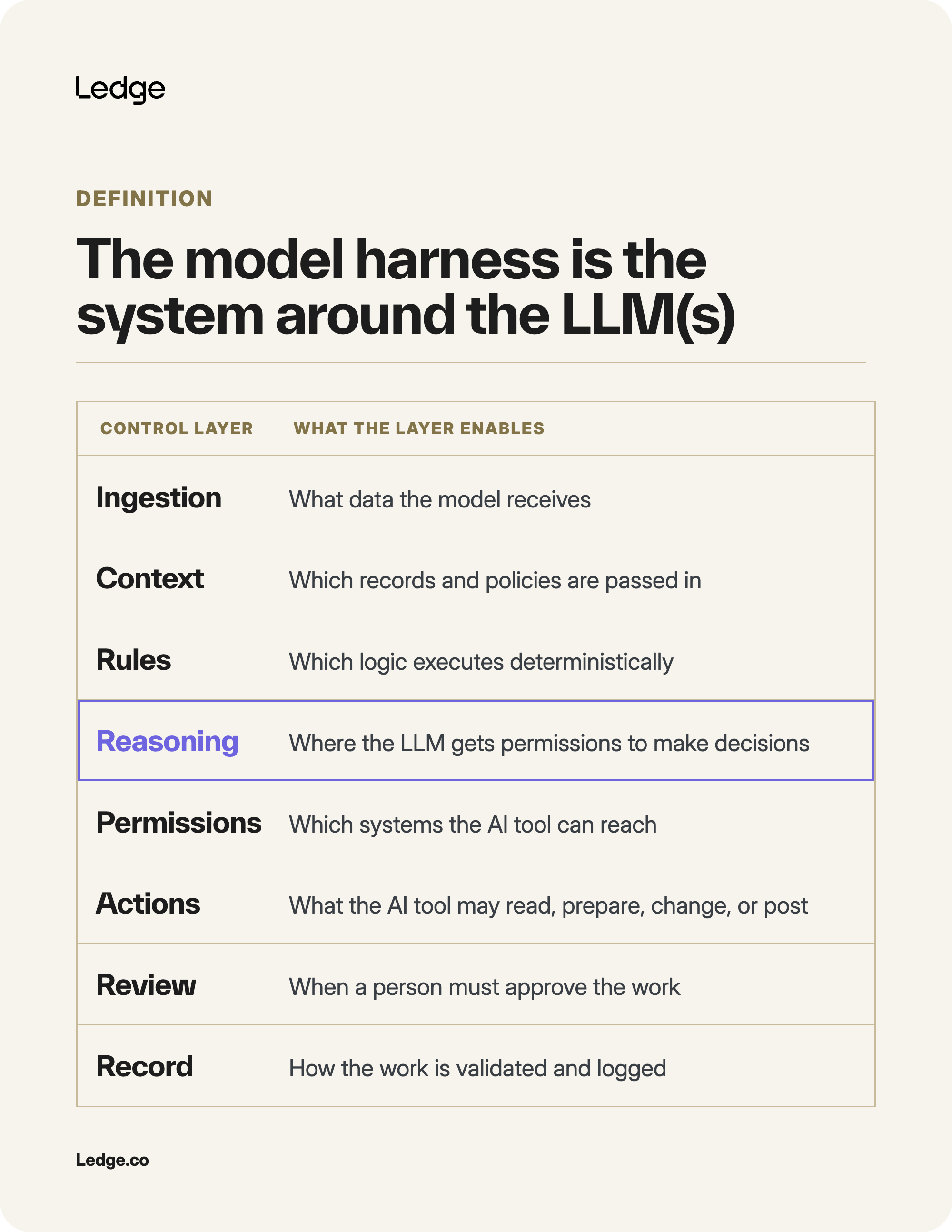
This is why leading AI infrastructure builders build the harness around the underlying models. The value of Ledge, for instance, comes not only from the model’s reasoning capabilities, but from the controls that govern how that reasoning is used within the accounting process: which model is used for which task, how much context is passed into it, when additional model calls are necessary, where deterministic logic should take over, and how unnecessary token consumption is avoided.
Those technical architecture choices directly address both the risks AI introduces into the accounting process and how much AI costs to utilize.
A well-designed harness reduces AI risks while making AI usage more efficient. The harness controls how the model receives information, applies rules, takes action, escalates exceptions, and consumes compute. The harness is also part of what determines whether an AI agent, or multiple AI agents working together, perform safely, responsibly, and reliably.
An example from accounting: reconciling a bank account
To make the idea concrete, consider one of the most common tasks in the month-end close: reconciling a cash account.
The model on its own
Imagine an accountant exports the bank statement and the general ledger cash detail to CSV files, pastes both into a general-purpose AI chat, and asks it to reconcile them.
The model will probably return something that looks finished: a list of matched items, a short list of unmatched ones, and perhaps a proposed adjusting entry.
But much of the process is left to chance. No one confirmed that both files cover the same dates or that the export captured every transaction. The model may pair items because the amounts look similar rather than because they meet your matching rules, and if you run the same request tomorrow, some matches may change. It can’t post anything to the ERP, it leaves no reliable record of how it reached its conclusions, and nothing stops a plausible but incorrect entry from being keyed in by hand.
The reasoning may be good. The process around it isn’t controlled.
The same task inside a harness
Now consider the same reconciliation performed by an AI agent operating inside a well-designed harness.
- Gather the data. The harness pulls the statement directly from the bank feed and the cash activity from the ERP using read-only credentials, rather than relying on manual exports.
- Validate the inputs. Before any reasoning begins, it confirms the reporting period, date coverage, and record counts, and checks that the opening balance ties to last month’s reconciliation. If the bank feed is incomplete, the run stops and the owner is alerted.
- Apply deterministic matching. Approved rules handle most of the work the same way every month: one-to-one matches on amount, date, and reference, plus defined rules for batched deposits, fees, and other one-to-many or many-to-many cases.
- Use the model where judgment helps. Only the leftovers go to the model, such as a deposit with a truncated memo, a credit with no reference, or a bulk transfer that may cover several items. The model proposes a match or an explanation and shows the evidence behind it.
- Check and route the output. Proposals within tolerance and below a materiality threshold can be accepted. Anything material, unfamiliar, or uncertain is routed to an accountant with the full context.
- Prepare, don’t post. Where an adjustment is needed, the agent drafts the journal entry with a working paper attached. A person reviews and approves it, and the ERP’s own approval workflow still applies.
- Record everything. Source data, rules applied, model suggestions, human decisions, and timestamps are saved together, so a reviewer or auditor can trace any line back to where it came from.
The model in both scenarios could be exactly the same. What changed is everything around it, and that is the difference between an impressive demo and a reconciliation a controller can sign off on.
This mirrors what we see in practice. Teams rarely struggle because a model can’t interpret a bank memo. They struggle because their bank doesn’t connect cleanly to the ERP, because credits arrive with no reference to match against, or because a reconciliation ties out in total while individual items don’t. Those are harness problems, and solving them is most of the work.
The risks an AI harness controls for in accounting
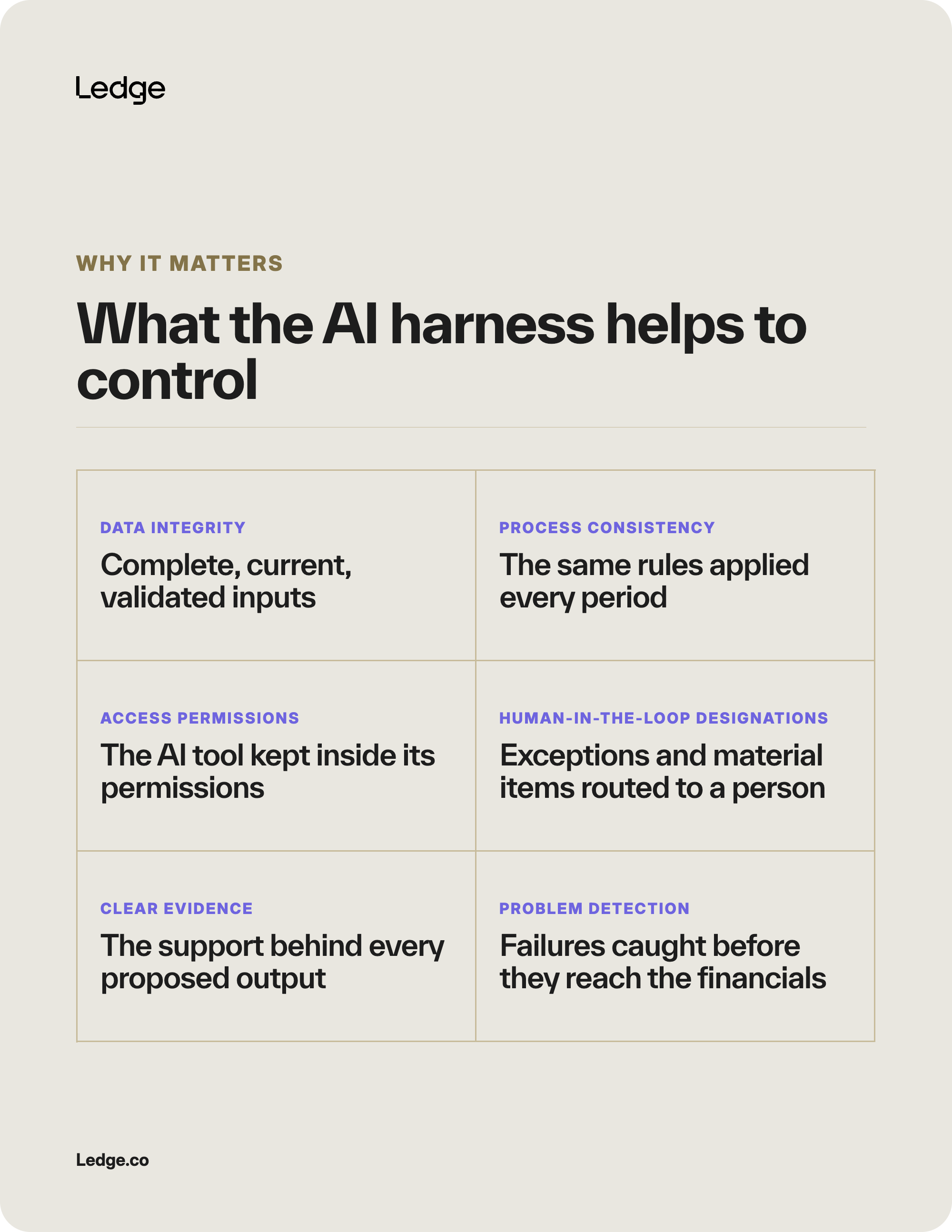
Here are the most important risks the AI harness needs to control for.
1. Incorrect or unsupported conclusions
AI models can produce answers that sound reasonable even when the underlying conclusion is incomplete or incorrect.
In accounting, that could mean:
- Suggesting the wrong transaction match
- Misclassifying an expense
- Applying the wrong accounting treatment
- Drafting an unsupported journal entry
- Misinterpreting an invoice or contract
- Explaining a variance using incomplete evidence
- Missing a material exception
The risk increases when the model is working with incomplete, inconsistent, or ambiguous information.
This is often the first concern finance leaders raise with us, and for good reason. Some have already watched an untested AI rollout misallocate an entire batch of AP. Others simply know what’s at stake: a wrong number that looks right is more dangerous than an obvious error, because it’s less likely to get caught.
These concerns are widespread. In a 2026 study commissioned by the Institute of Chartered Accountants of Scotland (ICAS), 72% of accounting professionals surveyed expressed concern that generative AI could produce errors or incorrect decisions.
How the AI harness controls for it
The AI harness should control what happens before and after the model produces a recommendation.
It can:
- Link conclusions to source data and supporting evidence
- Show the rules, assumptions, and calculations used
- Flag uncertain results
- Escalate unfamiliar or material items
- Prevent unsupported conclusions from moving forward automatically
- Require approval before higher-risk actions are completed
- Stop the workflow when the available information is insufficient
The AI model may generate the recommendation. The model harness determines whether that recommendation can move forward.
2. Incomplete or incorrect source data
AI can only work with the information it receives. If the source data is incomplete, duplicated, outdated, or tied to the wrong reporting period, the AI agent may still produce a polished result.
For example, the AI agent could:
- Reconcile only part of the transaction population
- Use a prior-period report
- Miss transactions from a delayed source
- Process duplicate records
- Compare datasets covering different dates
- Use inconsistent identifiers across systems
The accounting logic may be sound while the underlying population is wrong.
Teams tell us this is the source of a lot of anxiety. In implementation work, we regularly see a bad reconciliation trace back to missing fields in a settlement file, an unstable data pipeline, or a source that only partially uploaded. Controllers also worry about what never shows up at all: an autopay that bypassed AP, or a transaction that belongs in the period but surfaces months later, when auditors start testing for unrecorded liabilities.
How the AI harness controls for it
The harness should validate inputs before the model begins working.
Checks can include:
- Reporting period
- Required source systems
- Data freshness
- Expected versus actual record counts
- Required fields
- Duplicate files or transactions
- Data structure
- Completeness of the transaction population
- Reconciliation to authoritative systems
Where possible, the AI harness should pull data directly from source systems rather than rely on manually prepared uploads.
Input validation should happen before the model begins reasoning over the data.
3. Inconsistent application of accounting rules
AI models are probabilistic. Their outputs can vary depending on context, prompting, model version, and the information available.
That flexibility is useful when the agent needs to interpret an unfamiliar transaction or review an unstructured document. It is less useful for accounting rules that should be applied consistently.
Accountants have a sharp instinct about this. When we walk teams through the build of an AI agent, one of the questions we hear most is some version of: if I run this again next month on the same kind of data, will I get the same answer? For an accounting team, reproducibility isn’t a nice-to-have. It’s what lets a reviewer sign off with confidence.
Matching logic, calculations, materiality thresholds, approval paths, and structured system updates should behave the same way every time.
How the AI harness controls for it
The harness should separate AI reasoning from deterministic execution.
Use AI reasoning for:
- Ambiguous transactions
- Unstructured documents
- New exceptions
- Explanations
- Recommendations that require review
Use deterministic logic for:
- Approved matching rules
- Calculations
- Data transformations
- Required-field checks
- Materiality thresholds
- Routing rules
- Structured system updates
Once a rule has been defined, tested, and approved, the harness should apply it consistently.
That reduces variation and makes the workflow easier to reproduce, review, and audit.
4. Excessive access and permissions
Accounting AI agents may need access to sensitive financial data and core accounting systems across your fintech stack. They may also be able to update reconciliations, prepare journal entries, change workflow statuses, or write information back to the ERP.
Each additional permission increases the impact of a potential error.
This is one of the most concrete questions we get on calls. Prospects ask point-blank whether an AI agent could delete records in their ERP. Many arrive with a clear rule already in mind: read-only access everywhere except the ERP, where the agent may prepare entries, and where no entry can be prepared and approved by the same user. Others ask how to keep agents away from data that only one person on the team should see, like payroll. These instincts are exactly right, and a good harness should make them easy to enforce.
How the AI harness controls for it
The harness should enforce least-privilege access. Permissions can be separated by action, including:
- Reading data
- Analyzing information
- Preparing proposed work
- Recommending an action
- Updating workflow status
- Writing information to the ERP
- Posting an entry
- Approving an entry
The AI agent should receive only the access required for the specific workflow. The harness should also prevent the agent from approving its own work or bypassing segregation-of-duties requirements.
For many use cases, that means beginning with read-only access and expanding permissions gradually.
5. Missing human review
Some accounting tasks can be automated safely under predefined conditions. Others require judgment.
Material transactions, unusual exceptions, conflicting evidence, new accounting treatments, and higher-risk system actions may require review by an accountant.
The finance leaders we speak with are asking exactly where a person sits in it: who prepares, who reviews, who approves, and whether their existing ERP approval workflows still apply. Once they can see that clearly, the conversation usually shifts from whether to trust the agent to which work to start with.
How the AI harness controls for it
The AI harness should define when human review is required. For example, it may escalate work when:
- A transaction exceeds a materiality threshold
- Required evidence is missing
- Evidence conflicts
- The model encounters an unfamiliar exception
- The proposed treatment falls outside approved rules
- A higher-risk system action is required
Lower-risk work can continue automatically when predefined conditions are met.
Higher-risk work can be routed to the appropriate reviewer.
This makes human judgment part of the workflow rather than a final check applied to every output.
6. Poor auditability
A final answer is not enough for accounting work. Reviewers and auditors may need to understand:
- What data was used
- Which rules were applied
- Which calculations were performed
- Which exceptions were identified
- What the agent proposed
- What the agent changed
- Who reviewed the work
- Who approved it
- When each action occurred
If that information is not preserved, the work may be difficult to validate later.
Many finance organizations are still developing these capabilities. BDO's 2026 Audit Innovation Survey found that only 49% of surveyed senior finance leaders reported having the documentation and processes needed to explain and substantiate all AI-assisted financial outputs.
Auditor comfort comes up in nearly every evaluation we’re part of. Teams want to know whether their auditors will accept AI-prepared working papers, and few want to be the first company to find out. Many also carry recent memories of audits that consumed days of pulling support together for a sample of transactions. They know that whatever an agent produces will eventually face the same scrutiny, and they want the evidence to already be there when it does.
How the AI harness controls for it
The model harness should create an audit trail as the work happens.
That can include:
- Source records
- Supporting documentation
- Applied rules and thresholds
- Model and workflow versions
- Proposed outputs
- Exceptions
- Human corrections
- Approval records
- System changes
- Time-stamped activity
The reviewer should receive the full context behind the output rather than an isolated model response. Auditability should be built into the workflow from the beginning.
7. Sensitive data exposure
Accounting AI agents may work with highly sensitive information, including:
- Bank transactions
- Customer and vendor records
- Payroll data
- Invoices and contracts
- Account balances
- Journal entries
- Internal forecasts
- System credentials
Giving the model access to more information than it needs creates unnecessary risk.
Security review is often where evaluations slow down, and understandably so. Teams ask us how credentials for banks and payment processors are stored, whether their financial data is shared with or retained by third-party model providers, and which attestations, such as SOC 1 and SOC 2 Type II reports, a vendor can provide. For many organizations, those reports are the threshold for relying on any system in the close.
How the AI harness controls for it
The model harness should apply data-minimization principles. That means controlling:
- Which data sources the agent can access
- Which fields it can retrieve
- Which tools it can use
- Which systems it can modify
- How credentials and API keys are secured
- Where prompts, outputs, and activity logs are retained
- Which users can create or modify agents
- Which vendors and subprocessors handle the data
The AI agent should receive only the information required for the task it is performing.
8. Operational and integration failures
An accounting AI agent depends on more than the model. The workflow may also rely on:
- APIs
- Credentials
- ERP connections
- Source reports
- Banks
- Payment processors
- Spreadsheets
- Cloud platforms
- Workflow logic
Any of these components can fail.
A credential may expire. An API may become unavailable. A report format may change. A source system may stop updating.
These are the unglamorous issues that come up constantly in real implementations: a primary bank that doesn’t connect natively to the ERP, a bank feed that quietly moved from live updates to twice a day, credentials waiting on the one person who can provide them, and new bank connections that take weeks to approve. None of these are AI problems, but any one of them can stop an AI workflow cold.
How the AI harness controls for it
The harness should detect and respond to failures across the workflow. It should be able to:
- Detect failed or incomplete steps
- Prevent downstream work when an upstream dependency fails
- Show what has already been completed
- Preserve prior results
- Prevent duplicate actions
- Alert the appropriate owner
- Resume safely from a known point
- Support a manual fallback
The accounting team should know how the close will continue if part of the workflow becomes unavailable.
9. Silent failures
Visible failures are usually easier to manage. Silent failures are harder. A workflow may technically complete even though:
- A source report changed structure
- A system stopped updating
- A field was mapped incorrectly
- An accounting rule became outdated
- A model or prompt change affected the output
- Part of the workflow did not complete
The output may still appear valid.
This is the scenario experienced controllers worry about most, because it mirrors what they already fear in manual closes: the reconciliation that ties out in total while individual transactions don’t, or the amounts that match only by coincidence. What finance leaders tell us they want isn’t just a process that finished. It’s the confidence that everything running through the GL is actually right.
How the AI harness controls for it
The harness should monitor the accounting result, not only whether the software finished running. Checks can include:
- Expected record counts
- Data freshness
- Source availability
- Output completeness
- Exception rates
- Unusual period-over-period changes
- Required workflow steps
- Expected ranges
- Reconciliation status
A completed workflow should mean that the accounting requirements were satisfied.
This distinction between monitoring an AI agent and validating its work is increasingly important. LangChain's 2026 State of Agent Engineering survey found that 89% of respondents used observability tools, but only 52% conducted offline evaluations and 37% evaluated agents against live production activity. Knowing that an agent completed a task isn't the same as knowing it completed the task correctly.
10. Changes in the accounting environment
Accounting processes change over time. A company may add new entities, update its chart of accounts, change approval thresholds, introduce new accounting policies, add financial systems, or migrate to a new ERP.
The AI infrastructure can also change. Models, prompts, tools, integrations, and workflows evolve.
Internal audit teams are increasingly focused here. We hear growing requests for change management over the agents themselves: a draft, test, and deploy process; a record of who changed an agent and when; the ability to revert; and separation between the people who request agent changes and the people who implement them. Some teams want a regular report of new or modified agents so a reviewer can confirm each one still behaves as expected. Underneath it all is a fair question: if an agent was modified or retired mid-year, can you show your auditor exactly how it worked when it produced a given result?
How the AI harness controls for it
A production model harness needs ongoing ownership and versioning. Teams should define responsibility for:
- Monitoring performance
- Maintaining integrations
- Reviewing permissions
- Updating accounting rules
- Incorporating policy changes
- Testing model and prompt changes
- Running regression tests
- Maintaining documentation
- Responding to incidents
- Approving material workflow changes
The accounting team should know which version of the workflow, rules, and model governed a given result.
11. Automating a poor process
AI can make an inefficient process faster. If the existing close relies on unnecessary handoffs, duplicate spreadsheets, inconsistent rules, or unclear ownership, automation may preserve those problems.
Many teams sense this before they ever buy anything. Some describe a wall of cleanup work they expect to face before automation can even begin: undocumented spreadsheets that only their owner understands, inconsistent standards across entities, and checklists rebuilt by hand each month. That realization can feel discouraging. But it’s also an opening, because defining an agent’s rules forces exactly the documentation and standardization these teams have wanted for years.
How the AI harness controls for it
Harness design should begin with the workflow itself. Before automating a process, ask:
- Is every step necessary?
- Is the accounting rule clearly defined?
- Are multiple systems duplicating the same work?
- Can handoffs be reduced?
- Is required supporting evidence clearly established?
- Is ownership clear?
- Should the process change before it is automated?
The goal is to improve the operating model rather than reproduce the existing process with AI.
How does an AI harness create better AI agents?
A high-performing accounting AI agent depends on the full system around the model. As more finance organizations move toward agentic AI, the design of the surrounding system, the AI harness, becomes increasingly important. BDO's 2026 Audit Innovation Survey found that 47% of surveyed senior finance leaders were piloting or deploying agentic AI, while another 46% were evaluating it.
That surrounding system should control:
- Inputs: Whether the model receives complete, current, validated information
- Context: Whether the model has the evidence and accounting context required for the task
- Reasoning: Where AI interpretation is appropriate
- Rules: Which parts of the workflow should execute deterministically
- Tools: Which systems the agent can interact with
- Permissions: What the agent can read, prepare, change, post, or approve
- Approvals: When human review is required
- Validation: What must be true before work moves forward
- Escalation: When the agent should stop and route the work for review
- Auditability: What evidence is preserved
- Monitoring: How failures and unusual results are detected
- Maintenance: How the workflow stays current as systems, policies, and models change
These controls determine how reliably the model can perform inside an accounting workflow.
The AI harness determines how accounting AI performs
AI models will continue to improve. For accounting teams, improved model performance is only part of the equation.
The model harness determines what information reaches the model, what rules govern the workflow, what the agent can access, what actions it can take, how its work is checked, and when an accountant needs to step in.
That makes the harness a critical part of accounting AI performance.
A high-performing harness helps the model work with the right data, applies established rules consistently, limits unnecessary access, validates outputs, catches failures, and preserves the evidence needed to review the work.
Those controls are what make accounting AI reliable for scalable, production-ready workflows.
Frequently asked questions (FAQs)
1. What is an AI harness?
An AI harness is the software infrastructure surrounding an AI model that controls how it performs tasks. It manages the information the model receives, the tools it can use, the rules it follows, the actions it can take, and how its outputs are validated. The model provides reasoning capabilities, while the harness makes those capabilities usable within a defined business workflow.
2. What is the difference between an AI model, an AI agent, and an AI harness?
An AI model interprets information, reasons, and generates outputs. An AI agent uses a model to carry out tasks, often by interacting with external tools and systems. The AI harness is the infrastructure that makes those interactions possible and governs how the agent operates. An agent's reliability depends on both the model's capabilities and the controls built into its harness.
3. Can two AI agents using the same model produce different results?
Yes. Two agents can use the same underlying AI model but operate with different instructions, data sources, tools, accounting rules, validation checks, and permissions. These differences can significantly affect their accuracy, consistency, security, and performance. Model selection matters, but harness design determines how the model's capabilities are applied to a specific workflow.
4. How does an AI harness reduce hallucinations and accounting errors?
An AI harness cannot eliminate hallucinations, but it can reduce the likelihood that unsupported conclusions affect accounting records. It can validate source data, apply deterministic calculations and matching rules, require supporting evidence, check outputs against predefined conditions, and escalate uncertain or material items for human review. The goal is to prevent an incorrect model recommendation from becoming an approved accounting action.
5. Does an AI harness replace human review?
No. A well-designed harness determines when human review is necessary and when work can proceed automatically under approved rules. Routine, lower-risk tasks may require less intervention, while material transactions, unusual exceptions, accounting judgments, and higher-risk actions may require approval. In accounting, the harness should preserve existing approval requirements and segregation-of-duties controls.
6. How does an AI harness make accounting automation auditable?
An AI harness can preserve the source records, accounting rules, calculations, model outputs, exceptions, approvals, and system changes associated with each task. This creates a traceable record of how an accounting result was produced, what the agent recommended, and who reviewed or approved the work. Auditability depends on how these controls are implemented, not simply on whether the AI system maintains activity logs.
7. Does a better AI harness reduce the cost of running AI agents?
It can. A harness can reduce unnecessary model calls, limit how much information is passed to a model, select different models for different tasks, and use deterministic software for calculations and rules that do not require AI reasoning. These choices can reduce token consumption and compute costs while improving consistency. The actual savings depend on the workflow and how the harness is designed.
More resources
Disclaimer: This content is provided for general educational and informational purposes only and should not be relied upon as accounting, financial, legal, tax, or other professional advice. Readers should consult their organization's internal subject matter experts and qualified professional advisors before making decisions based on this information. Any examples, estimates, or performance outcomes are illustrative only, and actual results will vary depending on an organization's specific circumstances, systems, controls, and implementation.
Learn how Ledge can help govern your accounting AI
Set up a demo, ask about our model harness