


- Payment reconciliation is a persistent bottleneck for accounting teams. High transaction volumes, disconnected financial systems, and recurring exceptions can consume days of work during the month-end close.
- AI agents can automate matching across the full payment lifecycle. By connecting banks, payment processors, billing platforms, and ERPs, agents can reconcile transactions without requiring accountants to manually combine spreadsheets.
- AI can handle complex matching scenarios. Agents can identify one-to-many and many-to-one relationships, account for processing fees, FX differences, refunds, and settlement delays, and distinguish expected differences from genuine exceptions.
- Reliable automation requires transparency and controls. Finance teams should be able to inspect matching logic, trace transactions to source records, review supporting evidence, and retain authority over journal entry approvals.
- Exception management becomes more efficient with context. AI agents can surface discrepancies alongside related transactions, potential explanations, and supporting documentation so accountants can focus on issues requiring judgment.
- Continuous reconciliation reduces month-end pressure. Running matching and exception monitoring throughout the month helps prevent unresolved differences from accumulating at close.
- The goal is to give accountants more control, not less. With repetitive matching automated, finance teams can focus on investigations, approvals, financial analysis, and other responsibilities that require their expertise.
Payment reconciliation with AI: What to know before automating your workflows
Mike Lamie
//
Published:
November 2, 2026
//
Updated:
November 19, 2026
Article

Company name
About the company


Thank you! Your submission has been received!
Oops! Something went wrong while submitting the form.
See Ledge in action
Key Takeaways
Something I hear in conversations with AR leads, controllers, and finance directors: payment reconciliation keeps coming up as the job nobody can get off their plate. It's work that takes up a lot of focus, taking time away from accountants and controllers looking to make a bigger contribution to the business.
For instance, one e-commerce team shared with us that every month they pull their PayPal activity into a CSV and match thousands of transactions to incoming payments, one by one.
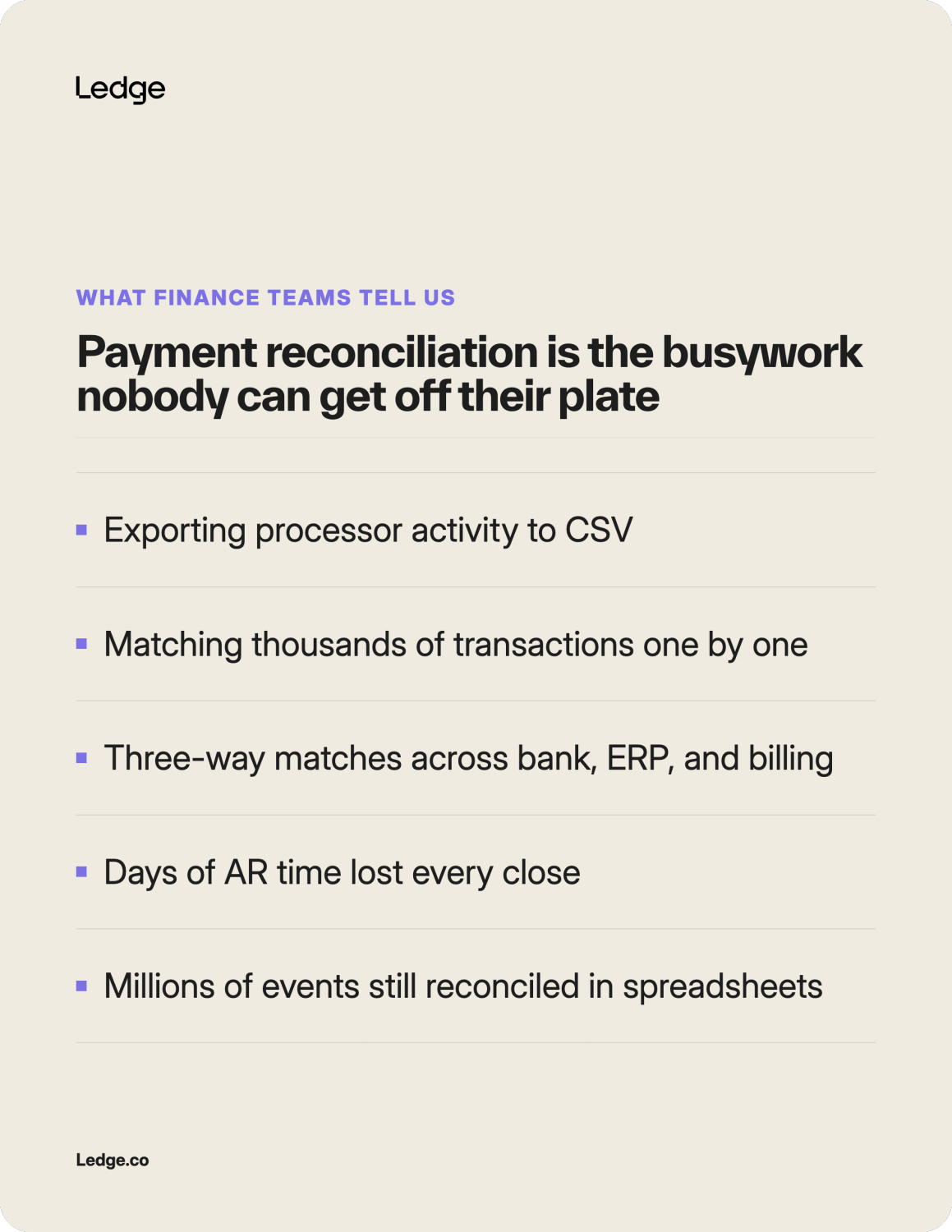
A subscription hardware company described what was essentially a three-way match: a batch settlement in the bank, a journal entry per transaction in NetSuite, and the customer detail that ties them together sitting in their billing system. It was costing their AR team three days of every close. A third team was processing hundreds of millions of events a month across four payment processors, and still told me most of their recons were done manually in spreadsheets.
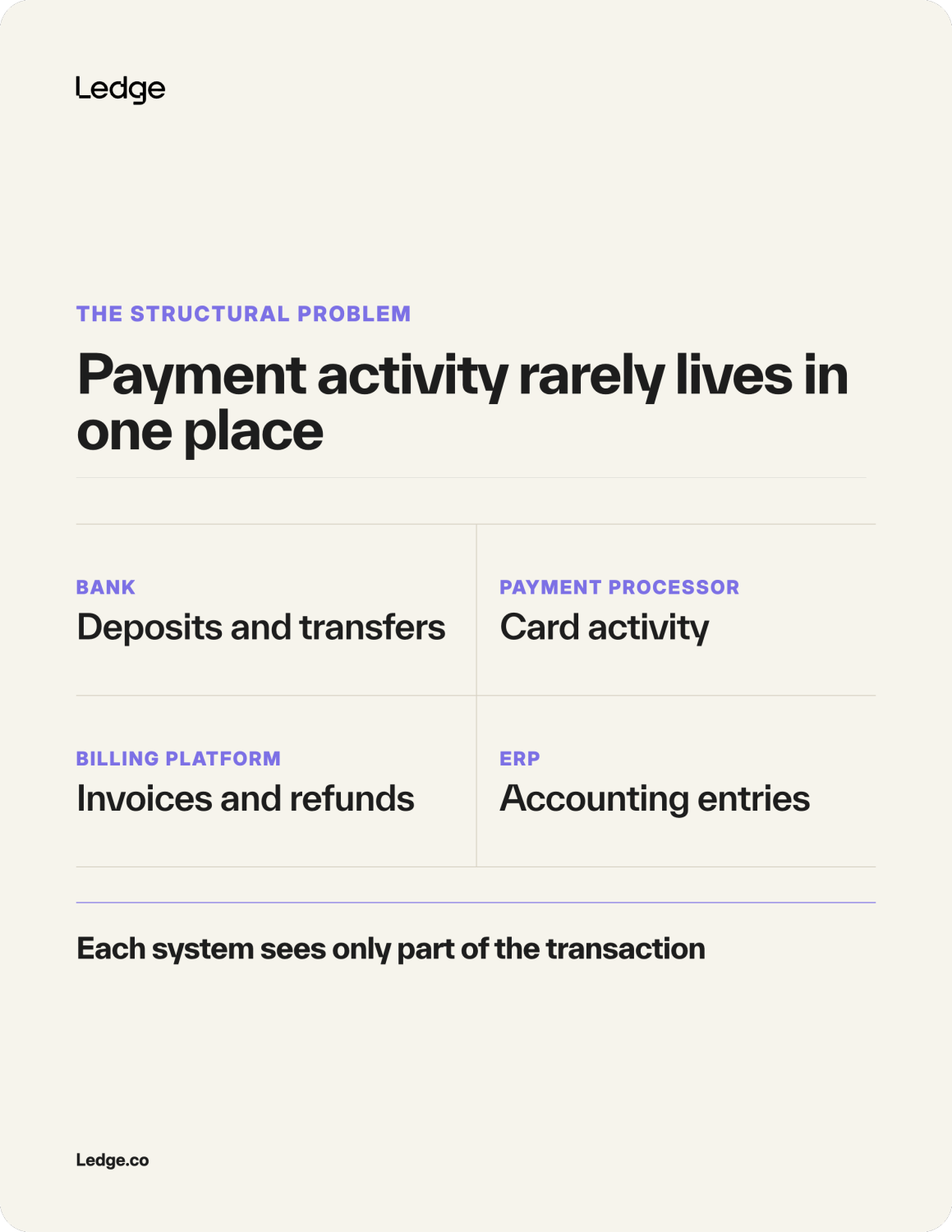
None of these teams had a bad process. The problem is structural. Payment activity rarely lives in one place:
- Banks process deposits and transfers
- Payment processors manage card activity
- Billing platforms track invoices and refunds
- Your ERP records the accounting entries
Each system sees only part of the transaction, and reconciling those payments means stitching those pieces together.
- Payouts arrive days after transactions
- Platform fees are netted inside deposits
- Refunds appear in different systems
- Chargebacks surface weeks later
- FX differences create small mismatches
Teams end up exporting reports, lining up spreadsheets, and investigating differences manually. The work is repetitive, but the complexity never goes away.
AI accounting agents can help. Instead of rebuilding reconciliation schedules from multiple exports, AI agents pull transactions across systems, match activity automatically, and surface exceptions with context. Finance reviews differences, resolves what requires judgment, and the reconciliation stays traceable end to end. The process shifts from reactive cleanup to continuous oversight.
What finance teams should consider before trusting AI agents with reconciliation
Of course, automating reconciliation is only valuable if finance teams can trust the results. Nearly every team I talk to raises some version of the same concerns, and they're important questions to ask before putting AI into a financial workflow.
The question is rarely whether AI can perform reconciliation. It's whether it can perform reconciliation consistently, with the controls, documentation, and accountability that accounting requires.
"How do I know it isn't making things up?"
One CFO asked me directly why his team couldn't just do this with Claude. His underlying concern was consistency: an LLM can return a different answer each time and leave nothing an auditor can follow.
The safeguard: A well-designed agent addresses this by generating deterministic logic and a structured plan once, then executing that logic consistently each period. Every match, formula, and assumption remains visible and traceable to the source data.
"Will our auditors accept it?"
Finance teams preparing for an IPO or subject to SOX 404(b) requirements often raise this question early.
The safeguard: The key is documentation. Each reconciliation should include source tracebacks, an activity log, comments, and sign-offs. Every journal entry posted to the ERP should link back to the supporting workpaper and the person responsible for preparing and approving it.
"Who controls what gets posted?"
No controller wants an AI agent booking entries without appropriate oversight.
The safeguard: The right setup keeps humans in control of approvals, respects the permissions already configured in the ERP, and preserves existing approval workflows. A proposed entry can enter the ERP's approval queue like any other, with the appropriate reviewer deciding whether it gets posted.
"What about our data?"
InfoSec teams want to know where financial data is stored, how it's encrypted, and whether it's used to train third-party models.
The safeguard: Those questions deserve documented answers, including a SOC 2 Type II report, clear contractual commitments about model training, and access permissions scoped to the finance workflows the agent needs to perform.
Building AI payment reconciliation agents with Ledge: What accounting teams should know
AI agents can take on much of the repetitive work involved in payment reconciliation, from matching transactions across disconnected systems to investigating differences and preparing supporting documentation.
But finance teams need more than automation. They need workflows that produce consistent results, maintain an audit trail, and keep accountants in control of financial decisions.
Ledge is designed around these requirements. Its AI accounting agents combine automated transaction matching with reusable logic, exception management, and human approval controls. Here's how this technical concept works in practice.
1. Connecting the full payment lifecycle, from transaction to settlement
The problem AI can help fix
A single payment can generate multiple records across different systems. The customer transaction appears in a payment processor, the invoice or refund lives in a billing platform, and the settlement arrives in the bank. Meanwhile, the ERP holds the corresponding accounting entries.
None of these systems independently reconciles the full lifecycle of a payment.
Finance teams often rely on separate exports to connect these records. Even when the underlying data is correct, differences in timing and formatting make the process difficult.
Ledge's approach
Ledge connects directly to banks, payment processors, billing platforms, ERPs, and other internal systems.
Its AI agents pull transaction data across these sources and automatically match related activity. Payouts reconcile to bank deposits, refunds match across billing and processor records, and chargebacks tie back to their original transactions.
Accounting teams can follow the full payment lifecycle in one reconciliation workflow, with every match traceable to its source.
My take
When I demo this, I start with a single payment's full story: from the order or invoice in the billing system, through the processor, to the net settlement that lands in the bank. Refunds, fees, and chargebacks are broken out along the way, so the deposit in the bank is fully explained before anyone opens a spreadsheet.
Instead of comparing spreadsheets, my goal is to help accounting sees a unified reconciliation view across systems.
2. Reconciling transactions even when the data doesn't match perfectly
The problem AI can help fix
Payment data rarely arrives in a consistent format:
- Processor payouts may bundle hundreds of transactions.
- Memo fields contain vague descriptions.
- Transaction references may be incomplete or missing.
- Amounts may differ because of rounding or FX conversions.
Traditional reconciliation tools often rely on exact matches. When references or amounts don't align, transactions become exceptions that accountants need to investigate manually.
Ledge's approach
Ledge uses AI to evaluate transactions in context, considering amounts, transaction groupings, timing differences, entity relationships, historical matching patterns, and unstructured descriptions.
This enables the system to identify one-to-many and many-to-one relationships, even when the data is incomplete.
When finance confirms or corrects a match, that feedback can inform reusable, deterministic matching rules. Accountants retain visibility into the logic and review exceptions requiring judgment.
My take
The question I get most in demos is whether the system learns, and if it does, how anyone knows what it's doing. When finance corrects or confirms a match, that feedback becomes part of the matching logic. Recurring patterns turn into deterministic rules that run the same way every period, with approvals and an audit trail, so the system improves without becoming a black box.
Finance reviews edge cases, but the majority of matching happens without manual intervention.
3. Account for fees, FX, and timing differences automatically
The problem AI can help fix
Payment processors may deduct fees before settlement, currency conversions can introduce variances, and transactions may appear in different accounting periods across systems.
These are normal aspects of payment processing, yet traditional reconciliation workflows often surface them as unexplained mismatches.
Ledge's approach
Ledge accounts for common differences directly within the reconciliation process, including processing fees, FX variances, settlement delays, and partial payouts.
For example, a $500 transaction that settles as $450 after a $50 processing fee can be matched with the fee accounted for, rather than flagged as an unexplained discrepancy.
Expected differences are separated from true exceptions, helping finance teams focus their investigations where they're needed.
My take
One thing I see often in conversations with finance teams is how much time gets spent investigating differences that are actually expected.
A finance team I spoke with recently receives payouts from three different payment providers, and each settlement arrives as customer receipts minus fees. Every month-end, they're left with small deltas between what the providers report and what lands in the bank. Their first question to me wasn't whether the system could match those payouts. It was what happens to the leftover difference: does it quietly disappear into a match, or get flagged so someone can classify it as bank charges?
I liked that question, because it's the right one.
I think this is an important distinction when evaluating AI reconciliation agents. The goal is to help accountants understand which differences are part of normal payment processing and which ones actually need their attention.
4. Investigate and resolve exceptions with the full context
The problem that AI can help fix
Some reconciliation differences require investigation across multiple systems and departments.
One person may investigate the discrepancy, another confirms the original transaction, and someone else updates the reconciliation schedule. Supporting information often becomes scattered across spreadsheets, email, and Slack.
By the time close arrives, teams may still be chasing answers.
Ledge's approach
Ledge centralizes exception management within the reconciliation workflow.
Each exception can include the related transactions, source-system data, reasons for the mismatch, and suggested resolutions.
Finance teams can assign ownership, track progress, and document the investigation in one place. When an adjustment is necessary, the agent can prepare a proposed journal entry for review and approval before posting it to the ERP.
The supporting evidence, approvals, and resolution history remain attached to the reconciliation, preserving an audit trail.
My take
In one proof of concept, my team at Ledge set up a rule to flag refunds that remained unreconciled after three days. On the first pass, the system surfaced 310 items.
One of those was a $386 refund that cleared on its own four days later, once a delayed settlement spanning a weekend and holiday arrived. No one needed to intervene.
I think this is a good example of why context matters in exception management. An outstanding transaction doesn't always mean something is wrong. Sometimes, the best course of action is to monitor the item and let the normal settlement process play out.
The important thing is that finance can see what's happening, track the exception, and maintain a complete audit trail without having to investigate every open item manually.
5. Identify reconciliation issues before they delay the close
The problem that AI can help fix
Reconciliation is often concentrated around month-end, when accountants are already managing multiple close responsibilities.
Progress lives in spreadsheets, managers request status updates, and outstanding differences can accumulate until the team is under the greatest time pressure.
Ledge's approach
The opportunity with AI payment reconciliation is to change how finance teams spend their time.
Instead of repeatedly exporting data, rebuilding matching schedules, and investigating expected differences, accountants can work from a reconciliation process that runs throughout the month.
Ledge's AI agents handle repetitive matching, account for common payment differences, and surface exceptions with supporting context. Finance teams review the results, approve adjustments, and apply judgment where necessary.
The result is a more consistent, traceable reconciliation workflow that reduces manual effort and helps teams keep pace with payment activity as their businesses grow.
My take
A retailer I spoke to sees around 400,000 transactions in a slow month and more than a million in December. Their reconciliation time climbs right along with it, from roughly 46 hours a month to nearly 190.
What stands out to me is when that work lands. The heaviest reconciliation load arrives in the same weeks the close is under the most pressure, and most of it gets done in one push at month-end.
I think this is where continuous reconciliation changes the picture. If matching runs daily, December's volume becomes a steady stream of small, current exceptions instead of a backlog discovered at close.
Operational benefits: How simpler payment reconciliation improves the month-end close
When accountants spend days matching transactions, investigating settlement differences, and preparing supporting schedules, that leaves less time for the other work needed to close the books.
The benefits of simplifying reconciliation extend beyond the time saved on matching transactions. Resolving differences earlier means fewer outstanding items to investigate at month-end, more complete supporting documentation, and reconciled balances that are ready for review.
For controllers, this also means better visibility into close progress. Instead of chasing reconciliation updates and discovering unresolved issues late in the process, they can see which accounts are ready for sign-off, which exceptions require attention, and whether adjustments are needed before financial reporting.
Ultimately, the goal is to make payment reconciliation a more manageable part of the close, so accounting teams can spend more time on account reviews, accruals, financial statement preparation, and the other responsibilities that require their judgment.
From month-end cleanup to continuous payment reconciliation
The finance teams I speak with already know how to reconcile their payments. What they need is a way to manage growing transaction volumes, disconnected systems, and recurring exceptions without dedicating days of every close to the same manual work.
That's where our team focuses on making a meaningful difference.
With Ledge, transaction matching, fee adjustments, exception monitoring, and reconciliation documentation can happen throughout the month. Accountants can review the underlying logic, investigate discrepancies with the full context, and approve any entries before they're posted to the ERP.
The goal is to give finance teams more control over the reconciliation process, with less time spent assembling data and repeating work they've already done.
As payment volumes grow and businesses add more systems, that becomes increasingly important. Finance teams need a reconciliation process that can keep up with the business while maintaining the accuracy, oversight, and auditability that accounting requires.
Frequently asked questions (FAQ)
1. How does AI automate payment reconciliation?
AI automates payment reconciliation by collecting transaction data from banks, payment processors, billing platforms, and ERPs, then matching related transactions across those systems. It can account for processing fees, refunds, chargebacks, settlement delays, and other common differences. Instead of manually comparing spreadsheets, accountants review the reconciled transactions, investigate exceptions, and approve any necessary adjustments.
2. Can AI reconcile payments when transaction amounts don't match?
Yes. AI reconciliation agents can match transactions even when amounts differ because of processing fees, foreign exchange conversions, partial settlements, or timing differences. They can also identify one-to-many and many-to-one relationships, such as a single bank deposit covering hundreds of customer payments. Expected differences are accounted for using defined rules, while unexplained discrepancies are flagged for review.
3. How accurate is AI payment reconciliation?
Accuracy depends on the quality of the source data, the matching logic, and the controls built into the system. A well-designed AI reconciliation platform uses consistent, traceable rules for recurring transactions and flags uncertain matches for human review. Finance teams should test accuracy using their own historical reconciliation data and confirm that every match, calculation, and adjustment can be traced back to its source.
4. Can AI payment reconciliation support audit and compliance requirements?
Yes, provided the platform maintains appropriate documentation and controls. Each reconciliation should include supporting source records, matching logic, exception histories, reviewer comments, and approval records. For organizations subject to SOX requirements or preparing for an IPO, it's especially important to evaluate audit trails, segregation of duties, ERP permissions, and human approval workflows. Using AI doesn't remove the accounting team's responsibility for financial accuracy and compliance.
5. What happens when an AI reconciliation agent finds a discrepancy?
The agent should flag the discrepancy and provide enough context for an accountant to investigate it. This may include the related transactions, source-system records, possible reasons for the difference, and a suggested resolution. Some differences, such as delayed settlements, may resolve naturally. Others may require investigation or an adjusting journal entry. Accountants remain responsible for reviewing exceptions and approving adjustments.
6. How does continuous payment reconciliation improve the month-end close?
Continuous payment reconciliation spreads matching and exception management throughout the month instead of concentrating the work at period-end. Transactions can be matched as data becomes available, while outstanding differences are identified and monitored earlier. This reduces the backlog of manual reconciliation work at close and helps controllers see which balances are ready for review, which exceptions remain unresolved, and where additional attention is needed.
More resources
Disclaimer: This content is provided for general educational and informational purposes only and should not be relied upon as accounting, financial, legal, tax, or other professional advice. Readers should consult their organization's internal subject matter experts and qualified professional advisors before making decisions based on this information. Any examples, estimates, or performance outcomes are illustrative only, and actual results will vary depending on an organization's specific circumstances, systems, controls, and implementation.
See how you can automate your month-end close in weeks, not months
Schedule your personalized demo