


Numeric and Ledge are often compared because both represent a new generation of close software—modern, AI-forward, and built to move beyond checklist-only tools.
At a high level, they appear similar. In practice, they are built around different assumptions about where automation should live in the close—and those assumptions shape how teams operate period over period.
This article breaks down those differences.
The core difference: insight & reporting layers vs execution layer
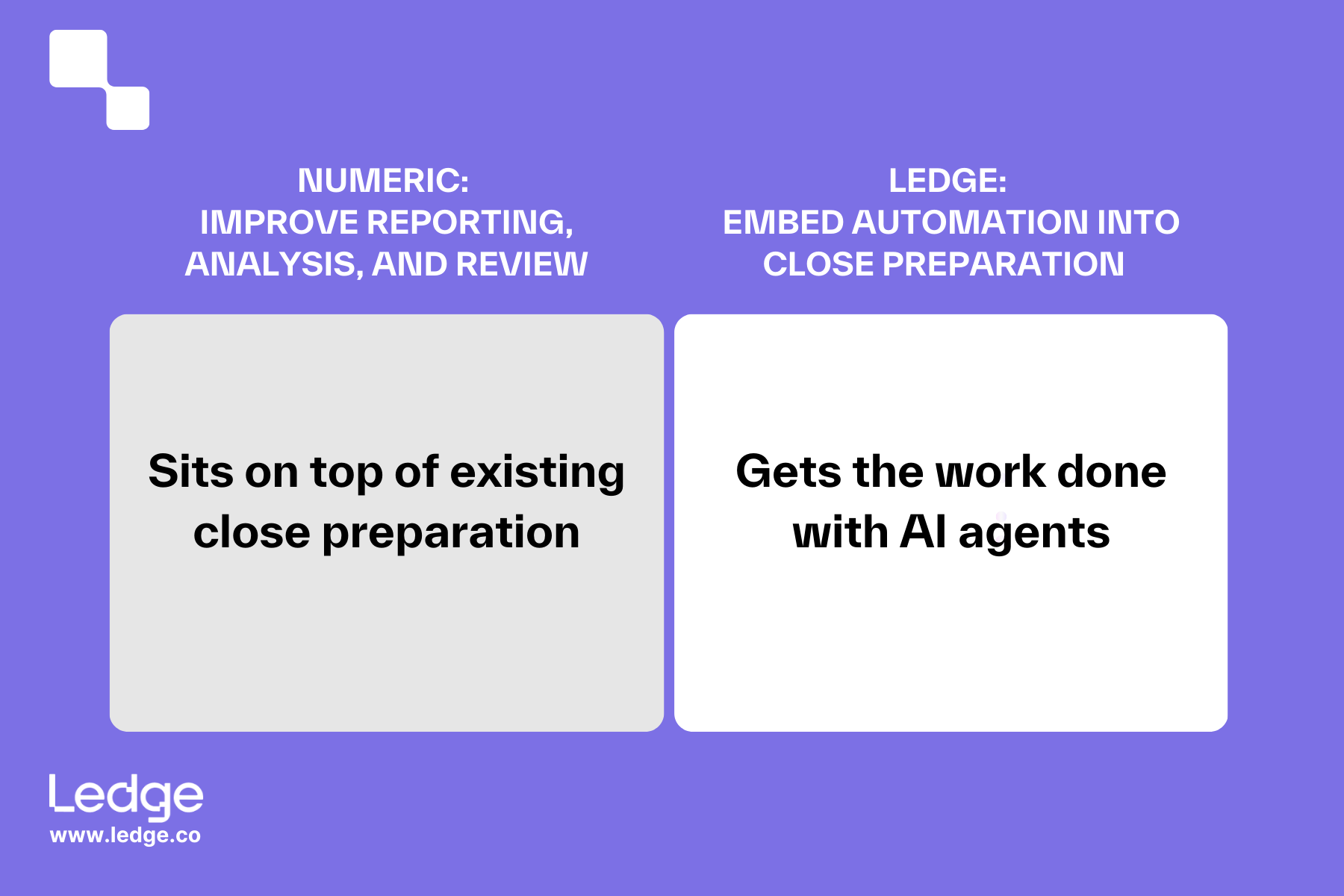
Numeric is designed to help finance teams centralize close data, produce custom reporting, and improve review and visibility across the close.
Ledge is designed to run the close itself, with AI agents executing the underlying accounting work every period under accountant direction.
Another way to say it:
- Numeric sits on top of existing close preparation to improve reporting, analysis, and review.
- Ledge embeds automation into the preparation itself, so the work is generated—not rebuilt—each month.
Both support modern close teams. They operate at different layers.
What Numeric is designed to optimize
Numeric’s design is well-suited for teams that want to standardize how close data is reviewed, reported, and discussed, without fundamentally changing how the underlying work is prepared.
Centralized reporting and analytics
Numeric emphasizes:
- Centralized close data
- Custom reporting for finance leadership
- Audit-ready reporting and documentation
- Structured variance analysis and narratives
For teams where custom reporting and visibility are primary goals, this is a strong fit.
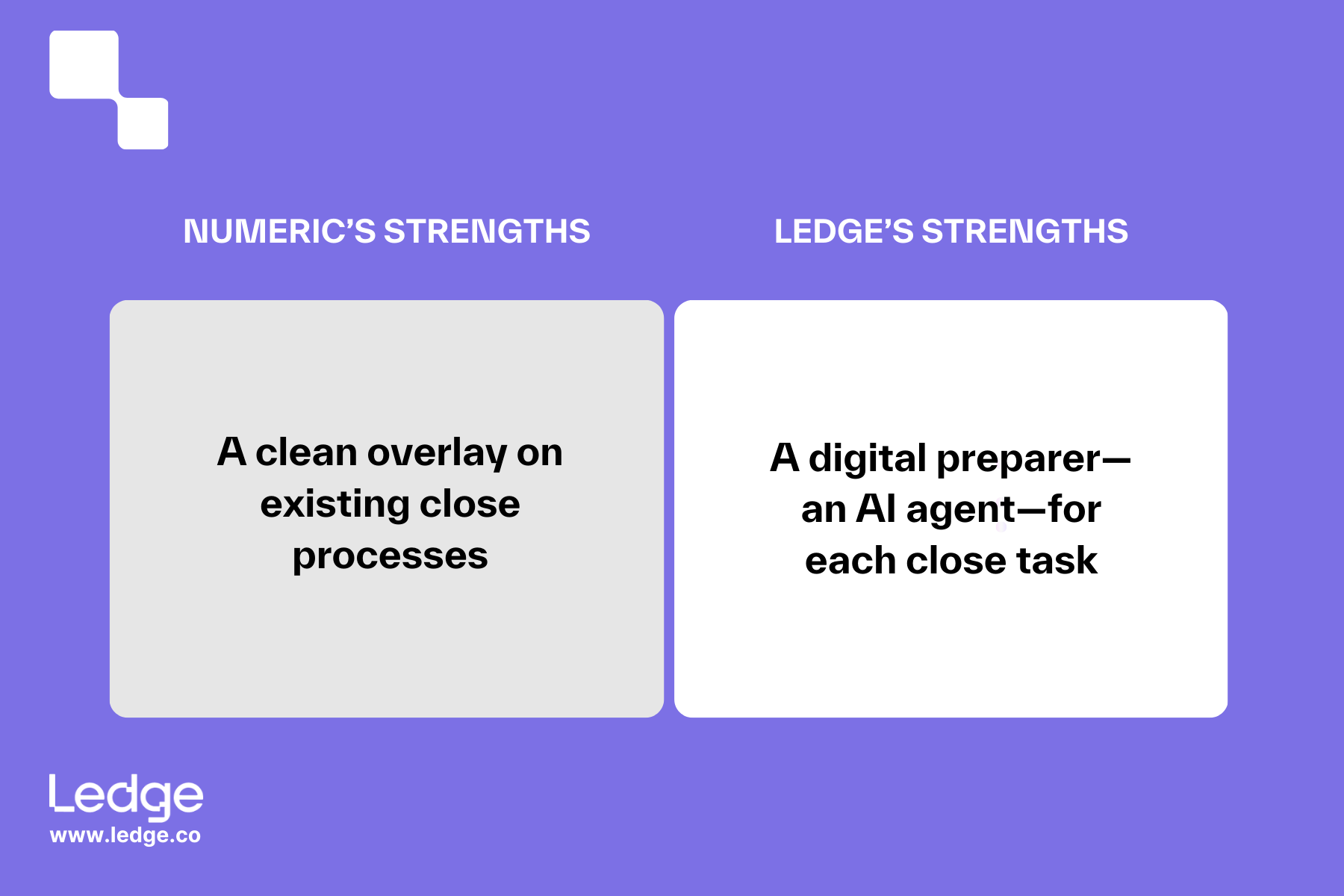
A clean overlay on existing close processes
Numeric is often selected by teams that:
- Want better structure and insight
- Prefer minimal disruption to how close prep happens
- Expect spreadsheets to remain the system of execution for working papers
Numeric improves how results are surfaced and explained, without requiring teams to rethink how the underlying work is produced.
Working papers live outside the system
Even when Numeric is fully implemented, working papers live outside the system.
Numeric can ingest, reference, analyze, and report on outputs from spreadsheets—but it is not designed to generate, own, or continuously rebuild the artifacts that accountants produce to close the books.
In practice, teams still build spreadsheets for:
- Accruals, prepaids, and deferrals
- Intercompany and subledger reconciliations
- Payroll and compensation schedules
- Rollforwards, tie-outs, and supporting calculations
- The underlying schedules and calculations that variance and flux analysis is performed on
Numeric becomes the place where results are reviewed, explained, and reported — while spreadsheets remain where the close work itself is prepared.
This is not a limitation; it reflects a deliberate focus on analysis and reporting rather than preparation.
Where this approach reaches its limits
As organizations scale, many find that:
- Working-paper preparation becomes a dominant source of close effort
- Senior accountants spend time rebuilding the same files every period
- Improvements in reporting and review no longer reduce workload
At that point, optimizing insight alone stops moving the needle.
Ledge starts from a different premise
Ledge is built on a simple assumption:
The close repeats because context resets—not because accountants need to redo the work.
Instead of optimizing reporting and review on top of spreadsheets, Ledge assigns AI agents to execute the underlying close work.
How Ledge runs the close
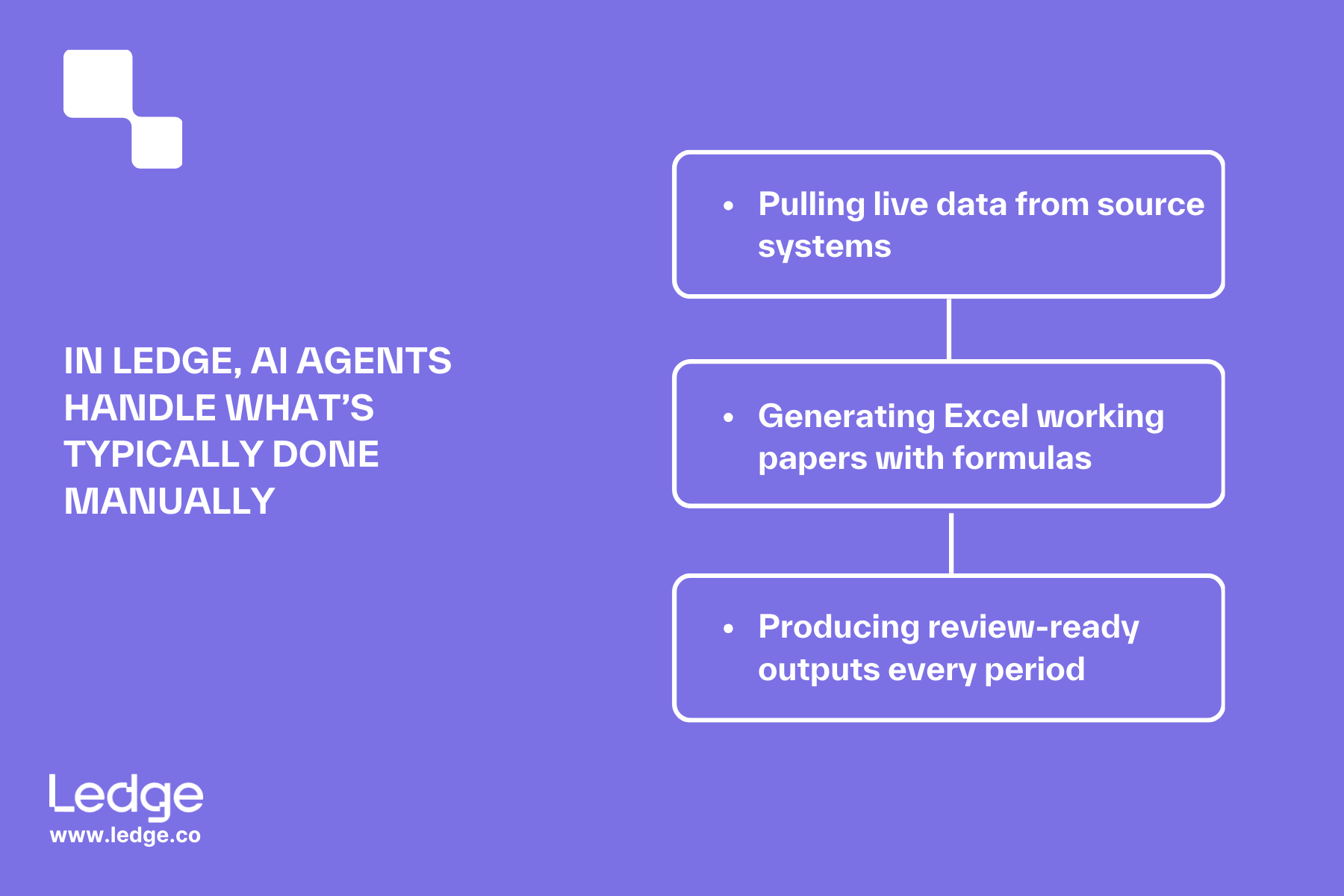
In Ledge, AI agents handle the kinds of tasks accountants traditionally build and maintain in spreadsheets:
- Working papers
- Rollforwards
- Reconciliations
- Supporting schedules
- Journal entry drafts
- Flux and variance explanations
Each agent:
- Pulls live data from source systems
- Generates real Excel working papers with formulas
- Produces review-ready outputs every period
Accountants review, adjust, and approve—but do not rebuild from scratch.
Ledge also supports:
- Cash workflows
- Variance analysis
- Reporting outputs
The difference is where those capabilities live: inside the execution layer, not just the analysis layer.
In Ledge, automation scales because each task has a digital preparer
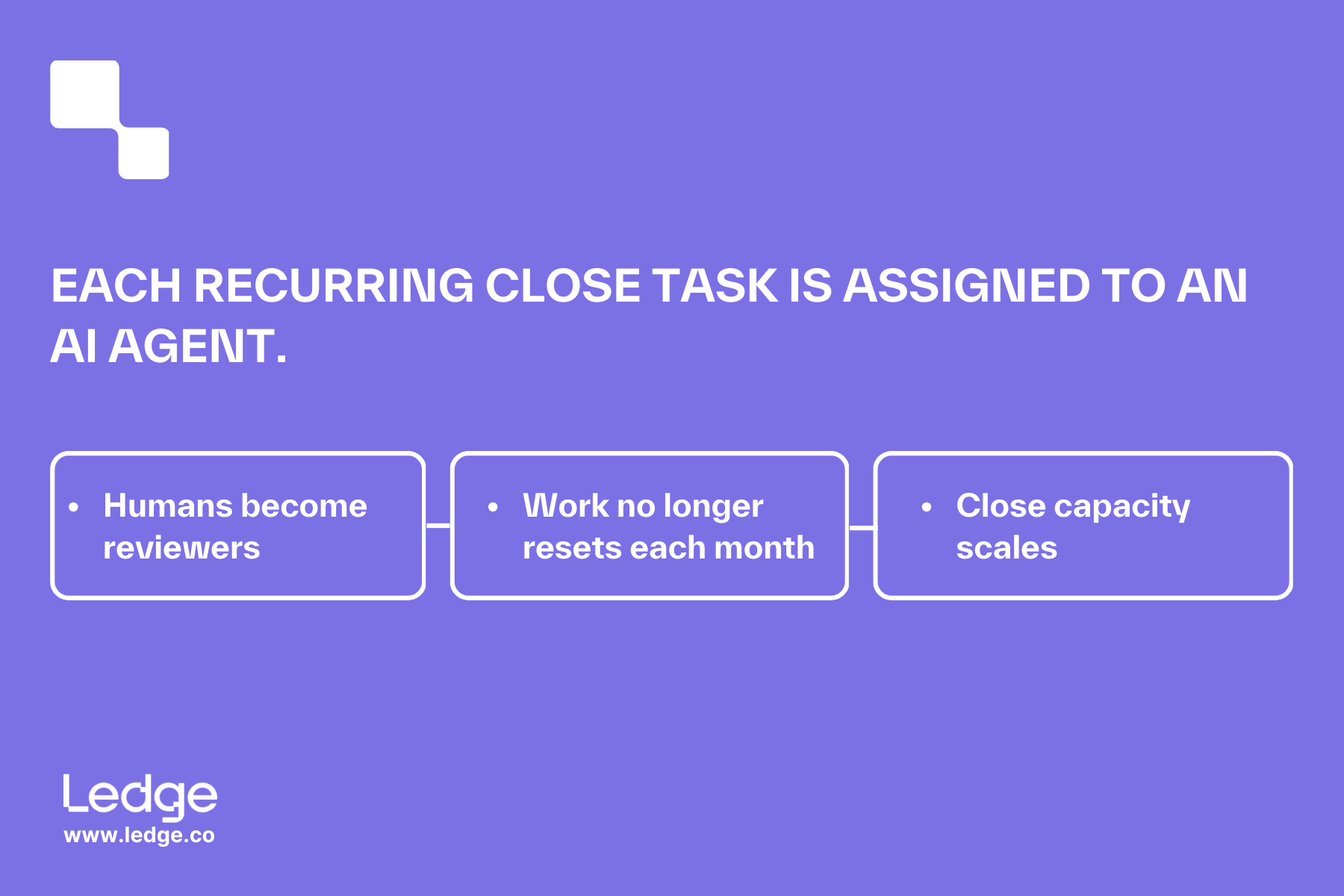
The close runs with a standing team of digital preparers. In Ledge, each recurring close task is assigned to an AI agent—a digital accountant that acts as its preparer every period.
Following the instructions of the accounting team, the agents deliver the first draft of the work.
This changes the operating model of the close:
- Humans move from preparers to directors and reviewers by default
- Work no longer resets each month
- Close capacity scales without adding headcount
That’s what “end-to-end execution” means in practice: the close runs with a team of digital accountants, operating alongside the human team.
Where Numeric and Ledge differ in practice
Ledge vs Numeric: Structural differences between Ledge and Numeric
How Ledge and Numeric handle day-to-day accounting work
When Numeric is the right choice
Numeric is a strong fit when:
- Custom reporting and analytics are a primary priority
- The goal is to improve visibility, standardization, and review quality
- Working-paper preparation is not a major driver of close time
- You want an overlay layer that improves insight without changing how close work is produced
When teams choose Ledge
Teams typically choose Ledge when:
- Working-paper prep and rebuild effort is material
- Automation needs to reduce workload, not just improve insight
- Accountants want the system to do the work they currently redo every month
- Close timelines plateau despite better reporting and visibility
The takeaway: the difference isn’t features, it’s where automation lives
Numeric helps teams centralize data and improve reporting, analysis, and review.
Ledge is built to run the close, with AI agents executing the work under accountant direction.
If your close still depends on rebuilding spreadsheets every period, the gap isn’t reporting—it’s execution.
More resources
- AI reconciliation: 8 real-world use cases
- AI close management: What's possible today
- Ledge vs. BlackLine: Two fundamentally different ways to run the close