BlackLine is one of the most established names in close management. It’s widely used by large accounting organizations that prioritize standardization, control, and audit readiness.
Ledge is an AI-native close automation platform built for teams that want the close to take materially less effort — not just be better tracked and governed.
At a high level, both platforms sit in the same category. In practice, they’re built on very different assumptions about how accounting work should happen — and that difference shows up quickly, even in a demo.
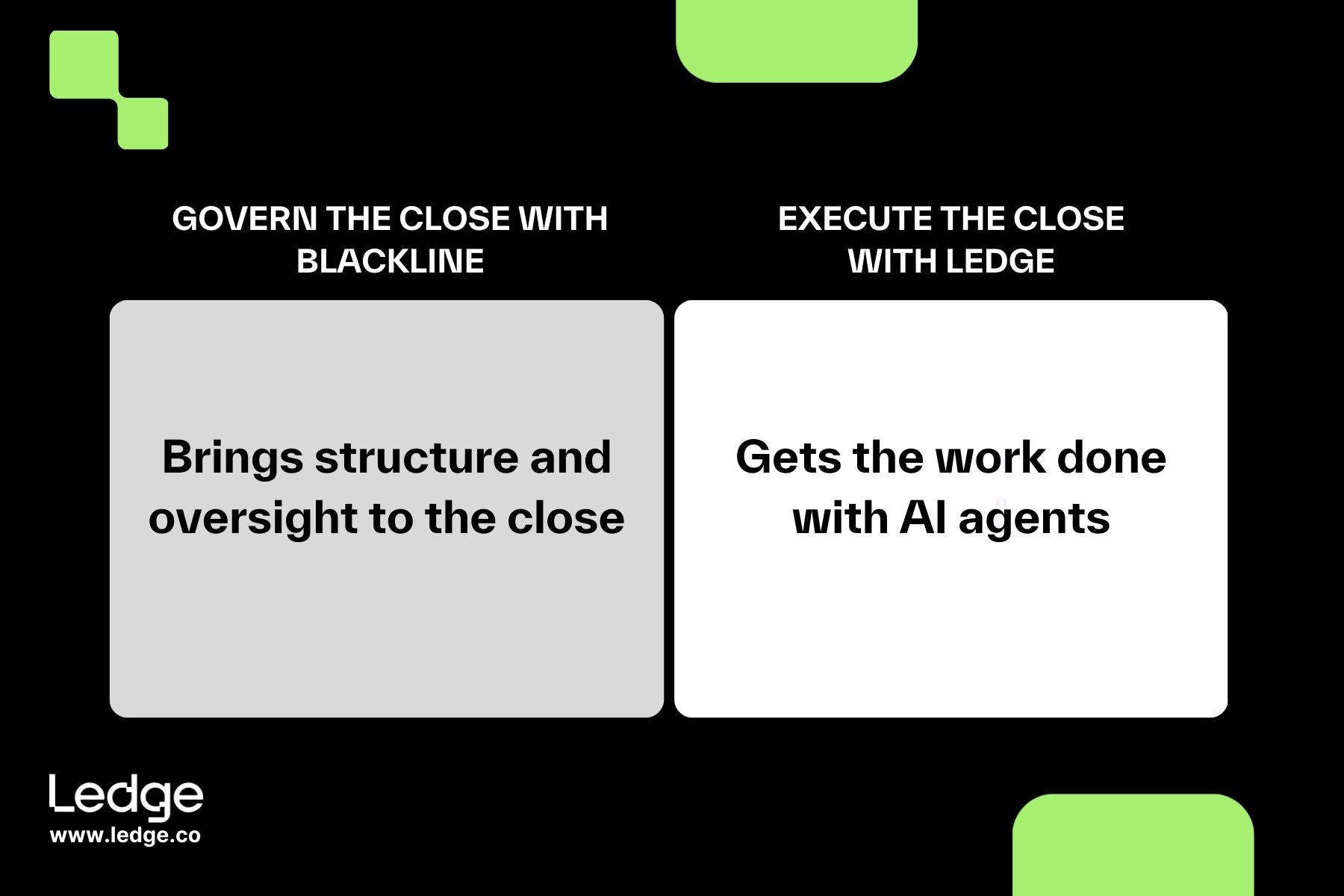
The core difference: BlackLine governs work; Ledge assigns AI agents to do it
BlackLine is designed to standardize and govern close processes.
Ledge is designed around a different operating model: AI agents run the close work every period, under accountant direction.
In Ledge, each close task — a reconciliation, a working paper, a rollforward, a journal entry, a flux explanation — can have its own AI agent responsible for executing it consistently month after month. Accountants direct, review, and approve the output.
That difference in starting point explains nearly everything that follows.
BlackLine excels at governance and control — which shapes how automation works
BlackLine was built to bring structure and oversight to the close.
Teams rely on it to:
- Standardize reconciliation processes
- Enforce approvals and sign-offs
- Maintain audit trails
- Manage close checklists across large teams
- Support compliance and certification
In large, centralized accounting organizations, this matters. BlackLine is especially strong when the primary objective is consistency and audit readiness at scale.
That design choice also shapes how automation works inside the platform.
BlackLine automates best when workflows are stable and well-defined
BlackLine does automate real accounting workflows. Many teams use it successfully for:
- Structured reconciliations
- High-volume matching
- Repeatable, predictable processes
Automation in BlackLine is typically built around rules and templates, configured upfront based on how a workflow is expected to behave. That approach works well when processes don’t change often.
The challenge is that most accounting environments aren’t static.
Spreadsheets persist because they are the most flexible way to handle change
In most finance teams we speak with, the bulk of the close effort lives in areas that don’t behave cleanly:
- Working papers
- Rollforwards
- Exception-heavy accounts
- Custom schedules
- Entity-specific logic
- One-off adjustments
What teams consistently describe is a familiar pattern:
- Data gets pulled from systems
- Shaped in Excel templates
- Reconciled and investigated manually
- Uploaded back into BlackLine for review and approval
BlackLine becomes the place where work is tracked and certified, while Excel remains the place where work is actually done.
This isn’t because BlackLine can’t support automation in these areas. It’s because standing up and maintaining automation for changing, exception-heavy workflows often requires effort that accounting teams can’t easily own on an ongoing basis.
Change becomes costly once automation is tightly configured
As the business evolves — new entities, new revenue streams, new payout logic — updating automation in BlackLine often means:
- Revisiting configuration decisions
- Coordinating across teams
- Involving system specialists or partners
- Testing carefully to avoid downstream impact
Over time, teams make pragmatic tradeoffs:
- Automate only the most stable workflows
- Leave edge cases manual
- Accept spreadsheets as the flexible layer
This is where BlackLine’s enterprise orientation becomes most visible. It’s optimized for controlled, infrequent change, not continuous iteration.
BlackLine’s ownership model assumes dedicated system stewardship
BlackLine works best when:
- There is dedicated ownership of the system
- Configuration is centrally managed
- Changes are planned and governed
That’s appropriate for large shared-services environments.
For leaner teams, it often results in slower automation velocity, limited coverage, and close effort that doesn’t materially decrease. This is also why many mid-market teams don’t seriously evaluate BlackLine — not because it’s weak software, but because the operating model doesn’t match how they want to work.
Ledge is built to run the close through AI agents
Ledge starts from a different premise:
The close repeats because context resets — not because accountants need to redo the work by hand.
Instead of managing work that humans prepare, Ledge assigns AI agents to prepare the work itself.
In practice, AI agents handle the kinds of tasks accountants normally build and maintain in spreadsheets:
- Working papers
- Rollforwards
- Reconciliations
- Supporting schedules
- Journal entry drafts
- Flux and variance explanations
Ledge generates real Excel working papers with live formulas. The spreadsheet isn’t something you upload at the end — it’s what the system produces for you.
Each agent runs its task every period, using the latest data, and produces review-ready output.
Automation scales when accountants can create and retrain agents themselves
The biggest difference isn’t AI — it’s who controls it.
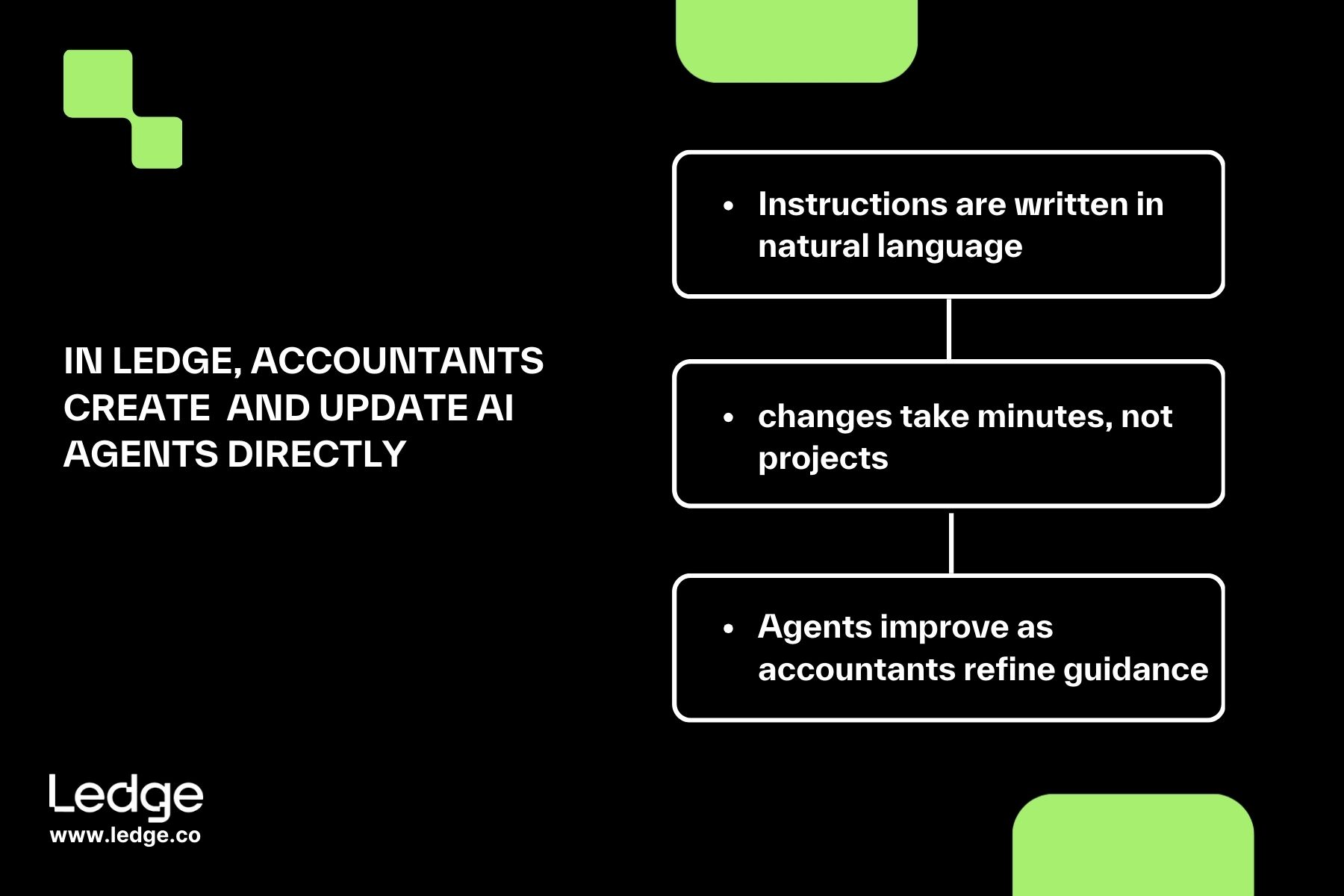
In Ledge:
- Accountants create and update AI agents directly
- Instructions are written in natural language
- Changes take minutes, not projects
- Agents improve as accountants refine guidance
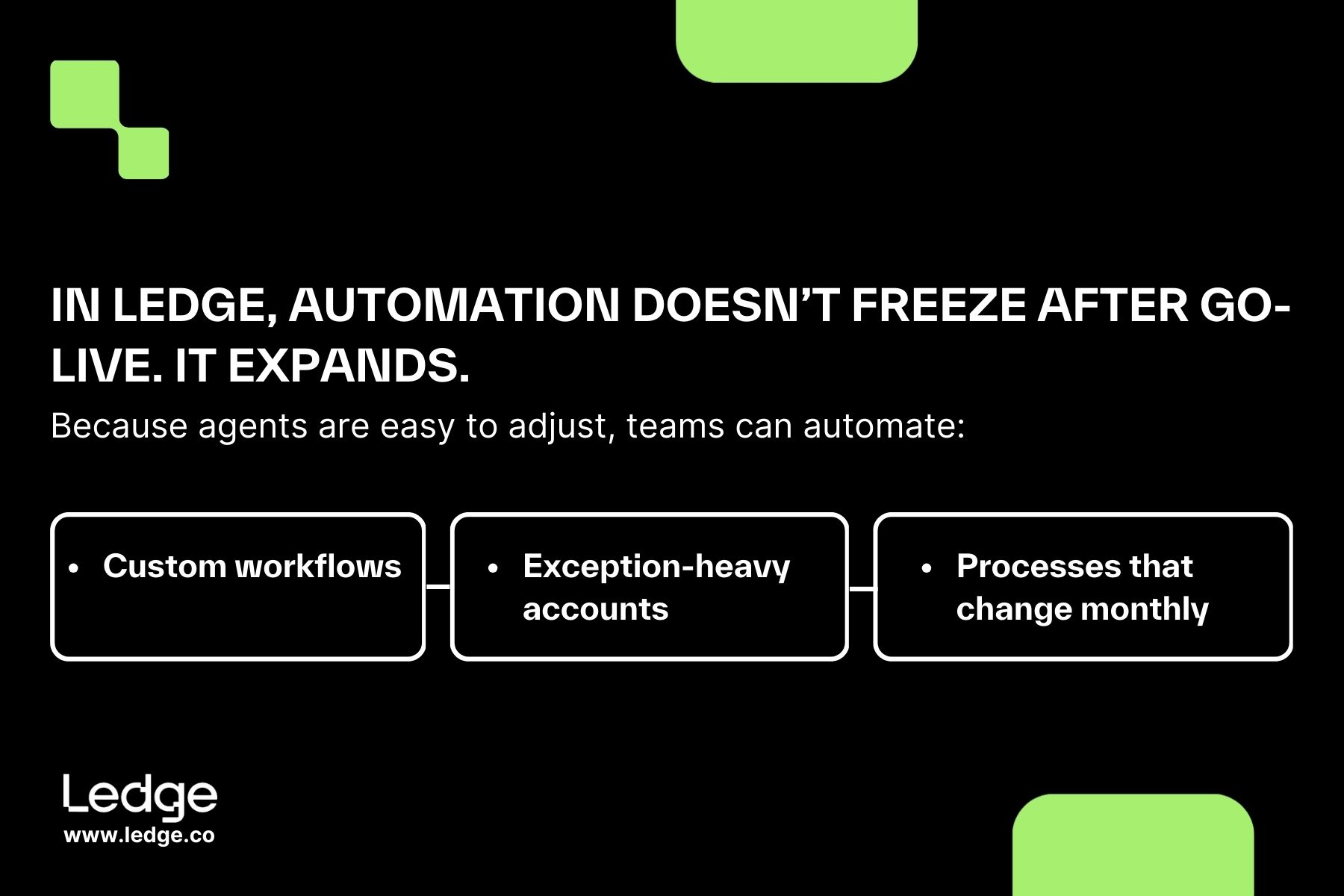
Because agents are easy to adjust, teams can automate:
- Custom workflows
- Exception-heavy accounts
- Processes that change month to month
Automation doesn’t freeze after go-live. It expands.
Ledge and BlackLine differ in where the work actually happens
The operating model shift is subtle — but decisive
BlackLine assumes:
humans prepare the work, systems govern it
Ledge assumes:
accountants direct the work, AI agents execute it
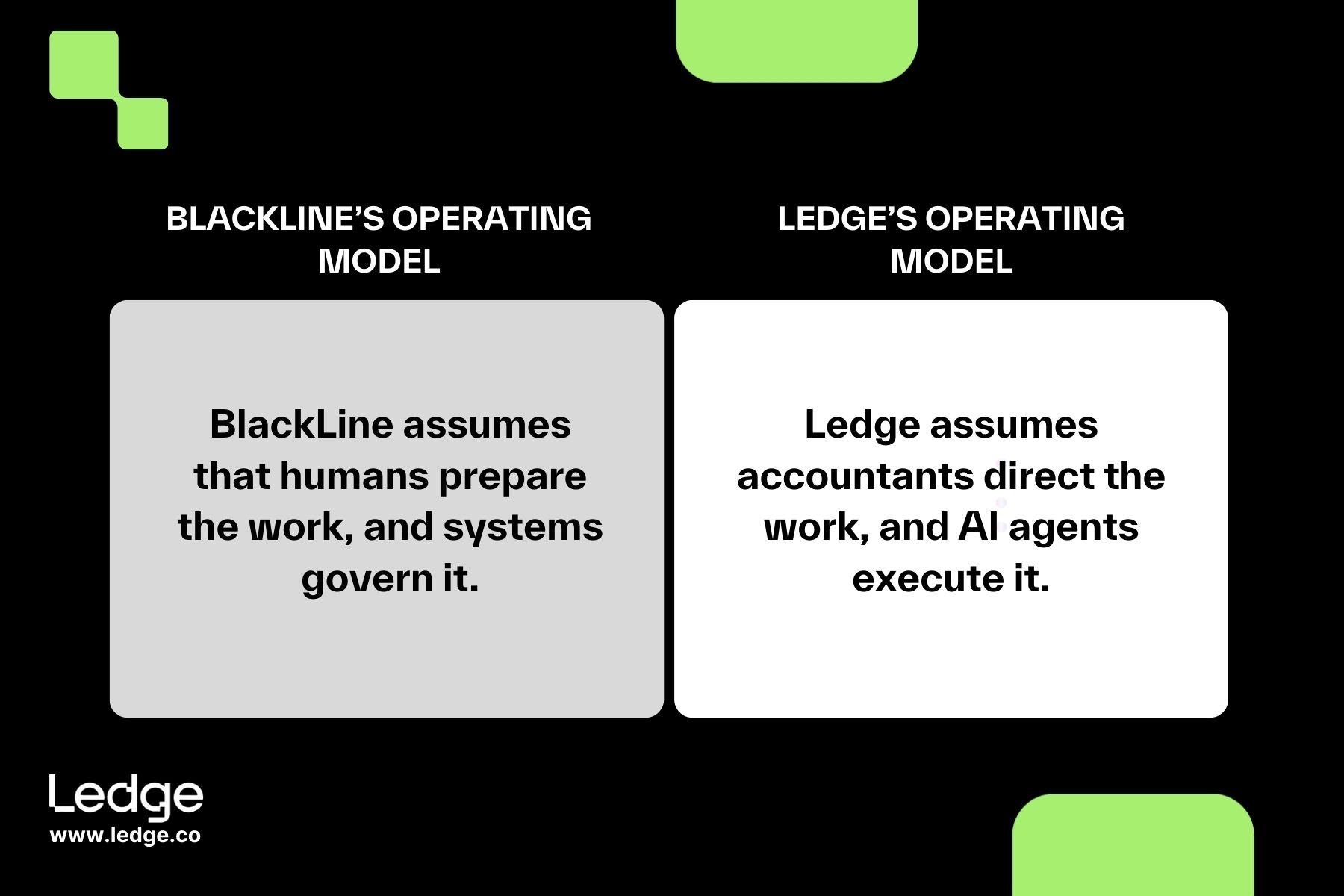
Accountants remain accountable. Judgment stays human. Execution scales without adding headcount.
When BlackLine is the right choice
BlackLine is a strong fit when:
- When governance and standardization are the top priorities
- Processes are stable
- Change is infrequent
- There’s capacity to support a dedicated close system
When teams look for a BlackLine alternative
Teams typically start looking for alternatives when:
- Spreadsheets still dominate close prep
- Automation is hard to change
- Cose effort hasn’t meaningfully decreased
That’s where Ledge fits.
The takeaway: the difference isn’t features, it’s the operating model
BlackLine is built to govern the close.
Ledge is built to run it—with AI agents executing the work under accountant direction.
If your close still depends on manual spreadsheets and automation that’s hard to adapt, the gap isn’t tooling. It’s how the work gets done.