Stripe Billing + Ledge Integration
By integrating Stripe Billing and Ledge, finance teams can automatically pull and prepare billing and revenue data into the close with agentic AI, so revenue reconciliations and deferred revenue schedules are ready for review instead of rebuilt manually.
Reconcile revenue and billing without rebuilding Stripe reports every month
But during the month-end close, finance teams must navigate the repetitive busywork of exporting billing data, rebuilding revenue schedules, and manually tracking deferred revenue and invoicing activity in spreadsheets.
This creates recurring friction that requires finance teams to reconstruct revenue and billing datasets manually every period before accounting work begins.
Ledge removes that rebuild. Workflow-specific AI agents, purpose-built and managed by finance, pull Stripe Billing data directly into the close and prepare revenue reconciliations, deferred revenue rollforwards, and supporting workpapers automatically.
What makes Stripe Billing + Ledge different

Stripe Billing tracks invoices, subscriptions, usage charges, and billing events that determine revenue recognition and deferred revenue.
Workflow-specific AI agents, purpose-built by finance in Ledge Agent Studio, pull this data and prepare schedules that reflect billed, earned, and deferred revenue without manual reconstruction.

Timing differences between invoicing, billing periods, and revenue recognition often create reconciling items.
Ledge generates workpapers that trace balances back to underlying Stripe Billing invoices, subscriptions, and billing events, making differences visible and auditable.
How the Stripe Billing + Ledge integration works
Securely connect Stripe Billing to Ledge in minutes using OAuth or API credentials.
Use Ledge’s Agent Studio to build workflow-specific AI agents, applying your revenue recognition and reconciliation logic in plain language.
AI agents automatically pull fresh Stripe Billing data, rebuild workpapers, and prepare reconciliations each period so your team starts the close in review.
Close faster with the work done-for-you
Work prepared by AI agents
Revenue reconciliations, deferred revenue rollforwards, invoice schedules, and flux support are prepared before review begins.
Excel-native outputs
AI agents generate fully editable Excel workpapers with live formulas and traceability to Stripe Billing invoice and subscription data.
Review instead of preparation
Accountants investigate revenue movements and approve results instead of rebuilding billing schedules.
Audit-ready by default
Billing data, calculations, assumptions, and approvals are captured automatically as part of the close.
Full close visibility
Stripe Billing-driven tasks are tracked alongside the rest of the close with clear ownership and status.
FAQ


Stripe Billing is treated as a billing data source that feeds close workflows, including invoices, subscriptions, and revenue activity.
No. Ledge prepares reconciliations and supporting work, while your ERP and revenue systems remain the systems of record.
Yes. Workpapers are generated as fully editable spreadsheets with formulas and traceability to Stripe Billing data.
No. All work is reviewed and approved by your team before posting.
Workflow-specific AI agents, built by finance within Ledge, pull billing and subscription data and prepare schedules that reflect timing differences between invoicing and revenue recognition.

What is Ledge?
Ledge is a close management platform that uses AI agents to execute the close work under your team’s direction.
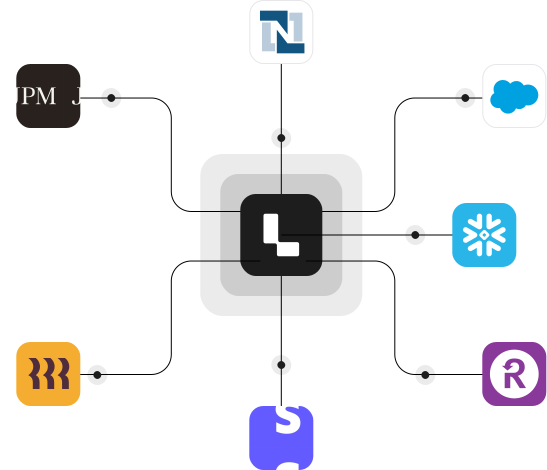
Workflow-specific AI agents, purpose-built by finance, pull data from systems like your ERP, banks, HRIS, AP platforms, CRM, billing systems like Stripe Billing, and more, then prepare reconciliations, schedules, and journal entries.
Ledge combines close orchestration, Excel-native workpapers, and human-in-the-loop approvals in a single platform.
Request a demo
See how Stripe Billing data flows into an agentic close with Ledge and how to eliminate manual rebuilds from your revenue workflows.