Conga CPQ + Ledge Integration
With the Conga CPQ integration for Ledge, sales contract and pricing data is automatically pulled and prepared for the month-end close—so revenue-related close work starts in review, not manual rebuild.
Eliminate manual contract and pricing rebuilds during close
For most accounting teams, Conga data is still handled manually. Contracts are exported, pricing details are copied into spreadsheets, and revenue-related schedules are rebuilt every period. The logic lives in Excel files and institutional knowledge, not in the close itself.
Ledge helps you get this work done with AI. Conga CPQ becomes a direct input to the close, and agents prepare the work consistently every month.
What makes Conga CPQ + Ledge different

Conga CPQ contains the source details that explain revenue behavior—contract terms, pricing structures, start and end dates, and amendments. With Conga connected to Ledge, AI agents pull the relevant CPQ data and prepare close-ready schedules and analysis automatically, instead of relying on one-off exports and manual interpretation.

CPQ data changes frequently. New deals, amendments, renewals, and pricing changes all create period-over-period movement that must be reconciled and explained at close. Ledge agents rebuild revenue support and related schedules each period using fresh Conga data, so close work reflects what actually changed, not what someone remembered to update in Excel.
How the Conga CPQ + Ledge integration works
Securely connect Conga CPQ to Ledge using a native, lightweight integration. Setup is fast and flexible enough to support multiple entities, orgs, or CRM environments.
Use Ledge’s Agent Studio to configure purpose-built AI agents for Conga CPQ specific tasks. Describe the workflow in plain language—such as how contract data feeds revenue review, deferred revenue schedules, or variance explanations—and create a custom agent in minutes.
Each period, agents automatically pull fresh Conga CPQ data, rebuild Excel workpapers with live formulas, and prepare revenue-related close work. Your team reviews and approves instead of rebuilding from scratch.
Revenue close work, prepared automatically
Prepared work instead of manual rebuild
Revenue support, contract summaries, and pricing-driven schedules are prepared before review begins.
Excel-native outputs
Agents generate fully editable Excel workpapers with live formulas and clear traceability back to Conga CPQ data.
Review instead of preparation
Accountants focus on judgment, exceptions, and approvals—not on exporting contracts and stitching spreadsheets together.
Visibility and control
Conga-related tasks are tracked alongside the rest of the close, with clear ownership, status, and dependencies.
Audit-ready by default
Source data, assumptions, calculations, and approvals are captured as part of the close, not recreated later.
FAQ


Conga CPQ is treated as an upstream contract and pricing data source that feeds agent-driven close workflows. It is not a standalone revenue system inside Ledge.
No. Ledge works alongside your ERP and CRM. Conga CPQ data is used to prepare close work, while posting and system-of-record processes remain unchanged.
Yes. Ledge is Excel-native. Agents generate Excel workpapers that your team can open, edit, and review.
No. Ledge is human-in-the-loop by default. Agents prepare the work; accountants review and approve before anything posts.

What is Ledge?
Ledge is an agent-driven close management platform where AI agents don’t just track progress—they execute close work under your team’s direction.
Each close task can have its own agent that pulls data from your ERP, banks, HRIS, AP platforms, CRMs, and billing systems like Conga CPQ, then prepares reconciliations, schedules, flux analysis, and draft journal entries before the task is even opened.
Ledge combines close orchestration, Excel-native workpapers, and human-in-the-loop approvals in a single platform—so the close runs on prepared work, not manual rebuilds.
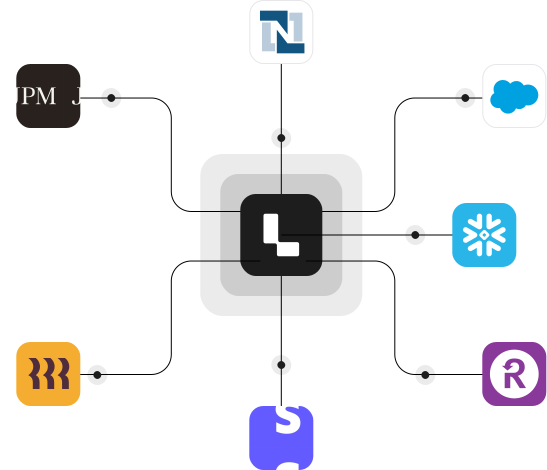
See the Conga CPQ + Ledge integration in action
Request a demo to see how Conga CPQ fits into an agent-driven close—and how contract data becomes close-ready without added manual work.