

Cash application should be as simple: match an invoice as soon as a payment comes in, so that the balance clears. In practice, it rarely works that way.
If you’re doing the work of matching invoices, you know that the process is messy:
- Memo lines say “inv 1234–8”
- Remittance details are buried in PDFs
- Payments cover multiple entities
- References are partial, vague, or missing
- Short pays and overpays pile up
- Clearing accounts grow
- AR aging drifts out of sync
Instead of focusing on collections or forecasting, finance spends time chasing attachments, formatting files, and cleaning up exceptions. Even when payments are applied, confidence is low:
- Was it matched correctly?
- Was the right entity cleared?
- Did anything get missed?
With 77% of finance leaders piloting, planning, or selectively adopting AI in their accounting practices according to a KPMG survey of CFOs and executives, cash application is a valuable place to start.
With Ledge’s close automation, for example, it’s possible to automate the cash application process using task-specific AI agents.
These AI agents remove the manual matching layer.
Instead of deciphering messy remittance data and re-keying information into the ERP, AI agents match payments in real time, post directly into the general ledger, and preserve full audit context. Finance reviews exceptions and teaches the system once. Cash stays accurate all day, every day.
Here's how this works in Ledge.
1. Let AI agents handle messy, real-world payment matching
(Instead of relying on clean references that rarely exist)
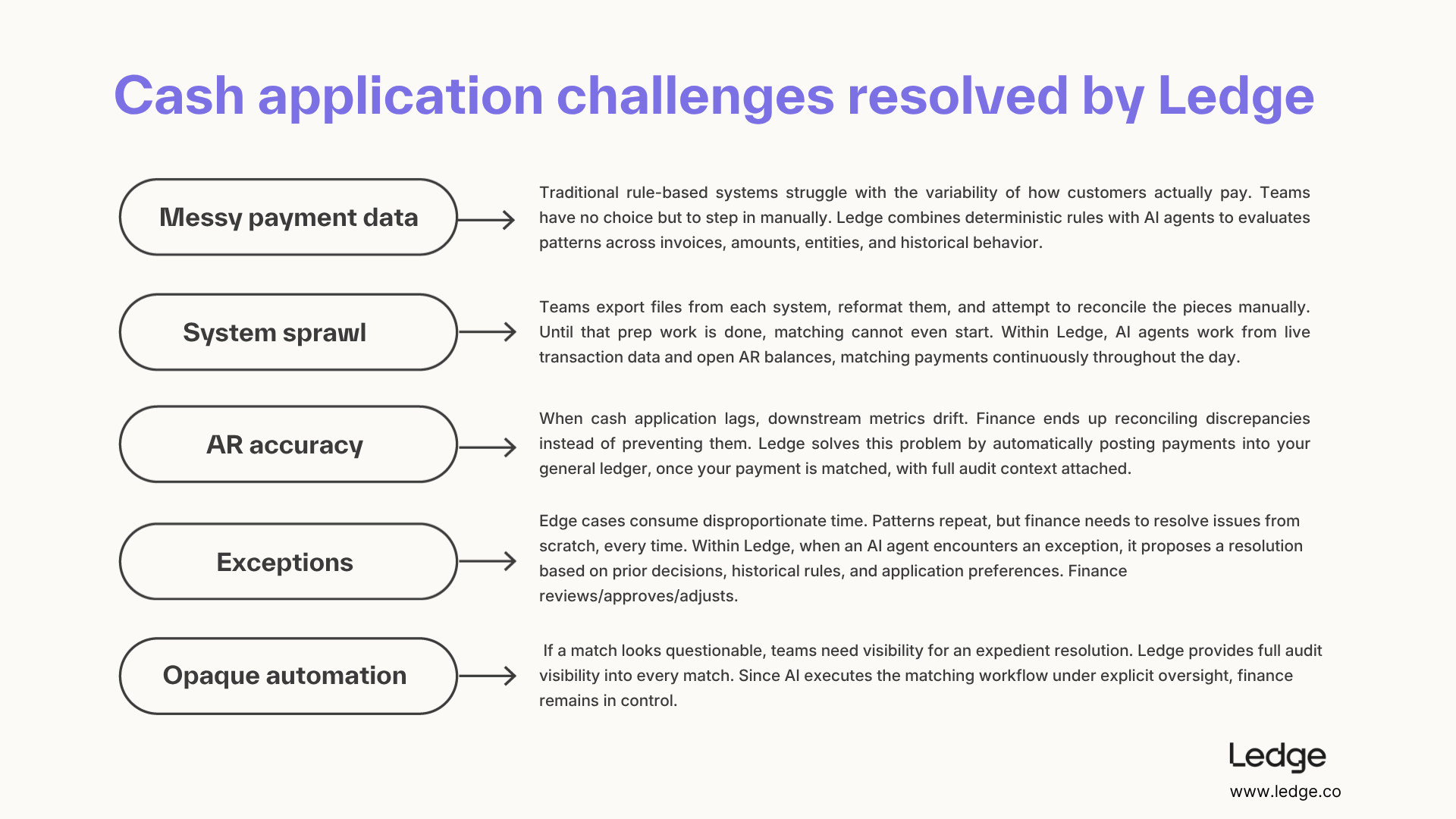
The challenge
Most automation assumes structured data such as:
- Exact invoice numbers
- Clean remittance files
- One payment per invoice
- Clear entity alignment
In practice; however, that is not how customers pay.
- Memo lines use shorthand
- Payments combine multiple invoices
- Remittance details live inside PDFs or email threads
- References are truncated or partially wrong
Without AI, these time consuming processes are tedious and extremely difficult. Traditional rule-based systems struggle with this variability. Match rates stall. Exceptions grow. Teams step in manually.
Cash application becomes a daily cleanup exercise.
How Ledge solves this
Ledge combines deterministic rules with AI agents to handle messy, real-world payments.
Finance can build agents that can:
- Interpret shorthand memo lines like “inv 1234–8”
- Extract remittance data from PDFs, emails, and shared inboxes
- Match one-to-many and many-to-one relationships
- Use full transaction and entity context when references are vague
Instead of depending on perfect data, the agent evaluates patterns across invoices, amounts, entities, and historical behavior.
As finance confirms matches and resolves edge cases, the system improves over time using your historical financial records as context.
The result: higher match rates without manual reconstruction.
2. Pull payment data directly from banks and processors
(Instead of assembling files before matching can begin)
The challenge
Cash data rarely lives in one place.
- Banks
- Payment processors
- Remittance inboxes
- ERP open AR reports
Teams export files from each system, reformat them, and attempt to reconcile the pieces manually.
Until that prep work is done, matching cannot even start. Meanwhile, Undeposited Funds grow, clearing accounts linger, and AR visibility falls behind the pace of reality.
How Ledge solves this
Ledge pulls payment data directly from your banks, payment processors, and ERP.
- No file formatting
- No manual uploads
- No stitching together spreadsheets
The AI agent works from live transaction data and open AR balances, matching payments continuously throughout the day.
Cash application stops being a batch process at month-end. It becomes real-time.
3. Keep AR, aging, and DSO accurate all day
(Instead of discovering mismatches after the fact)
The challenge
When cash application lags, downstream metrics drift.
- AR aging reflects invoices that are already paid
- Collections teams reach out to customers unnecessarily
- DSO calculations lose accuracy
- Revenue operations loses confidence in reporting
Finance ends up reconciling discrepancies instead of preventing them.
How Ledge solves this
Once a payment is matched, Ledge can automatically post it directly into your general ledger, such as NetSuite, with full audit context attached.
Every posting includes:
- The matched invoices
- The source payment record
- Supporting remittance details
- The logic used for matching
Undeposited Funds stays clean, AR aging reports reflect reality, and DSO remains accurate.
Cash and receivables stay aligned continuously, not just at close.
4. Handle exceptions once — and never touch them again
(Instead of re-solving the same short pays every month)
The challenge
Some payments will always require intelligent judgment.
- Short pays due to deductions
- Overpayments
- Partial applications
- Cross-entity payments
- Unapplied credits
These edge cases consume disproportionate time. And often, the patterns repeat.
- The same customer deduction pattern
- The same rounding difference
- The same allocation logic
But teams resolve them from scratch every time.
How Ledge solves this
When the agent encounters an exception, it proposes a resolution based on:
- Your prior decisions
- Historical patterns
- Entity rules
- Application preferences
Finance reviews and approves or adjusts.
Once confirmed, that logic is reused automatically the next time the same pattern appears. The agent learns from how your team resolves edge cases and applies that reasoning going forward.
Exceptions shrink over time instead of compounding.
5. See exactly how each payment was applied
(Instead of trusting a black box)
The challenge
Cash application affects customer balances, revenue reporting, and audit integrity. If a match looks questionable, teams need visibility for an expedient resolution:
- Why was this invoice cleared?
- What logic connected this payment to these balances?
- Who approved it?
Opaque automation creates risk.
How Ledge solves this
Ledge provides full audit visibility into every match.
You can see:
- The source payment
- The open invoices considered
- The matching logic applied
- Any AI reasoning behind ambiguous decisions
- The approval history
Finance remains in control.
AI executes the matching workflow under explicit oversight, and humans step in when judgment is required.
Nothing posts without visibility.
AI cash application reduces noise in the close
Many teams try to improve close speed by accelerating reconciliation during peak days.
AI cash application improves the foundation instead.
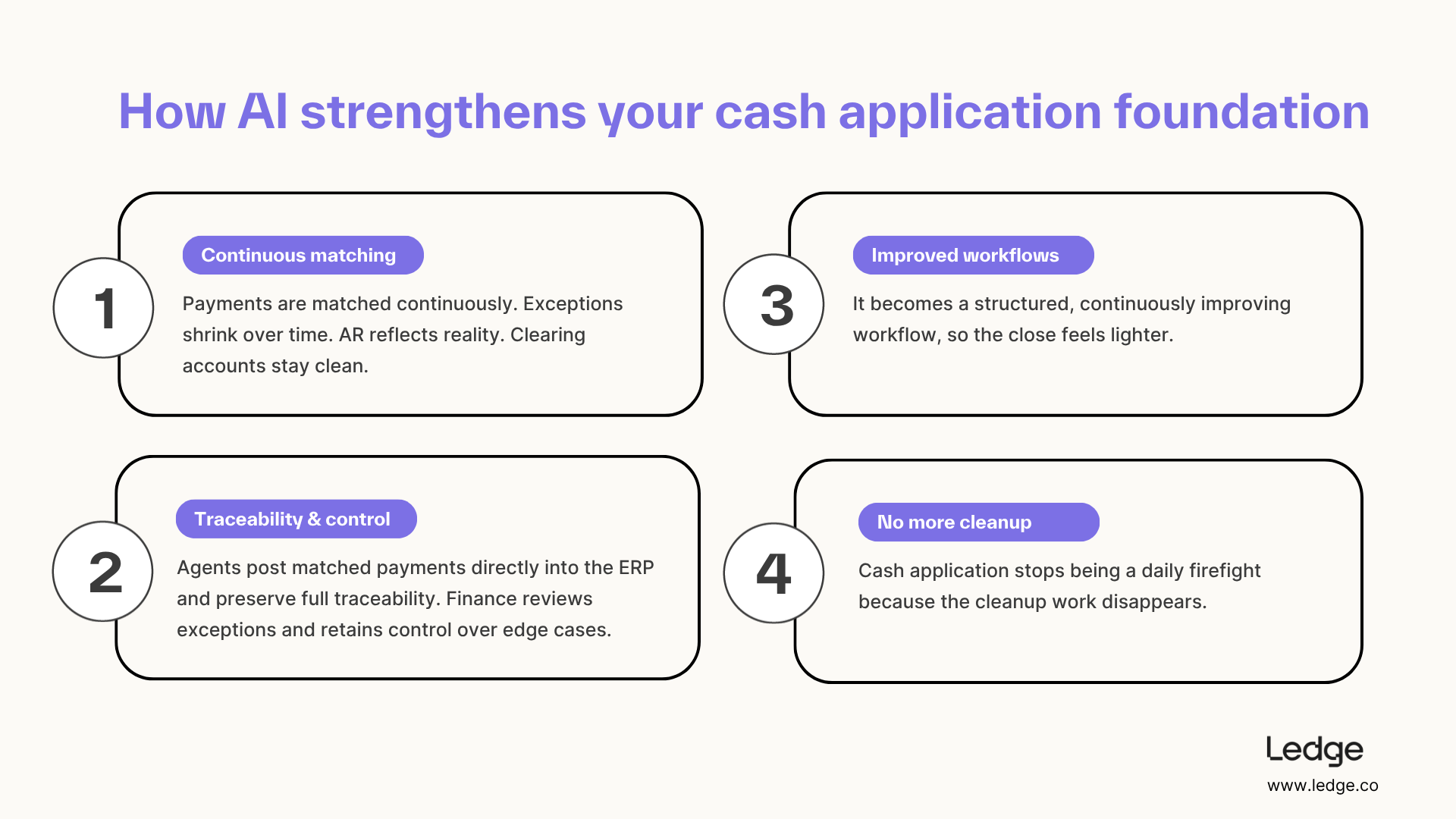
Payments are matched continuously. Exceptions shrink over time. AR reflects reality. Clearing accounts stay clean.
Agents handle messy data from banks and processors, post matched payments directly into the ERP, and preserve full traceability. Finance reviews exceptions and retains control over edge cases.
Cash application stops being a daily firefight.
It becomes a structured, continuously improving workflow, so the close feels lighter not because the team moves faster, but because the cleanup work disappears.